Grade 8 · Social StudiesHIS.8.5Premium
Fault Lines: Six Objects on the Road to War, 1820–1861
Grade 8 causes of the Civil War: six exhibit objects, from a cotton hook to a secession broadside, plus census data on states and slavery.
Preview
OwlSheets.com
Name Date
Fault Lines: Six Objects on the Road to War, 1820–1861
Study six labeled objects from a Springfield, Illinois, exhibit to explain why the Union broke apart.
Two sections, one Union
The exhibit is in a history museum in Springfield, Illinois, Abraham Lincoln's hometown. Read Labels 1 and 2 and the table. Then answer the questions.
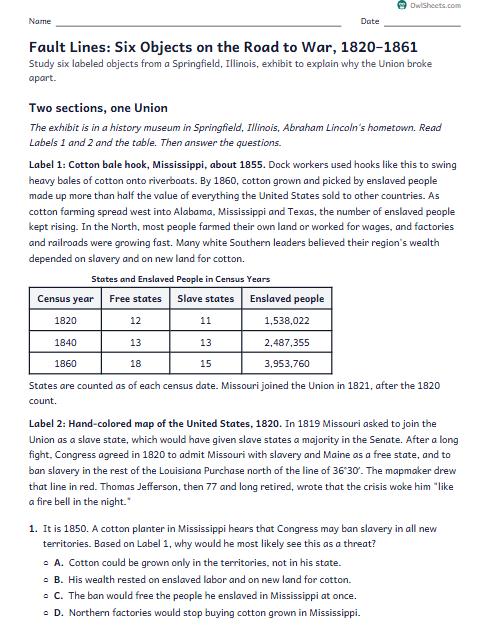
Label 1: Cotton bale hook, Mississippi, about 1855. Dock workers used hooks like this to swing heavy bales of cotton onto riverboats. By 1860, cotton grown and picked by enslaved people made up more than half the value of everything the United States sold to other countries. As cotton farming spread west into Alabama, Mississippi and Texas, the number of enslaved people kept rising. In the North, most people farmed their own land or worked for wages, and factories and railroads were growing fast. Many white Southern leaders believed their region's wealth depended on slavery and on new land for cotton.
| Census year | Free states | Slave states | Enslaved people |
|---|---|---|---|
| 1820 | 12 | 11 | 1,538,022 |
| 1840 | 13 | 13 | 2,487,355 |
| 1860 | 18 | 15 | 3,953,760 |
Label 2: Hand-colored map of the United States, 1820. In 1819 Missouri asked to join the Union as a slave state, which would have given slave states a majority in the Senate. After a long fight, Congress agreed in 1820 to admit Missouri with slavery and Maine as a free state, and to ban slavery in the rest of the Louisiana Purchase north of the line of 36°30′. The mapmaker drew that line in red. Thomas Jefferson, then 77 and long retired, wrote that the crisis woke him "like a fire bell in the night."
The preview shows the first questions. Unlock the worksheet to see all of it.
Related worksheets
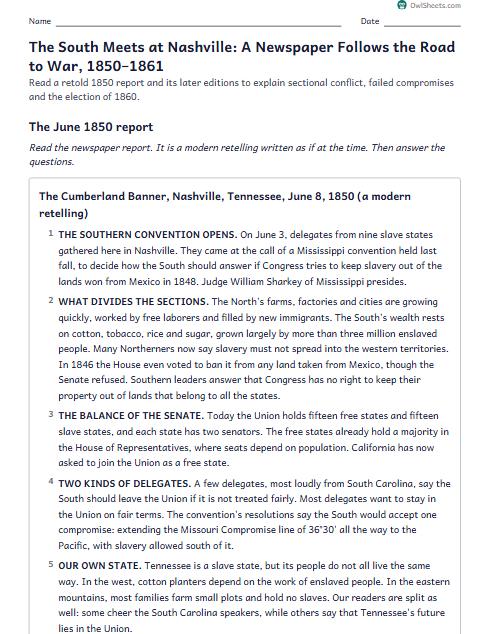
The South Meets at Nashville: A Newspaper Follows the Road to War, 1850–1861
Grade 8 · HIS.8.5
14 questionsPremium
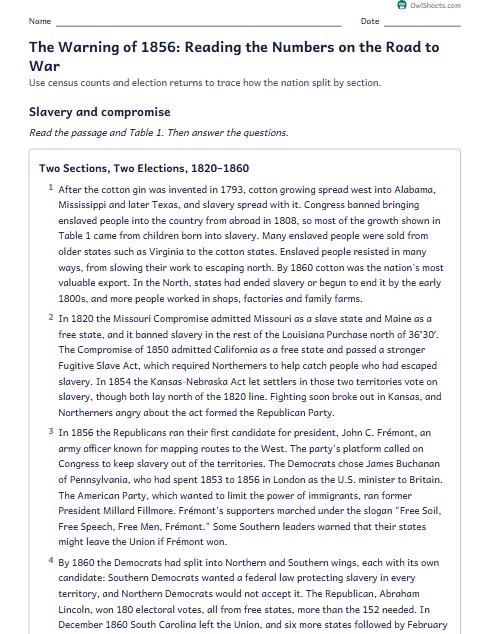
The Warning of 1856: Reading the Numbers on the Road to War
Grade 8 · HIS.8.5
14 questionsPremium
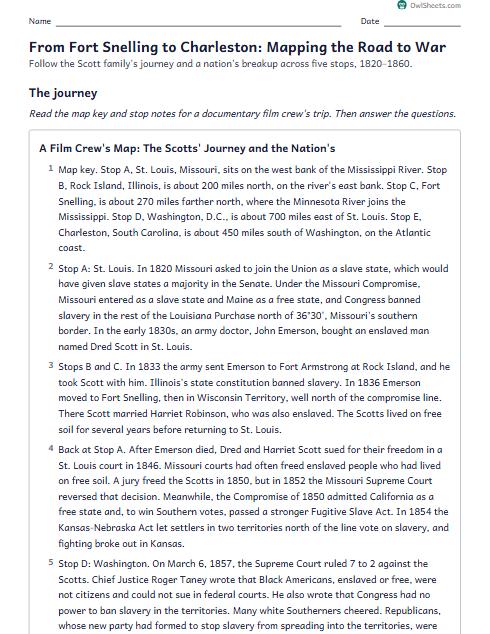
From Fort Snelling to Charleston: Mapping the Road to War
Grade 8 · HIS.8.5
14 questionsPremium
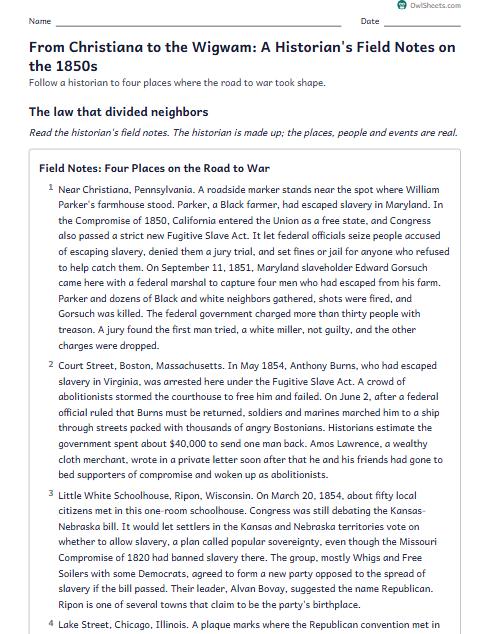
From Christiana to the Wigwam: A Historian's Field Notes on the 1850s
Grade 8 · HIS.8.5
13 questionsPremium
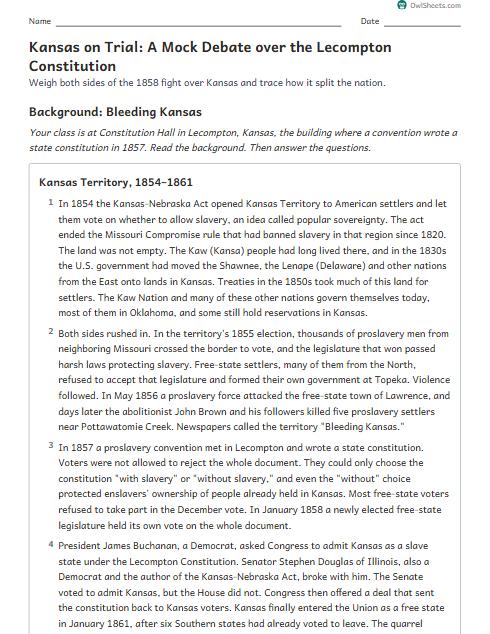
Kansas on Trial: A Mock Debate over the Lecompton Constitution
Grade 8 · HIS.8.5
12 questionsPremium
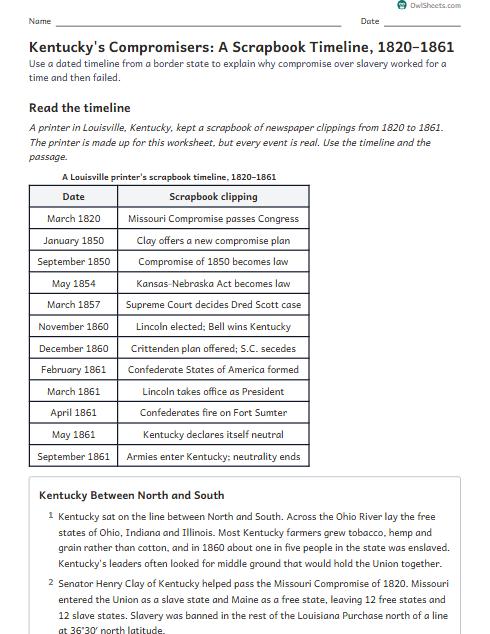
Kentucky's Compromisers: A Scrapbook Timeline, 1820–1861
Grade 8 · HIS.8.5
11 questionsPremium