Grade 8 · Social StudiesHIS.8.5Premium
From Christiana to the Wigwam: A Historian's Field Notes on the 1850s
Grade 8 causes of the Civil War: field notes on the Fugitive Slave Act at Christiana and Boston, the Republican Party's birth and the election of 1860.
Preview
OwlSheets.com
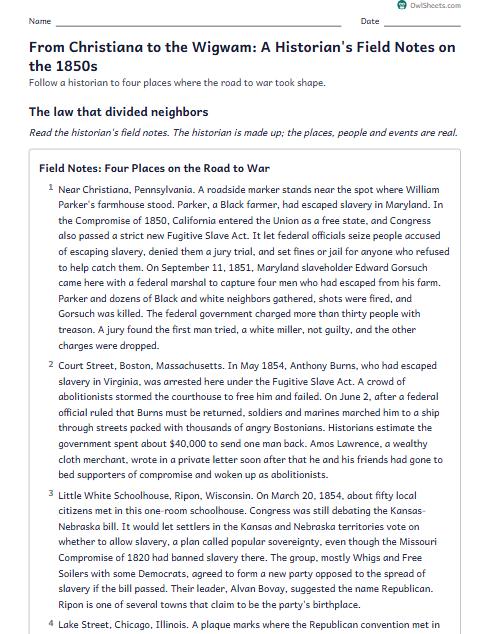
From Christiana to the Wigwam: A Historian's Field Notes on the 1850s
Follow a historian to four places where the road to war took shape.
The law that divided neighbors
Read the historian's field notes. The historian is made up; the places, people and events are real.
Field Notes: Four Places on the Road to War
1Near Christiana, Pennsylvania. A roadside marker stands near the spot where William Parker's farmhouse stood. Parker, a Black farmer, had escaped slavery in Maryland. In the Compromise of 1850, California entered the Union as a free state, and Congress also passed a strict new Fugitive Slave Act. It let federal officials seize people accused of escaping slavery, denied them a jury trial, and set fines or jail for anyone who refused to help catch them. On September 11, 1851, Maryland slaveholder Edward Gorsuch came here with a federal marshal to capture four men who had escaped from his farm. Parker and dozens of Black and white neighbors gathered, shots were fired, and Gorsuch was killed. The federal government charged more than thirty people with treason. A jury found the first man tried, a white miller, not guilty, and the other charges were dropped.
2Court Street, Boston, Massachusetts. In May 1854, Anthony Burns, who had escaped slavery in Virginia, was arrested here under the Fugitive Slave Act. A crowd of abolitionists stormed the courthouse to free him and failed. On June 2, after a federal official ruled that Burns must be returned, soldiers and marines marched him to a ship through streets packed with thousands of angry Bostonians. Historians estimate the government spent about $40,000 to send one man back. Amos Lawrence, a wealthy cloth merchant, wrote in a private letter soon after that he and his friends had gone to bed supporters of compromise and woken up as abolitionists.
3Little White Schoolhouse, Ripon, Wisconsin. On March 20, 1854, about fifty local citizens met in this one-room schoolhouse. Congress was still debating the Kansas-Nebraska bill. It would let settlers in the Kansas and Nebraska territories vote on whether to allow slavery, a plan called popular sovereignty, even though the Missouri Compromise of 1820 had banned slavery there. The group, mostly Whigs and Free Soilers with some Democrats, agreed to form a new party opposed to the spread of slavery if the bill passed. Their leader, Alvan Bovay, suggested the name Republican. Ripon is one of several towns that claim to be the party's birthplace.
4Lake Street, Chicago, Illinois. A plaque marks where the Republican convention met in May 1860 in a huge wooden hall called the Wigwam. In 1856 the party's first candidate for president had lost after failing to carry several Northern states, including Pennsylvania, Indiana and Illinois. The early favorite in 1860, Senator William Seward of New York, was famous for strong antislavery speeches. On the third ballot, delegates chose Abraham Lincoln of Illinois. The party's platform opposed slavery in the territories but promised not to interfere with slavery in the states where it already existed.
5Last page, written at home. Lincoln won the election of November 1860 with about 40 percent of the popular vote. His name was not even printed on the ballot in most Southern states. Southern leaders argued that if no new slave states could join the Union, the free states would soon outvote them in Congress, and that a Republican president could not be trusted to protect slavery. On December 20, 1860, South Carolina voted to secede, or leave the Union.
- A. He could ask Ohio's governor to cancel the order.
- B. He could be fined or jailed if he refused to help.
- C. He could refuse to help, because Ohio was a free state.
- D. He had to wait until a jury decided the man's case.
- A. It meant federal marshals could no longer enter Pennsylvania to make arrests.
- B. It showed that most white Northerners had joined the abolitionist movement.
- C. It showed that Congress had repealed the Fugitive Slave Act after the shooting.
- D. It suggested Northern juries would not punish people who resisted the law.
The preview shows the first questions. Unlock the worksheet to see all of it.
Related worksheets
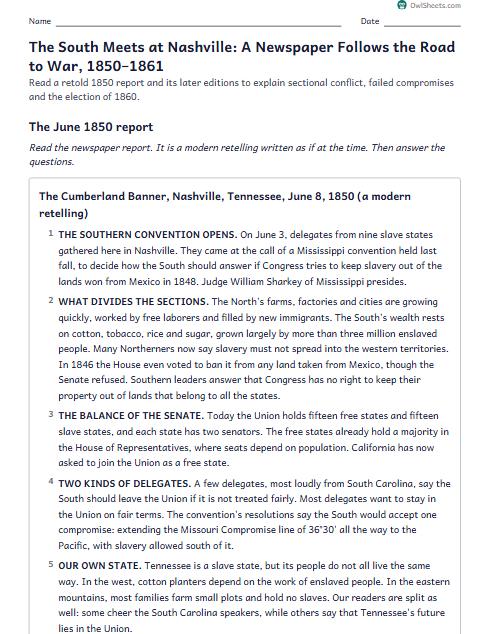
The South Meets at Nashville: A Newspaper Follows the Road to War, 1850–1861
Grade 8 · HIS.8.5
14 questionsPremium
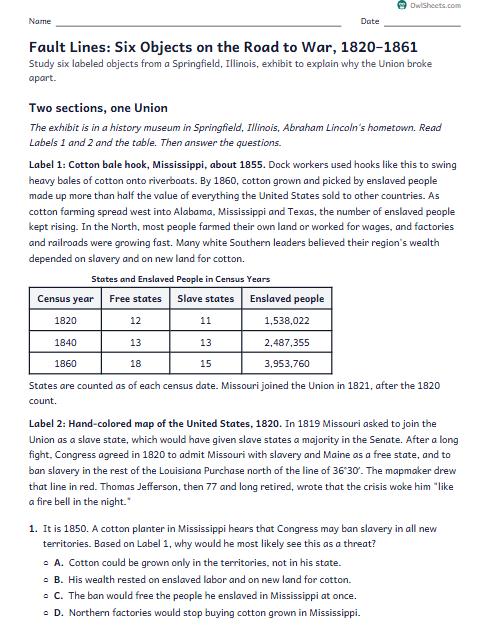
Fault Lines: Six Objects on the Road to War, 1820–1861
Grade 8 · HIS.8.5
14 questionsPremium
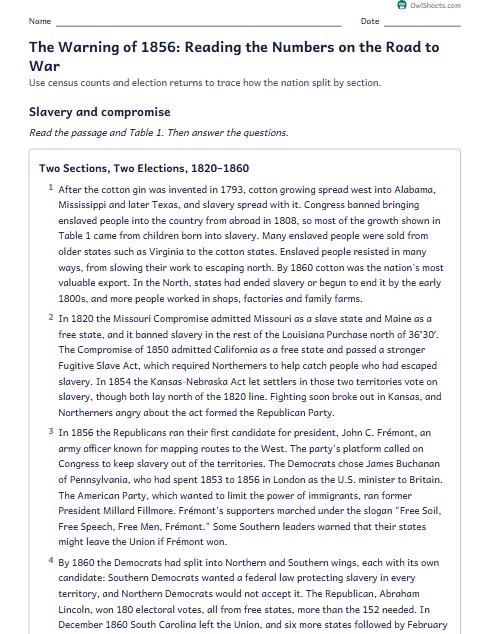
The Warning of 1856: Reading the Numbers on the Road to War
Grade 8 · HIS.8.5
14 questionsPremium
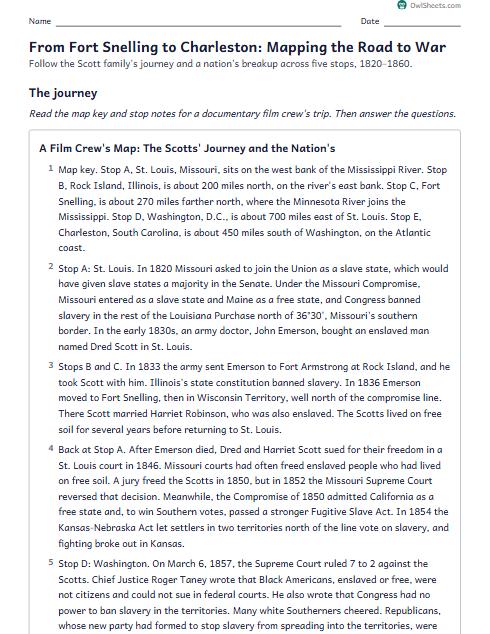
From Fort Snelling to Charleston: Mapping the Road to War
Grade 8 · HIS.8.5
14 questionsPremium
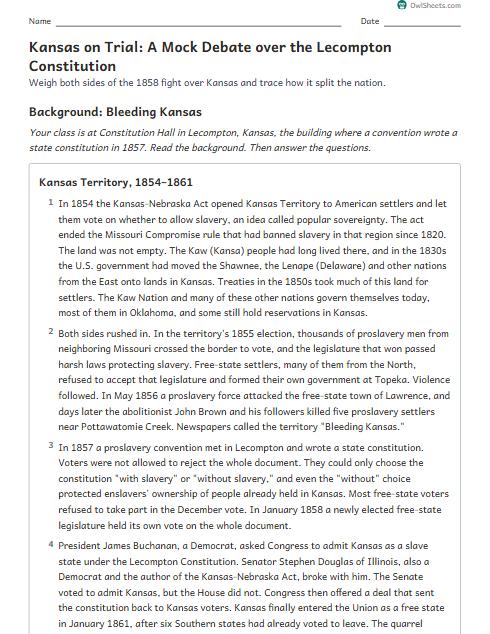
Kansas on Trial: A Mock Debate over the Lecompton Constitution
Grade 8 · HIS.8.5
12 questionsPremium
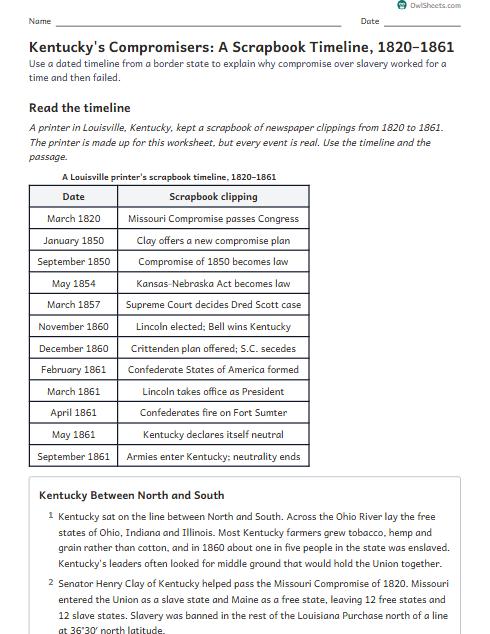
Kentucky's Compromisers: A Scrapbook Timeline, 1820–1861
Grade 8 · HIS.8.5
11 questionsPremium