Grade 8 · Social StudiesGEO.8.3Premium
Counting Newcomers: A Historian's Notes on Milwaukee
Grade 8 census practice: a historian's Milwaukee field notes, Wisconsin census counts and an 1880-style census page show growth, city growth and immigration.
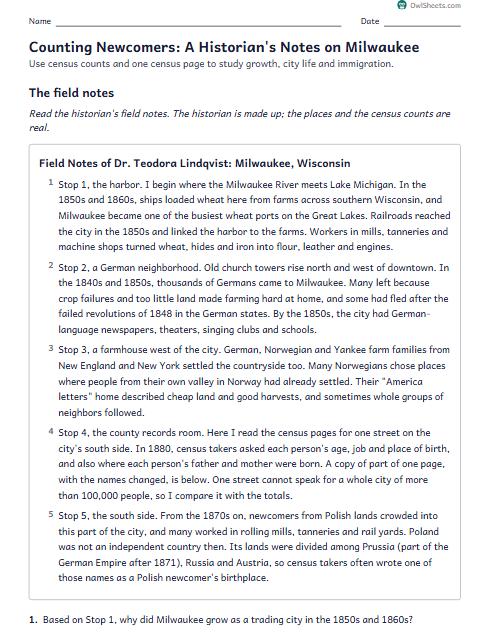
Preview
OwlSheets.com
Counting Newcomers: A Historian's Notes on Milwaukee
Use census counts and one census page to study growth, city life and immigration.
The field notes
Read the historian's field notes. The historian is made up; the places and the census counts are real.
Field Notes of Dr. Teodora Lindqvist: Milwaukee, Wisconsin
1Stop 1, the harbor. I begin where the Milwaukee River meets Lake Michigan. In the 1850s and 1860s, ships loaded wheat here from farms across southern Wisconsin, and Milwaukee became one of the busiest wheat ports on the Great Lakes. Railroads reached the city in the 1850s and linked the harbor to the farms. Workers in mills, tanneries and machine shops turned wheat, hides and iron into flour, leather and engines.
2Stop 2, a German neighborhood. Old church towers rise north and west of downtown. In the 1840s and 1850s, thousands of Germans came to Milwaukee. Many left because crop failures and too little land made farming hard at home, and some had fled after the failed revolutions of 1848 in the German states. By the 1850s, the city had German-language newspapers, theaters, singing clubs and schools.
3Stop 3, a farmhouse west of the city. German, Norwegian and Yankee farm families from New England and New York settled the countryside too. Many Norwegians chose places where people from their own valley in Norway had already settled. Their "America letters" home described cheap land and good harvests, and sometimes whole groups of neighbors followed.
4Stop 4, the county records room. Here I read the census pages for one street on the city's south side. In 1880, census takers asked each person's age, job and place of birth, and also where each person's father and mother were born. A copy of part of one page, with the names changed, is below. One street cannot speak for a whole city of more than 100,000 people, so I compare it with the totals.
5Stop 5, the south side. From the 1870s on, newcomers from Polish lands crowded into this part of the city, and many worked in rolling mills, tanneries and rail yards. Poland was not an independent country then. Its lands were divided among Prussia (part of the German Empire after 1871), Russia and Austria, so census takers often wrote one of those names as a Polish newcomer's birthplace.
- A. Its harbor and railroads linked wheat farms to ships on the lake.
- B. Its gold and silver mines drew miners from across the country.
- C. It was the state capital, so most of Wisconsin's people lived there.
- D. Its own farms grew more wheat than the countryside around it.
Old church towers rise north and west of downtown.In the 1840s and 1850s, thousands of Germans came to Milwaukee.Many left because crop failures and too little land made farming hard at home, and some had fled after the failed revolutions of 1848 in the German states.By the 1850s, the city had German-language newspapers, theaters, singing clubs and schools.
The preview shows the first questions. Unlock the worksheet to see all of it.
Related worksheets
Counted in the North End: Boston Reads the 1890 Census
Grade 8 · GEO.8.3
14 questionsPremium
Whose City? Two Bostonians Read the Census, 1855
Grade 8 · GEO.8.3
13 questionsPremium
Flour, Falls and Newcomers: Minnesota in the Census, 1870–1890
Grade 8 · GEO.8.3
14 questionsPremium
Upriver with the Census: The River Cities, 1840–1860
Grade 8 · GEO.8.3
14 questionsPremium
The Nation's Center Moves West: A Census Exhibit
Grade 8 · GEO.8.3
11 questionsPremium
Where Should the New School Go? A Council Reads the 1890 Census
Grade 8 · GEO.8.3
10 questionsPremium