Grade 8 · Social StudiesGEO.8.3Premium
Counted in the North End: Boston Reads the 1890 Census
Grade 8 census practice: a newspaper-style Boston report from 1891 and census tables show city growth, annexation, urbanization and immigration.
Preview
OwlSheets.com
Counted in the North End: Boston Reads the 1890 Census
Read a newspaper-style report on Boston's census results, then use three census tables to analyze growth, city life and immigration.
A city that grew
Read the note, the report and the tables. Then answer the questions.
What the Count Found: Boston in the Census of 1890 (a modern retelling)
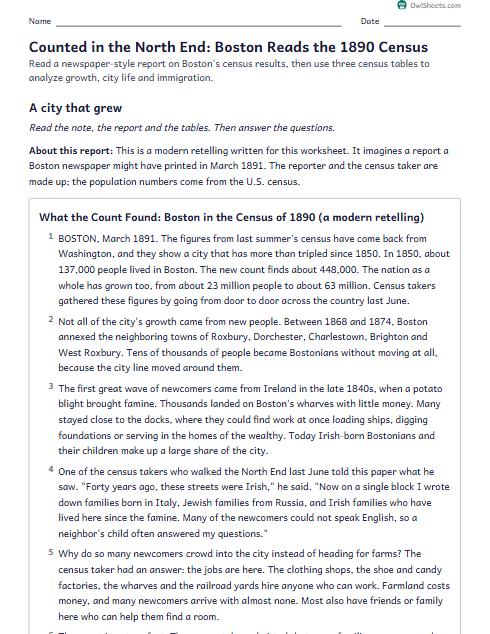
1BOSTON, March 1891. The figures from last summer's census have come back from Washington, and they show a city that has more than tripled since 1850. In 1850, about 137,000 people lived in Boston. The new count finds about 448,000. The nation as a whole has grown too, from about 23 million people to about 63 million. Census takers gathered these figures by going from door to door across the country last June.
2Not all of the city's growth came from new people. Between 1868 and 1874, Boston annexed the neighboring towns of Roxbury, Dorchester, Charlestown, Brighton and West Roxbury. Tens of thousands of people became Bostonians without moving at all, because the city line moved around them.
3The first great wave of newcomers came from Ireland in the late 1840s, when a potato blight brought famine. Thousands landed on Boston's wharves with little money. Many stayed close to the docks, where they could find work at once loading ships, digging foundations or serving in the homes of the wealthy. Today Irish-born Bostonians and their children make up a large share of the city.
4One of the census takers who walked the North End last June told this paper what he saw. "Forty years ago, these streets were Irish," he said. "Now on a single block I wrote down families born in Italy, Jewish families from Russia, and Irish families who have lived here since the famine. Many of the newcomers could not speak English, so a neighbor's child often answered my questions."
5Why do so many newcomers crowd into the city instead of heading for farms? The census taker had an answer: the jobs are here. The clothing shops, the shoe and candy factories, the wharves and the railroad yards hire anyone who can work. Farmland costs money, and many newcomers arrive with almost none. Most also have friends or family here who can help them find a room.
6The count is not perfect. The census taker admitted that some families were away when he called, and that he wrote down some names as best he could spell them. Some city leaders around the country have complained that their own counts came out too low.
| Year | People |
|---|---|
| 1850 | 136,881 |
| 1860 | 177,840 |
| 1870 | 250,526 |
| 1880 | 362,839 |
| 1890 | 448,477 |
The preview shows the first questions. Unlock the worksheet to see all of it.
Related worksheets
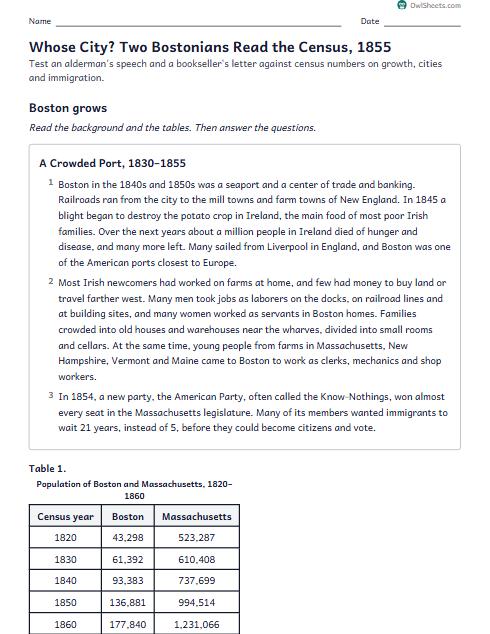
Whose City? Two Bostonians Read the Census, 1855
Grade 8 · GEO.8.3
13 questionsPremium
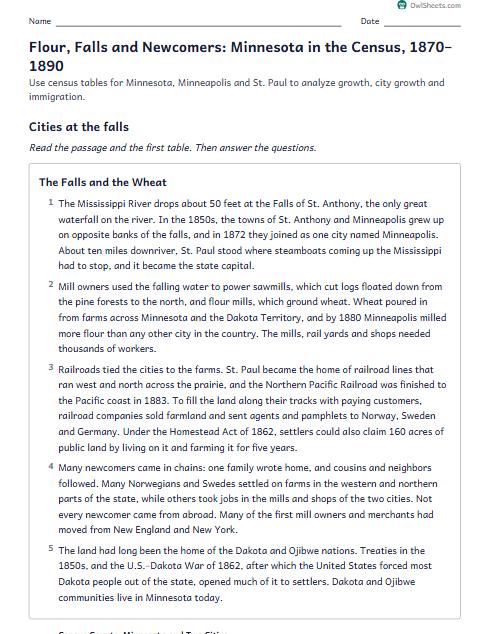
Flour, Falls and Newcomers: Minnesota in the Census, 1870–1890
Grade 8 · GEO.8.3
14 questionsPremium
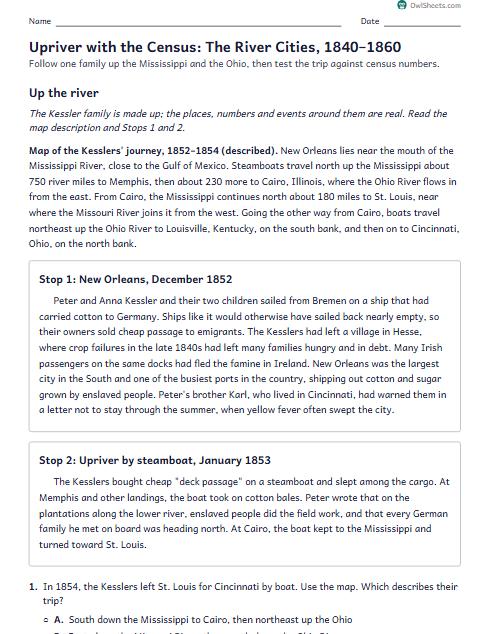
Upriver with the Census: The River Cities, 1840–1860
Grade 8 · GEO.8.3
14 questionsPremium
Counting Newcomers: A Historian's Notes on Milwaukee
Grade 8 · GEO.8.3
14 questionsPremium
The Nation's Center Moves West: A Census Exhibit
Grade 8 · GEO.8.3
11 questionsPremium
Where Should the New School Go? A Council Reads the 1890 Census
Grade 8 · GEO.8.3
10 questionsPremium