Grade 8 · Social StudiesECO.8.3Premium
Unveiling Day: A Reporter's New York, October 28, 1886
Grade 8 economics: a report from New York on October 28, 1886 and immigration data explain big business, the Knights of Labor and why newcomers came.
Preview
OwlSheets.com
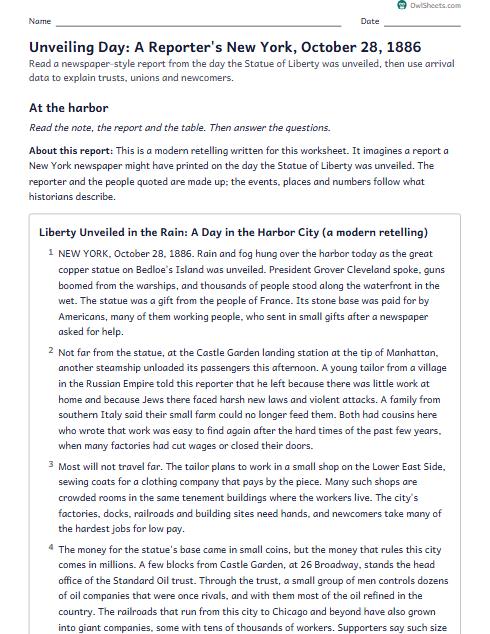
Unveiling Day: A Reporter's New York, October 28, 1886
Read a newspaper-style report from the day the Statue of Liberty was unveiled, then use arrival data to explain trusts, unions and newcomers.
At the harbor
Read the note, the report and the table. Then answer the questions.
Liberty Unveiled in the Rain: A Day in the Harbor City (a modern retelling)
1NEW YORK, October 28, 1886. Rain and fog hung over the harbor today as the great copper statue on Bedloe's Island was unveiled. President Grover Cleveland spoke, guns boomed from the warships, and thousands of people stood along the waterfront in the wet. The statue was a gift from the people of France. Its stone base was paid for by Americans, many of them working people, who sent in small gifts after a newspaper asked for help.
2Not far from the statue, at the Castle Garden landing station at the tip of Manhattan, another steamship unloaded its passengers this afternoon. A young tailor from a village in the Russian Empire told this reporter that he left because there was little work at home and because Jews there faced harsh new laws and violent attacks. A family from southern Italy said their small farm could no longer feed them. Both had cousins here who wrote that work was easy to find again after the hard times of the past few years, when many factories had cut wages or closed their doors.
3Most will not travel far. The tailor plans to work in a small shop on the Lower East Side, sewing coats for a clothing company that pays by the piece. Many such shops are crowded rooms in the same tenement buildings where the workers live. The city's factories, docks, railroads and building sites need hands, and newcomers take many of the hardest jobs for low pay.
4The money for the statue's base came in small coins, but the money that rules this city comes in millions. A few blocks from Castle Garden, at 26 Broadway, stands the head office of the Standard Oil trust. Through the trust, a small group of men controls dozens of oil companies that were once rivals, and with them most of the oil refined in the country. The railroads that run from this city to Chicago and beyond have also grown into giant companies, some with tens of thousands of workers. Supporters say such size brings cheaper goods. Critics say it crushes small firms and lets a few men set prices and wages.
5Workers have answered with organizations of their own. The Knights of Labor welcomes skilled and unskilled workers, men and women, from most trades. Its leaders say its membership jumped from about 110,000 last year to more than 700,000 this year. But since the bombing at Haymarket Square in Chicago in May, many newspapers have turned against unions, and several large strikes this year have failed. Some skilled craftsmen, such as the cigar makers led by Samuel Gompers, plan to meet in December to form a new federation of trade unions for skilled workers.
6As the crowds went home in the rain, a dock worker beside me looked out at the statue. "She is a fine lady," he said. "I hope she brings us a fine wage."
The preview shows the first questions. Unlock the worksheet to see all of it.
Related worksheets
Hand-Rolled to Machine-Made: A Tobacco Trade Gallery
Grade 8 · ECO.8.3
14 questionsPremium
The Richest Hill: Copper, Unions and Newcomers in Butte, 1878–1900
Grade 8 · ECO.8.3
14 questionsPremium
Harbor to Coal Patch: A Route Through Pennsylvania, 1896–1898
Grade 8 · ECO.8.3
15 questionsPremium
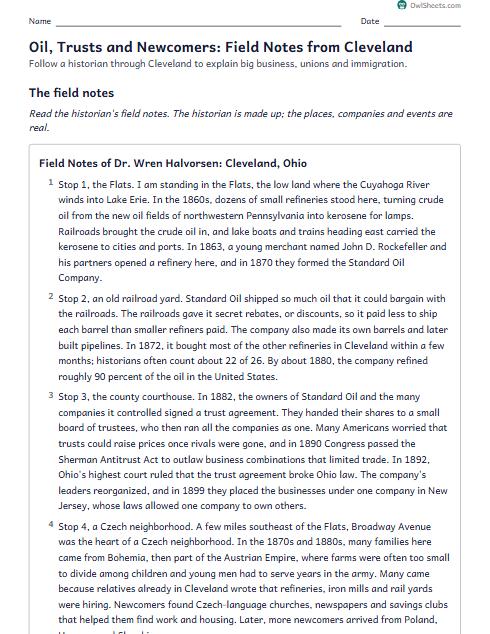
Oil, Trusts and Newcomers: Field Notes from Cleveland
Grade 8 · ECO.8.3
14 questionsPremium
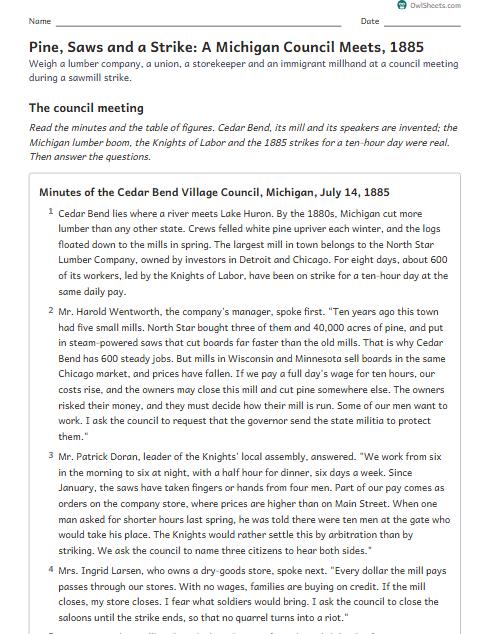
Pine, Saws and a Strike: A Michigan Council Meets, 1885
Grade 8 · ECO.8.3
11 questionsPremium
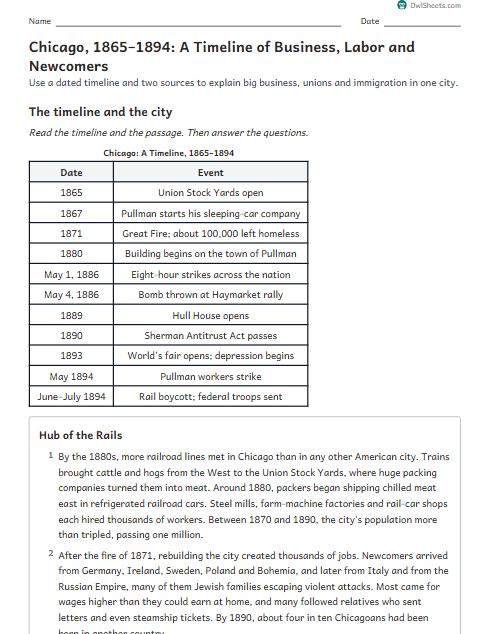
Chicago, 1865–1894: A Timeline of Business, Labor and Newcomers
Grade 8 · ECO.8.3
11 questionsPremium