Grade 8 · Social StudiesECO.8.3Premium
Oil, Trusts and Newcomers: Field Notes from Cleveland
Grade 8 economics: a historian's Cleveland field notes, census counts and two sources on Standard Oil explain big business, labor unions and immigration.
Preview
OwlSheets.com
Oil, Trusts and Newcomers: Field Notes from Cleveland
Follow a historian through Cleveland to explain big business, unions and immigration.
The field notes
Read the historian's field notes. The historian is made up; the places, companies and events are real.
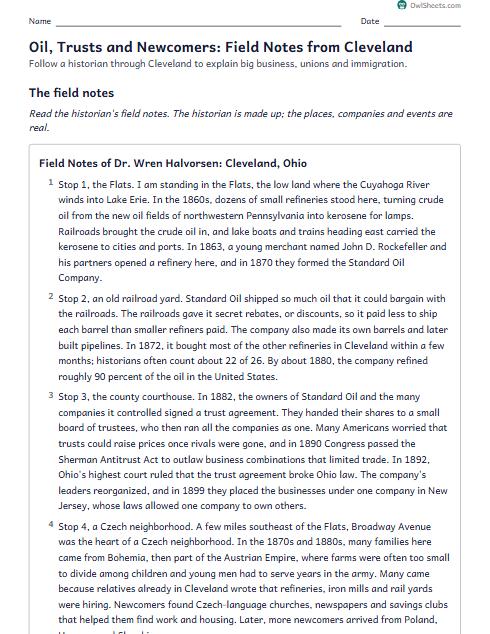
Field Notes of Dr. Wren Halvorsen: Cleveland, Ohio
1Stop 1, the Flats. I am standing in the Flats, the low land where the Cuyahoga River winds into Lake Erie. In the 1860s, dozens of small refineries stood here, turning crude oil from the new oil fields of northwestern Pennsylvania into kerosene for lamps. Railroads brought the crude oil in, and lake boats and trains heading east carried the kerosene to cities and ports. In 1863, a young merchant named John D. Rockefeller and his partners opened a refinery here, and in 1870 they formed the Standard Oil Company.
2Stop 2, an old railroad yard. Standard Oil shipped so much oil that it could bargain with the railroads. The railroads gave it secret rebates, or discounts, so it paid less to ship each barrel than smaller refiners paid. The company also made its own barrels and later built pipelines. In 1872, it bought most of the other refineries in Cleveland within a few months; historians often count about 22 of 26. By about 1880, the company refined roughly 90 percent of the oil in the United States.
3Stop 3, the county courthouse. In 1882, the owners of Standard Oil and the many companies it controlled signed a trust agreement. They handed their shares to a small board of trustees, who then ran all the companies as one. Many Americans worried that trusts could raise prices once rivals were gone, and in 1890 Congress passed the Sherman Antitrust Act to outlaw business combinations that limited trade. In 1892, Ohio's highest court ruled that the trust agreement broke Ohio law. The company's leaders reorganized, and in 1899 they placed the businesses under one company in New Jersey, whose laws allowed one company to own others.
4Stop 4, a Czech neighborhood. A few miles southeast of the Flats, Broadway Avenue was the heart of a Czech neighborhood. In the 1870s and 1880s, many families here came from Bohemia, then part of the Austrian Empire, where farms were often too small to divide among children and young men had to serve years in the army. Many came because relatives already in Cleveland wrote that refineries, iron mills and rail yards were hiring. Newcomers found Czech-language churches, newspapers and savings clubs that helped them find work and housing. Later, more newcomers arrived from Poland, Hungary and Slovakia.
5Stop 5, a union hall. Workers in Cleveland's shops and mills often worked ten or more hours a day, six days a week, and could be let go when business slowed. Some joined the Knights of Labor, which welcomed most workers, skilled or unskilled, but the Knights shrank quickly after 1886. In December 1886, union leaders meeting in Columbus, Ohio, formed the American Federation of Labor (AFL). Its first president, Samuel Gompers, was a cigar maker born in London who had come to New York as a boy. The AFL joined together unions of skilled workers in each craft, such as cigar makers, carpenters and machinists. It pressed for higher wages, shorter hours and safer shops, and its unions went on strike when bargaining failed.
- A. It had no railroads yet, so refiners shipped all their kerosene by lake.
- B. Its own river held crude oil, so refiners could draw it from the water.
- C. It was in the Pennsylvania oil region, where most crude oil was drilled.
- D. Rail and water routes linked it to the oil fields and to buyers in the East.
- A. He would have trouble matching Standard Oil's prices for kerosene.
- B. The railroad would be required by Ohio law to give him the same rate.
- C. Standard Oil would buy barrels from his shop to save on its costs.
- D. He would be able to charge less than Standard Oil and win its buyers.
The preview shows the first questions. Unlock the worksheet to see all of it.
Related worksheets
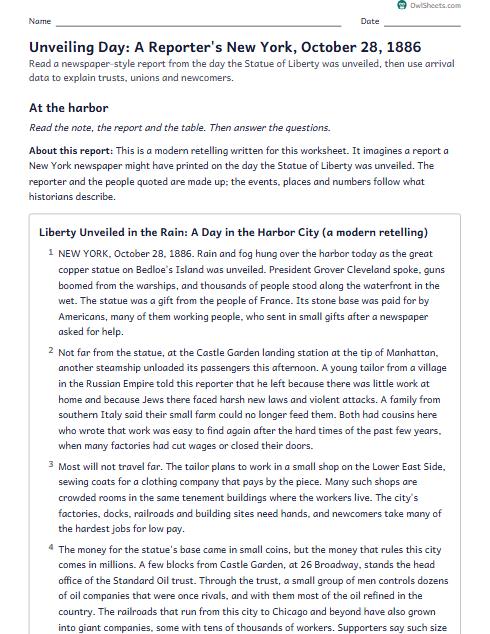
Unveiling Day: A Reporter's New York, October 28, 1886
Grade 8 · ECO.8.3
14 questionsPremium
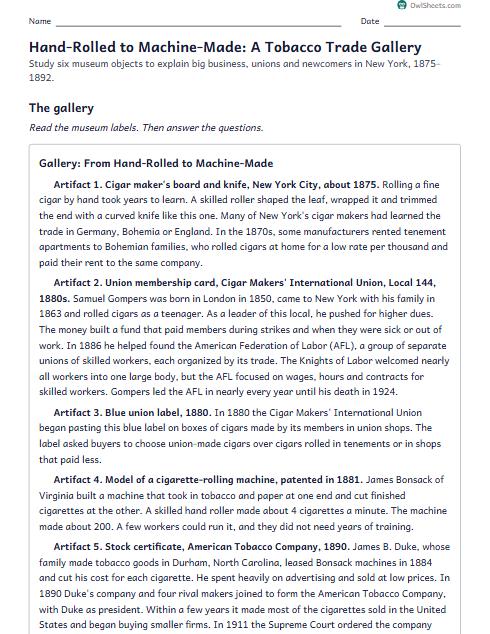
Hand-Rolled to Machine-Made: A Tobacco Trade Gallery
Grade 8 · ECO.8.3
14 questionsPremium
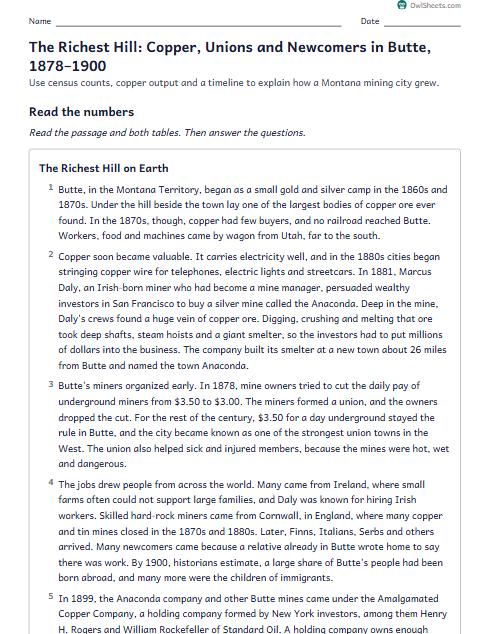
The Richest Hill: Copper, Unions and Newcomers in Butte, 1878–1900
Grade 8 · ECO.8.3
14 questionsPremium
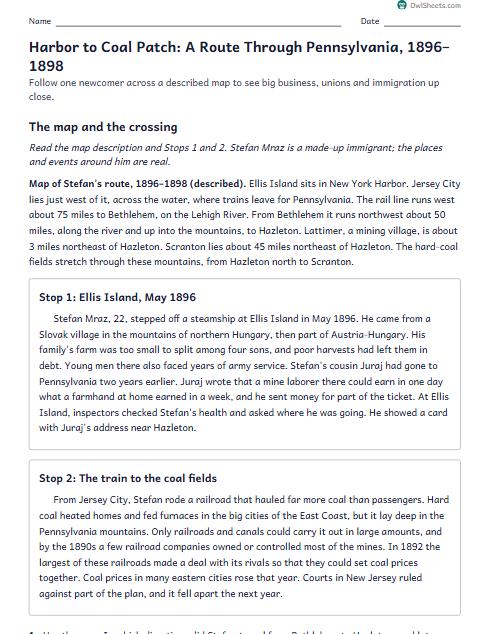
Harbor to Coal Patch: A Route Through Pennsylvania, 1896–1898
Grade 8 · ECO.8.3
15 questionsPremium
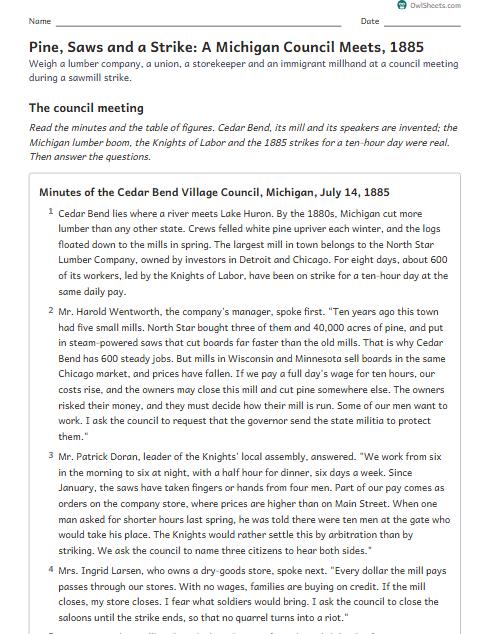
Pine, Saws and a Strike: A Michigan Council Meets, 1885
Grade 8 · ECO.8.3
11 questionsPremium
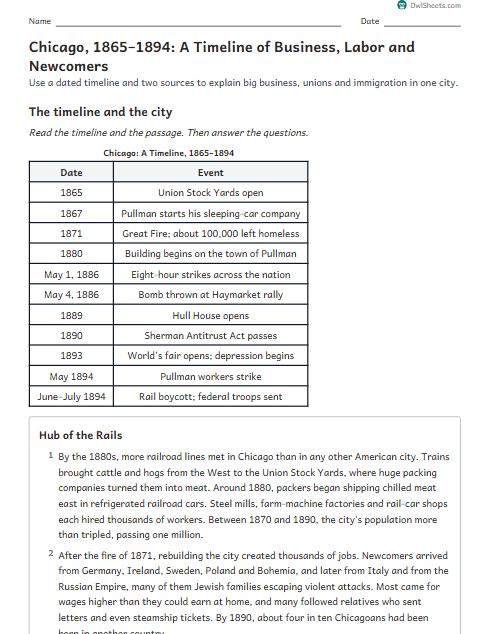
Chicago, 1865–1894: A Timeline of Business, Labor and Newcomers
Grade 8 · ECO.8.3
11 questionsPremium