Grade 8 · Social StudiesECO.8.3Premium
Hand-Rolled to Machine-Made: A Tobacco Trade Gallery
Grade 8 economics: museum labels from New York's cigar trade, a rolling machine, a trust and a steamship ticket explain business, unions and immigration.
Preview
OwlSheets.com
Hand-Rolled to Machine-Made: A Tobacco Trade Gallery
Study six museum objects to explain big business, unions and newcomers in New York, 1875–1892.
The gallery
Read the museum labels. Then answer the questions.
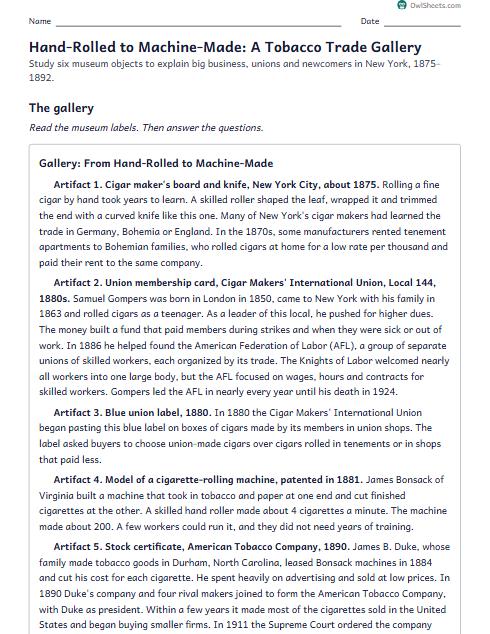
Gallery: From Hand-Rolled to Machine-Made
Artifact 1. Cigar maker's board and knife, New York City, about 1875. Rolling a fine cigar by hand took years to learn. A skilled roller shaped the leaf, wrapped it and trimmed the end with a curved knife like this one. Many of New York's cigar makers had learned the trade in Germany, Bohemia or England. In the 1870s, some manufacturers rented tenement apartments to Bohemian families, who rolled cigars at home for a low rate per thousand and paid their rent to the same company.
Artifact 2. Union membership card, Cigar Makers' International Union, Local 144, 1880s. Samuel Gompers was born in London in 1850, came to New York with his family in 1863 and rolled cigars as a teenager. As a leader of this local, he pushed for higher dues. The money built a fund that paid members during strikes and when they were sick or out of work. In 1886 he helped found the American Federation of Labor (AFL), a group of separate unions of skilled workers, each organized by its trade. The Knights of Labor welcomed nearly all workers into one large body, but the AFL focused on wages, hours and contracts for skilled workers. Gompers led the AFL in nearly every year until his death in 1924.
Artifact 3. Blue union label, 1880. In 1880 the Cigar Makers' International Union began pasting this blue label on boxes of cigars made by its members in union shops. The label asked buyers to choose union-made cigars over cigars rolled in tenements or in shops that paid less.
Artifact 4. Model of a cigarette-rolling machine, patented in 1881. James Bonsack of Virginia built a machine that took in tobacco and paper at one end and cut finished cigarettes at the other. A skilled hand roller made about 4 cigarettes a minute. The machine made about 200. A few workers could run it, and they did not need years of training.
Artifact 5. Stock certificate, American Tobacco Company, 1890. James B. Duke, whose family made tobacco goods in Durham, North Carolina, leased Bonsack machines in 1884 and cut his cost for each cigarette. He spent heavily on advertising and sold at low prices. In 1890 Duke's company and four rival makers joined to form the American Tobacco Company, with Duke as president. Within a few years it made most of the cigarettes sold in the United States and began buying smaller firms. In 1911 the Supreme Court ordered the company broken up under the Sherman Antitrust Act of 1890.
Artifact 6. Steamship ticket, Hamburg to New York, 1892. This ticket belonged to a Jewish family from the Russian Empire. After 1881, attacks on Jewish towns and new laws limiting where Jews could live and work led many families to leave. A cousin who rolled cigars in New York sent part of the fare. By then, large steamships crossed the Atlantic in about ten days. In 1892 the family passed through the new immigrant station on Ellis Island and found rooms on the Lower East Side near the cousin.
- A. Workers without years of training could tend it, so craft skill mattered less.
- B. Families in tenements could now make more cigarettes at home each day.
- C. Rollers trained in Germany or England were needed to keep it running.
- D. Each machine needed more skilled rollers than a hand shop had used.
One machine did the work of about skilled hand rollers. In a 10-hour day, one machine made about cigarettes.
The preview shows the first questions. Unlock the worksheet to see all of it.
Related worksheets
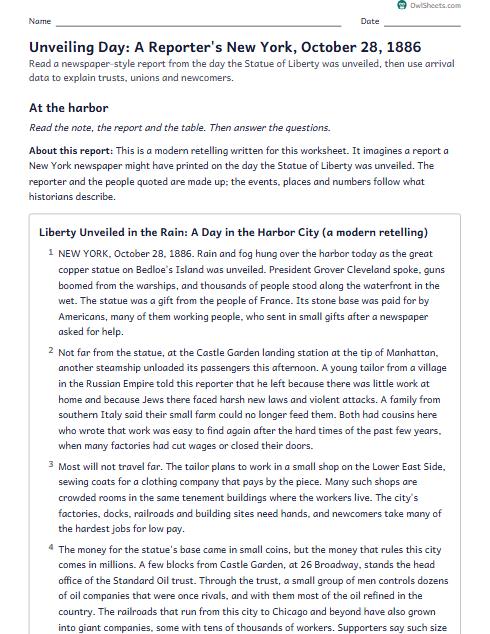
Unveiling Day: A Reporter's New York, October 28, 1886
Grade 8 · ECO.8.3
14 questionsPremium
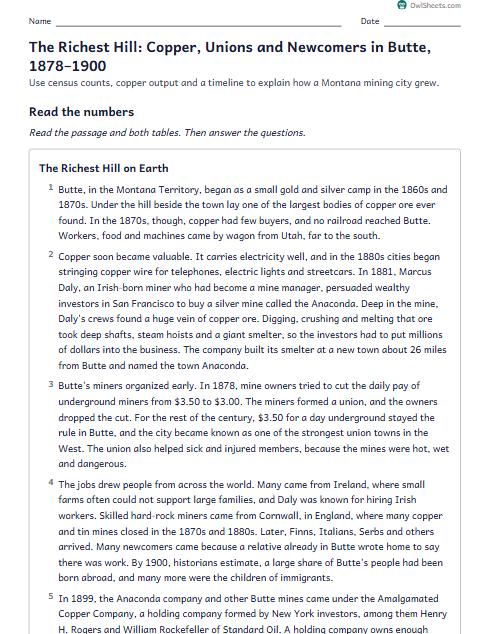
The Richest Hill: Copper, Unions and Newcomers in Butte, 1878–1900
Grade 8 · ECO.8.3
14 questionsPremium
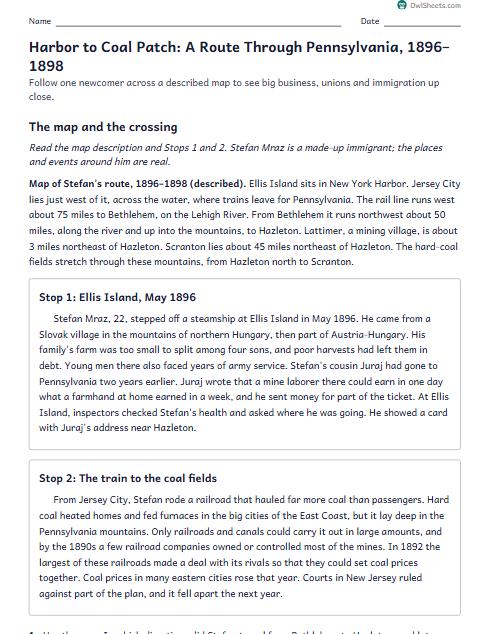
Harbor to Coal Patch: A Route Through Pennsylvania, 1896–1898
Grade 8 · ECO.8.3
15 questionsPremium
Oil, Trusts and Newcomers: Field Notes from Cleveland
Grade 8 · ECO.8.3
14 questionsPremium
Pine, Saws and a Strike: A Michigan Council Meets, 1885
Grade 8 · ECO.8.3
11 questionsPremium
Chicago, 1865–1894: A Timeline of Business, Labor and Newcomers
Grade 8 · ECO.8.3
11 questionsPremium