Grade 8 · Social StudiesECO.8.3Premium
The Richest Hill: Copper, Unions and Newcomers in Butte, 1878–1900
Grade 8 economics: Butte census counts, copper output and a timeline explain big business, a miners' union and why immigrants came, 1878–1900.
Preview
OwlSheets.com
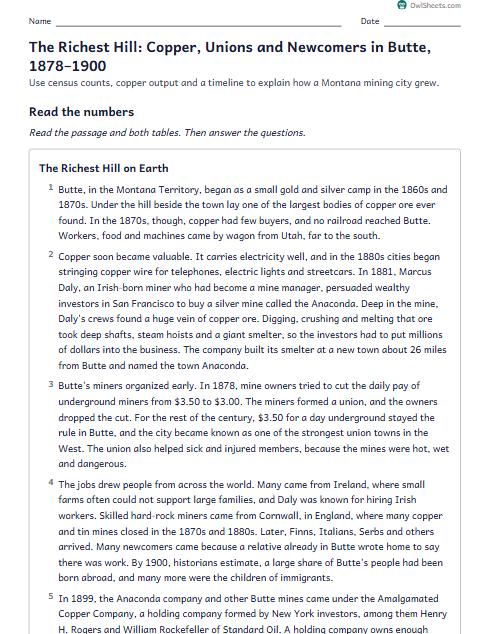
The Richest Hill: Copper, Unions and Newcomers in Butte, 1878–1900
Use census counts, copper output and a timeline to explain how a Montana mining city grew.
Read the numbers
Read the passage and both tables. Then answer the questions.
The Richest Hill on Earth
1Butte, in the Montana Territory, began as a small gold and silver camp in the 1860s and 1870s. Under the hill beside the town lay one of the largest bodies of copper ore ever found. In the 1870s, though, copper had few buyers, and no railroad reached Butte. Workers, food and machines came by wagon from Utah, far to the south.
2Copper soon became valuable. It carries electricity well, and in the 1880s cities began stringing copper wire for telephones, electric lights and streetcars. In 1881, Marcus Daly, an Irish-born miner who had become a mine manager, persuaded wealthy investors in San Francisco to buy a silver mine called the Anaconda. Deep in the mine, Daly's crews found a huge vein of copper ore. Digging, crushing and melting that ore took deep shafts, steam hoists and a giant smelter, so the investors had to put millions of dollars into the business. The company built its smelter at a new town about 26 miles from Butte and named the town Anaconda.
3Butte's miners organized early. In 1878, mine owners tried to cut the daily pay of underground miners from $3.50 to $3.00. The miners formed a union, and the owners dropped the cut. For the rest of the century, $3.50 for a day underground stayed the rule in Butte, and the city became known as one of the strongest union towns in the West. The union also helped sick and injured members, because the mines were hot, wet and dangerous.
4The jobs drew people from across the world. Many came from Ireland, where small farms often could not support large families, and Daly was known for hiring Irish workers. Skilled hard-rock miners came from Cornwall, in England, where many copper and tin mines closed in the 1870s and 1880s. Later, Finns, Italians, Serbs and others arrived. Many newcomers came because a relative already in Butte wrote home to say there was work. By 1900, historians estimate, a large share of Butte's people had been born abroad, and many more were the children of immigrants.
5In 1899, the Anaconda company and other Butte mines came under the Amalgamated Copper Company, a holding company formed by New York investors, among them Henry H. Rogers and William Rockefeller of Standard Oil. A holding company owns enough stock in other companies to control them. Amalgamated soon controlled much of the copper mined in Butte, and more of the decisions about its mines were made in New York.
| Year | People in Butte | U.S. copper (short tons) |
|---|---|---|
| 1880 | 3,363 | 30,000 |
| 1890 | 10,723 | 130,000 |
| 1900 | 30,470 | 300,000 |
| Year | Event |
|---|---|
| 1878 | Miners form a union over a pay cut |
| 1881 | Investors buy the Anaconda mine |
| 1881 | First railroad reaches Butte |
| 1884 | Smelter opens at Anaconda |
| 1899 | Amalgamated Copper takes control |
In 1900, Butte had about times as many people as in 1880. U.S. copper output in 1900 was about times its 1880 output.
The preview shows the first questions. Unlock the worksheet to see all of it.
Related worksheets
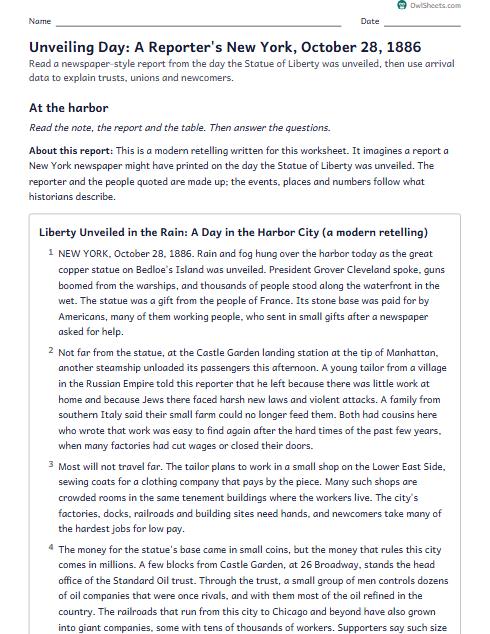
Unveiling Day: A Reporter's New York, October 28, 1886
Grade 8 · ECO.8.3
14 questionsPremium
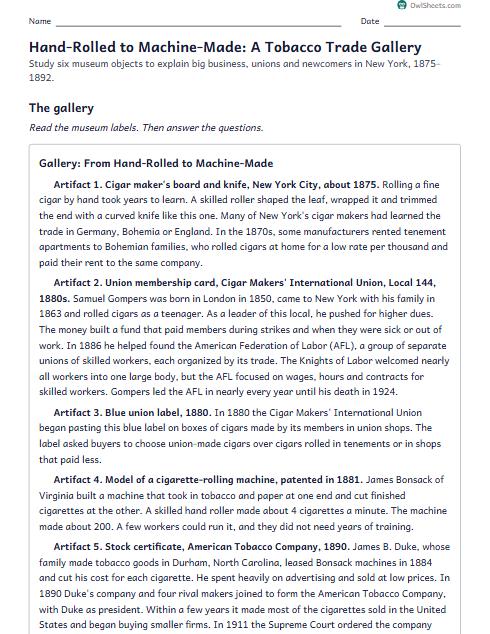
Hand-Rolled to Machine-Made: A Tobacco Trade Gallery
Grade 8 · ECO.8.3
14 questionsPremium
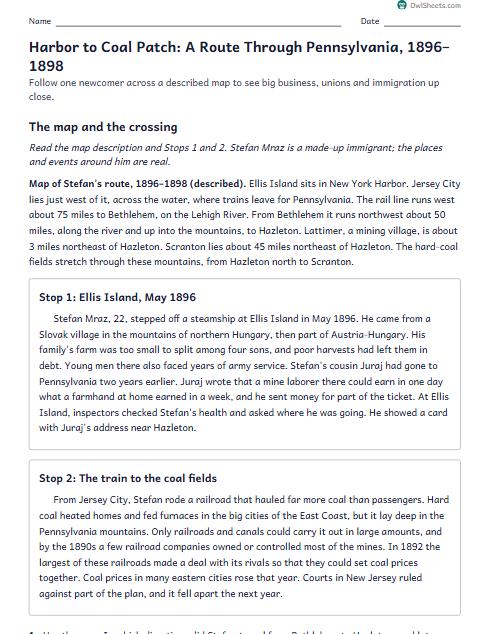
Harbor to Coal Patch: A Route Through Pennsylvania, 1896–1898
Grade 8 · ECO.8.3
15 questionsPremium
Oil, Trusts and Newcomers: Field Notes from Cleveland
Grade 8 · ECO.8.3
14 questionsPremium
Pine, Saws and a Strike: A Michigan Council Meets, 1885
Grade 8 · ECO.8.3
11 questionsPremium
Chicago, 1865–1894: A Timeline of Business, Labor and Newcomers
Grade 8 · ECO.8.3
11 questionsPremium