Grade 7 · Social StudiesECO.7.1Premium
From Fleece to Fair: Wool, Weavers and the Fairs of Flanders
Grade 7 economics: museum labels follow English wool from a manor to the guilds, cloth hall and fairs of Ypres to explain how medieval trade grew.
Preview
OwlSheets.com
From Fleece to Fair: Wool, Weavers and the Fairs of Flanders
Use museum labels to follow English wool from a manor to a Flemish cloth town and its fairs.
Room 1: The manor
Read the wall text and labels 1 and 2. Then answer the questions.
From Fleece to Fair (exhibit labels)
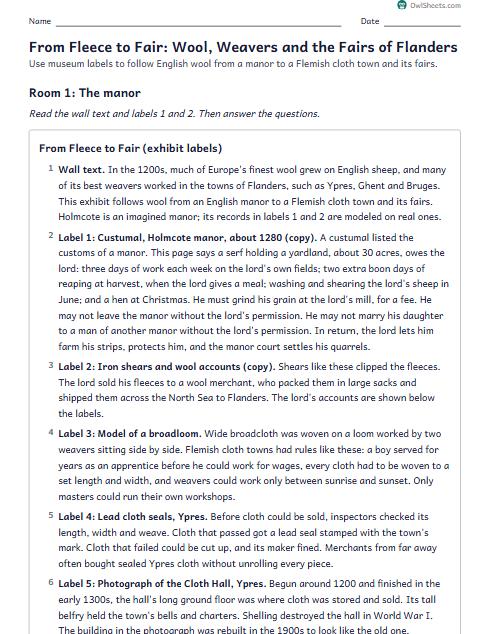
1Wall text. In the 1200s, much of Europe's finest wool grew on English sheep, and many of its best weavers worked in the towns of Flanders, such as Ypres, Ghent and Bruges. This exhibit follows wool from an English manor to a Flemish cloth town and its fairs. Holmcote is an imagined manor; its records in labels 1 and 2 are modeled on real ones.
2Label 1: Custumal, Holmcote manor, about 1280 (copy). A custumal listed the customs of a manor. This page says a serf holding a yardland, about 30 acres, owes the lord: three days of work each week on the lord's own fields; two extra boon days of reaping at harvest, when the lord gives a meal; washing and shearing the lord's sheep in June; and a hen at Christmas. He must grind his grain at the lord's mill, for a fee. He may not leave the manor without the lord's permission. He may not marry his daughter to a man of another manor without the lord's permission. In return, the lord lets him farm his strips, protects him, and the manor court settles his quarrels.
3Label 2: Iron shears and wool accounts (copy). Shears like these clipped the fleeces. The lord sold his fleeces to a wool merchant, who packed them in large sacks and shipped them across the North Sea to Flanders. The lord's accounts are shown below the labels.
4Label 3: Model of a broadloom. Wide broadcloth was woven on a loom worked by two weavers sitting side by side. Flemish cloth towns had rules like these: a boy served for years as an apprentice before he could work for wages, every cloth had to be woven to a set length and width, and weavers could work only between sunrise and sunset. Only masters could run their own workshops.
5Label 4: Lead cloth seals, Ypres. Before cloth could be sold, inspectors checked its length, width and weave. Cloth that passed got a lead seal stamped with the town's mark. Cloth that failed could be cut up, and its maker fined. Merchants from far away often bought sealed Ypres cloth without unrolling every piece.
6Label 5: Photograph of the Cloth Hall, Ypres. Begun around 1200 and finished in the early 1300s, the hall's long ground floor was where cloth was stored and sold. Its tall belfry held the town's bells and charters. Shelling destroyed the hall in World War I. The building in the photograph was rebuilt in the 1900s to look like the old one.
7Label 6: Wax seal from a town charter (copy). In the 1100s, the counts of Flanders granted written rights to many cloth towns, including Ypres. Townspeople had their own aldermen and court and could hold markets. They paid the count dues in money, not in work on his fields.
8Label 7: Folding balance and tally stick, from a fair. In the 1100s and 1200s, five Flemish towns, Ypres, Lille, Messines, Torhout and Bruges, took turns holding fairs, so a fair was open somewhere in Flanders for much of the year. English wool merchants, Italian bankers and German traders came. The count promised merchants safe travel to and from the fairs, and fair courts settled disputes quickly. A buyer could take goods at one fair and pay at a later one. A notched stick, split so each side kept half, recorded the debt.
| Year | Sheep in lord's flock | Sacks of wool sold | Wool income (pounds) |
|---|---|---|---|
| 1250 | 300 | 1 | 5 |
| 1270 | 550 | 2 | 12 |
| 1290 | 800 | 3 | 21 |
- A. He reaps his own grain first and gives the lord a hen instead.
- B. He hires a weaver from the town to reap the lord's fields.
- C. He asks the manor court to move the boon days to the winter.
- D. He reaps the lord's grain on those days, and the lord feeds him.
The preview shows the first questions. Unlock the worksheet to see all of it.
Related worksheets
Thursday Market to Midsummer Fair: A Hollinsford Timeline, 1086–1349
Grade 7 · ECO.7.1
15 questionsPremium
Work Days or Coins? A Manor Meeting near Provins, 1232
Grade 7 · ECO.7.1
15 questionsPremium
Six Deniers and a Year and a Day: The Customs of Lorris, 1155
Grade 7 · ECO.7.1
15 questionsPremium
Runaway Serfs or Rising Rents? Two Letters About a New Town
Grade 7 · ECO.7.1
15 questionsPremium
Abbey Fields to City Guilds: Paris, 800–1300
Grade 7 · ECO.7.1
12 questionsPremium
Ridges in the Grass: A Historian's Notes on Village, Town and Fair
Grade 7 · ECO.7.1
12 questionsPremium