Grade 7 · Social StudiesECO.7.1Premium
Six Deniers and a Year and a Day: The Customs of Lorris, 1155
Grade 7 economics: compare serfs' duties on a manor with the rights in the Customs of Lorris (1155), and explain how towns, guilds and fairs grew.
Preview
OwlSheets.com
Six Deniers and a Year and a Day: The Customs of Lorris, 1155
Source a royal charter to see how manor life, new villages, guilds and fairs differed.
Background: manors, new villages, guilds and fairs
Read the background. Then answer the questions.
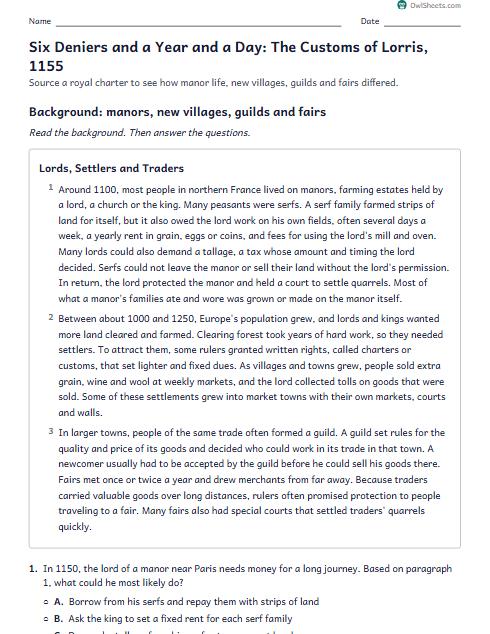
Lords, Settlers and Traders
1Around 1100, most people in northern France lived on manors, farming estates held by a lord, a church or the king. Many peasants were serfs. A serf family farmed strips of land for itself, but it also owed the lord work on his own fields, often several days a week, a yearly rent in grain, eggs or coins, and fees for using the lord's mill and oven. Many lords could also demand a tallage, a tax whose amount and timing the lord decided. Serfs could not leave the manor or sell their land without the lord's permission. In return, the lord protected the manor and held a court to settle quarrels. Most of what a manor's families ate and wore was grown or made on the manor itself.
2Between about 1000 and 1250, Europe's population grew, and lords and kings wanted more land cleared and farmed. Clearing forest took years of hard work, so they needed settlers. To attract them, some rulers granted written rights, called charters or customs, that set lighter and fixed dues. As villages and towns grew, people sold extra grain, wine and wool at weekly markets, and the lord collected tolls on goods that were sold. Some of these settlements grew into market towns with their own markets, courts and walls.
3In larger towns, people of the same trade often formed a guild. A guild set rules for the quality and price of its goods and decided who could work in its trade in that town. A newcomer usually had to be accepted by the guild before he could sell his goods there. Fairs met once or twice a year and drew merchants from far away. Because traders carried valuable goods over long distances, rulers often promised protection to people traveling to a fair. Many fairs also had special courts that settled traders' quarrels quickly.
- A. Borrow from his serfs and repay them with strips of land
- B. Ask the king to set a fixed rent for each serf family
- C. Demand a tallage from his serfs at an amount he chose
- D. Ask a guild in a nearby town to pay for the journey
- A. To get a charter from the king for his workshop
- B. To be accepted by that town's weavers' guild
- C. To live in the town for a year and a day first
- D. To sell his first cloth at a fair far away
The preview shows the first questions. Unlock the worksheet to see all of it.
Related worksheets
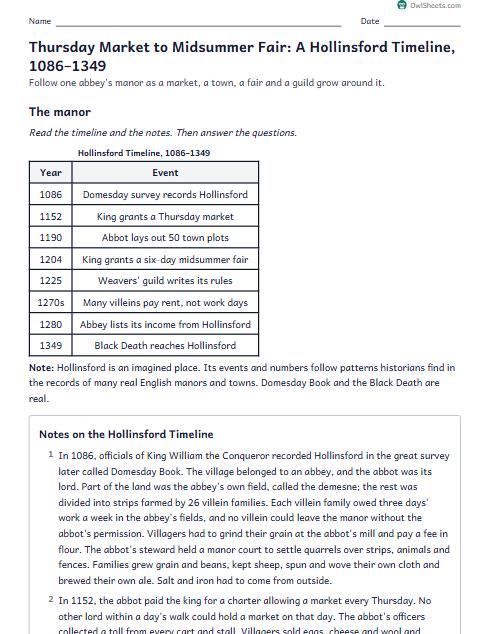
Thursday Market to Midsummer Fair: A Hollinsford Timeline, 1086–1349
Grade 7 · ECO.7.1
15 questionsPremium
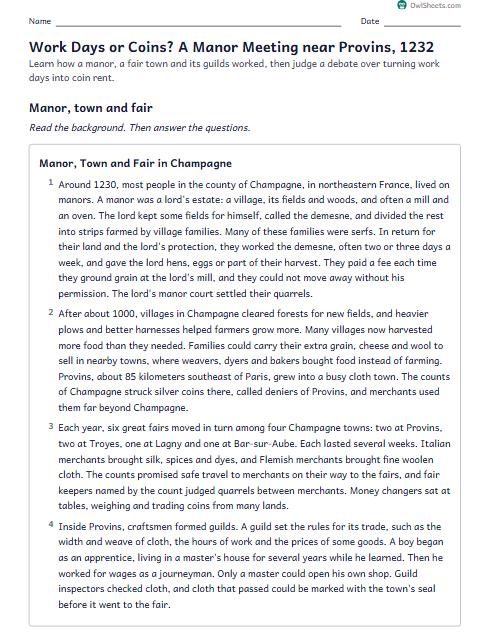
Work Days or Coins? A Manor Meeting near Provins, 1232
Grade 7 · ECO.7.1
15 questionsPremium
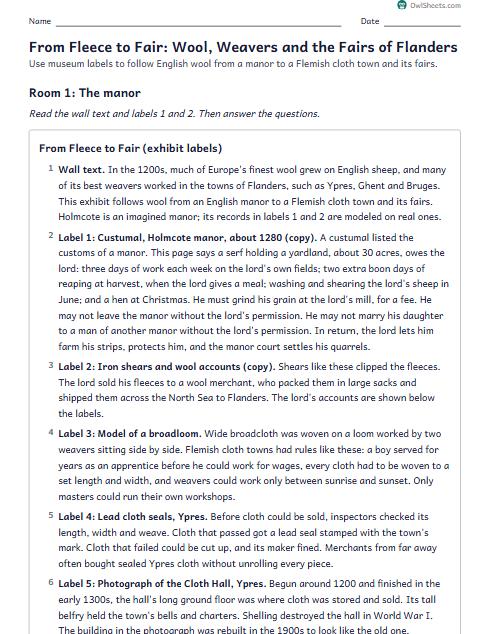
From Fleece to Fair: Wool, Weavers and the Fairs of Flanders
Grade 7 · ECO.7.1
14 questionsPremium
Runaway Serfs or Rising Rents? Two Letters About a New Town
Grade 7 · ECO.7.1
15 questionsPremium
Abbey Fields to City Guilds: Paris, 800–1300
Grade 7 · ECO.7.1
12 questionsPremium
Ridges in the Grass: A Historian's Notes on Village, Town and Fair
Grade 7 · ECO.7.1
12 questionsPremium