Grade 7 · Social StudiesECO.7.1Premium
Work Days or Coins? A Manor Meeting near Provins, 1232
Grade 7 economics: how a manor near Provins worked, how the Champagne fairs and guilds grew, and an imagined debate on turning work days into coins.
Preview
OwlSheets.com
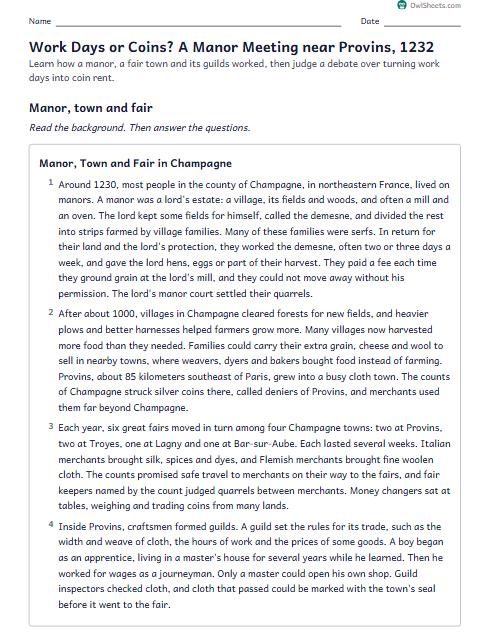
Work Days or Coins? A Manor Meeting near Provins, 1232
Learn how a manor, a fair town and its guilds worked, then judge a debate over turning work days into coin rent.
Manor, town and fair
Read the background. Then answer the questions.
Manor, Town and Fair in Champagne
1Around 1230, most people in the county of Champagne, in northeastern France, lived on manors. A manor was a lord's estate: a village, its fields and woods, and often a mill and an oven. The lord kept some fields for himself, called the demesne, and divided the rest into strips farmed by village families. Many of these families were serfs. In return for their land and the lord's protection, they worked the demesne, often two or three days a week, and gave the lord hens, eggs or part of their harvest. They paid a fee each time they ground grain at the lord's mill, and they could not move away without his permission. The lord's manor court settled their quarrels.
2After about 1000, villages in Champagne cleared forests for new fields, and heavier plows and better harnesses helped farmers grow more. Many villages now harvested more food than they needed. Families could carry their extra grain, cheese and wool to sell in nearby towns, where weavers, dyers and bakers bought food instead of farming. Provins, about 85 kilometers southeast of Paris, grew into a busy cloth town. The counts of Champagne struck silver coins there, called deniers of Provins, and merchants used them far beyond Champagne.
3Each year, six great fairs moved in turn among four Champagne towns: two at Provins, two at Troyes, one at Lagny and one at Bar-sur-Aube. Each lasted several weeks. Italian merchants brought silk, spices and dyes, and Flemish merchants brought fine woolen cloth. The counts promised safe travel to merchants on their way to the fairs, and fair keepers named by the count judged quarrels between merchants. Money changers sat at tables, weighing and trading coins from many lands.
4Inside Provins, craftsmen formed guilds. A guild set the rules for its trade, such as the width and weave of cloth, the hours of work and the prices of some goods. A boy began as an apprentice, living in a master's house for several years while he learned. Then he worked for wages as a journeyman. Only a master could open his own shop. Guild inspectors checked cloth, and cloth that passed could be marked with the town's seal before it went to the fair.
- A. New fields and plows → extra food → food sold in towns → more people did crafts
- B. Fairs began → counts made coins → villages cleared forests → harvests shrank
- C. Towns grew → villages lost their fields → farmers moved to Provins → plows improved
- D. Guilds formed → villages stopped farming → food came from Italy → towns grew
- A. A guild inspector, to have his coins marked with the seal
- B. A manor reeve, to pay the fee for grinding at the mill
- C. A fair keeper, to ask the count for a pass to travel home
- D. A money changer, to have his coins weighed and traded
The preview shows the first questions. Unlock the worksheet to see all of it.
Related worksheets
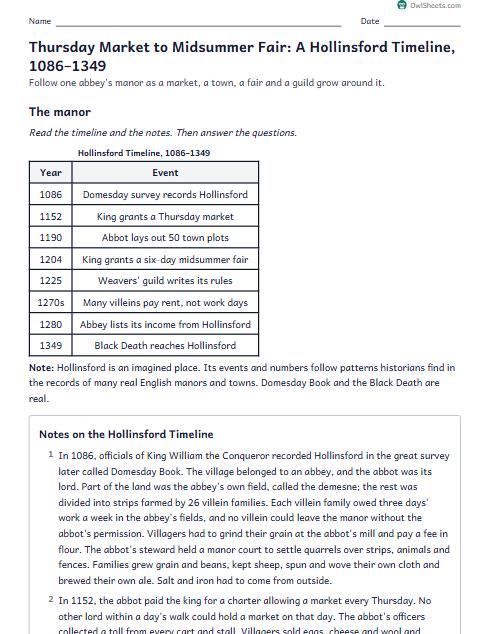
Thursday Market to Midsummer Fair: A Hollinsford Timeline, 1086–1349
Grade 7 · ECO.7.1
15 questionsPremium
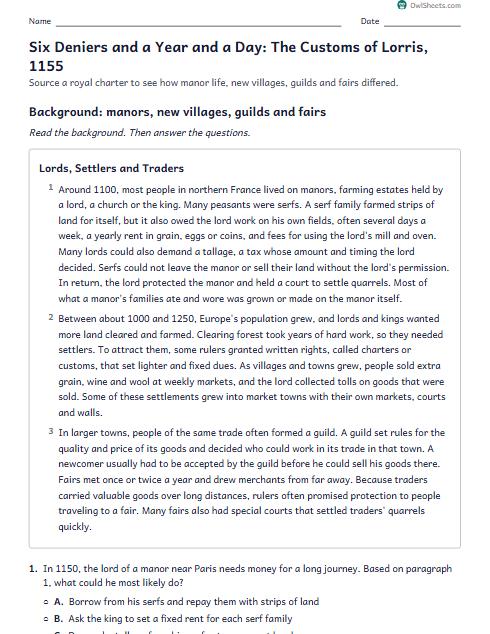
Six Deniers and a Year and a Day: The Customs of Lorris, 1155
Grade 7 · ECO.7.1
15 questionsPremium
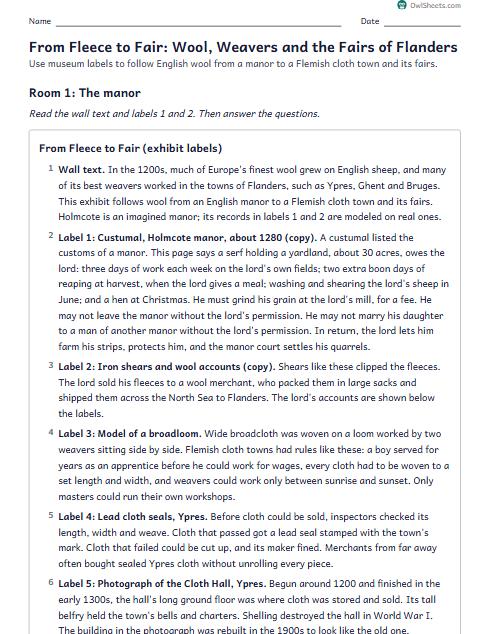
From Fleece to Fair: Wool, Weavers and the Fairs of Flanders
Grade 7 · ECO.7.1
14 questionsPremium
Runaway Serfs or Rising Rents? Two Letters About a New Town
Grade 7 · ECO.7.1
15 questionsPremium
Abbey Fields to City Guilds: Paris, 800–1300
Grade 7 · ECO.7.1
12 questionsPremium
Ridges in the Grass: A Historian's Notes on Village, Town and Fair
Grade 7 · ECO.7.1
12 questionsPremium