Grade 7 · Social StudiesECO.7.1Premium
Thursday Market to Midsummer Fair: A Hollinsford Timeline, 1086–1349
Grade 7 economics: use a dated timeline, notes and an income table to see how a manor worked and how a market, town, fair and guild grew around it.
Preview
OwlSheets.com
Thursday Market to Midsummer Fair: A Hollinsford Timeline, 1086–1349
Follow one abbey's manor as a market, a town, a fair and a guild grow around it.
The manor
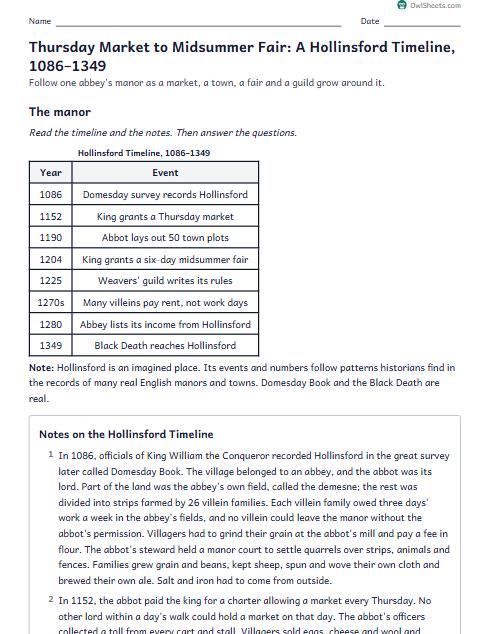
Read the timeline and the notes. Then answer the questions.
| Year | Event |
|---|---|
| 1086 | Domesday survey records Hollinsford |
| 1152 | King grants a Thursday market |
| 1190 | Abbot lays out 50 town plots |
| 1204 | King grants a six-day midsummer fair |
| 1225 | Weavers' guild writes its rules |
| 1270s | Many villeins pay rent, not work days |
| 1280 | Abbey lists its income from Hollinsford |
| 1349 | Black Death reaches Hollinsford |
Notes on the Hollinsford Timeline
1In 1086, officials of King William the Conqueror recorded Hollinsford in the great survey later called Domesday Book. The village belonged to an abbey, and the abbot was its lord. Part of the land was the abbey's own field, called the demesne; the rest was divided into strips farmed by 26 villein families. Each villein family owed three days' work a week in the abbey's fields, and no villein could leave the manor without the abbot's permission. Villagers had to grind their grain at the abbot's mill and pay a fee in flour. The abbot's steward held a manor court to settle quarrels over strips, animals and fences. Families grew grain and beans, kept sheep, spun and wove their own cloth and brewed their own ale. Salt and iron had to come from outside.
2In 1152, the abbot paid the king for a charter allowing a market every Thursday. No other lord within a day's walk could hold a market on that day. The abbot's officers collected a toll from every cart and stall. Villagers sold eggs, cheese and wool and bought salt, pots and iron tools.
3In 1190, the abbot laid out 50 plots along the road beside the market place. Each plot holder, called a burgess, paid 12 pence a year in money rent and owed no work in the abbey's fields. A burgess could sell his plot or leave it to his children. Bakers, smiths, tanners and weavers moved in from villages nearby.
4In 1204, the king granted the abbey a fair for six days around midsummer. The fair drew traders the weekly market never saw: wool buyers from Flanders, wine sellers from Gascony and spice dealers from London. The abbey held a fair court that heard merchants' quarrels within a day.
5By 1225, the town's weavers had formed a guild and written down its rules. Only guild members could sell cloth in the Hollinsford market. A boy learned the trade as an apprentice, living for seven years in a master's house. Every cloth had to be a set width, and guild wardens measured it before it was sold. A weaver whose cloth was found faulty paid a fine. Members paid into a common box that helped sick members and widows.
6By the 1270s, many villein families paid the abbey a money rent instead of working its fields, and the abbey hired laborers for wages. In 1349, the Black Death reached Hollinsford, and the abbey's records list nearly half of its tenants as dead.
- A. The king's survey had counted them to serve in a new army.
- B. The manor court could judge only people born in Hollinsford.
- C. The abbey's own fields depended on the work the villeins owed.
- D. The abbot needed them to buy goods at the Thursday market.
The preview shows the first questions. Unlock the worksheet to see all of it.
Related worksheets
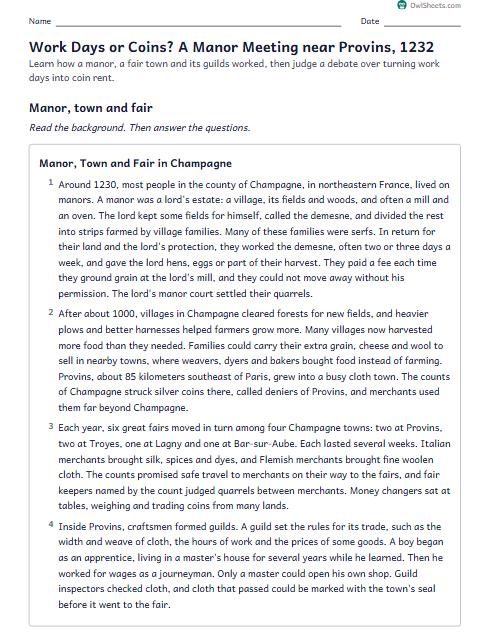
Work Days or Coins? A Manor Meeting near Provins, 1232
Grade 7 · ECO.7.1
15 questionsPremium
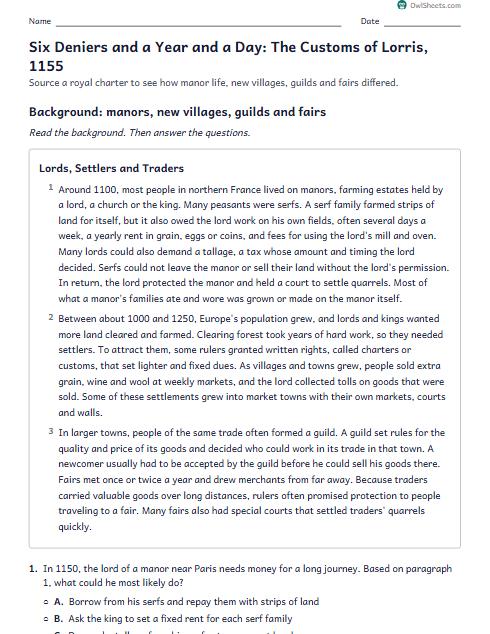
Six Deniers and a Year and a Day: The Customs of Lorris, 1155
Grade 7 · ECO.7.1
15 questionsPremium
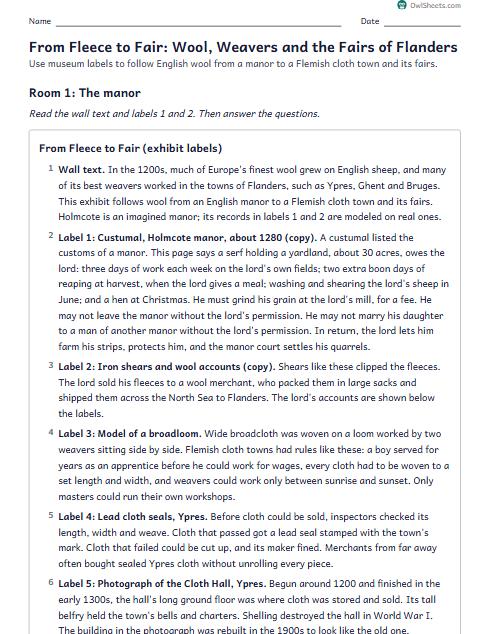
From Fleece to Fair: Wool, Weavers and the Fairs of Flanders
Grade 7 · ECO.7.1
14 questionsPremium
Runaway Serfs or Rising Rents? Two Letters About a New Town
Grade 7 · ECO.7.1
15 questionsPremium
Abbey Fields to City Guilds: Paris, 800–1300
Grade 7 · ECO.7.1
12 questionsPremium
Ridges in the Grass: A Historian's Notes on Village, Town and Fair
Grade 7 · ECO.7.1
12 questionsPremium