Grade 7 · Social StudiesHIS.7.3Premium
From Desert Road to Coastal Fort: A Timeline of West African Gold
Grade 7 history: a dated timeline and passage trace Ghana, Mali and Songhai, the gold and salt trade, Mansa Musa, Timbuktu and the shift to the coast.
Preview
OwlSheets.com
From Desert Road to Coastal Fort: A Timeline of West African Gold
Use a dated timeline and a background passage to trace Ghana, Mali and Songhai from about 800 to 1600.
The timeline and the background
Read the timeline and the background. Then answer the questions.
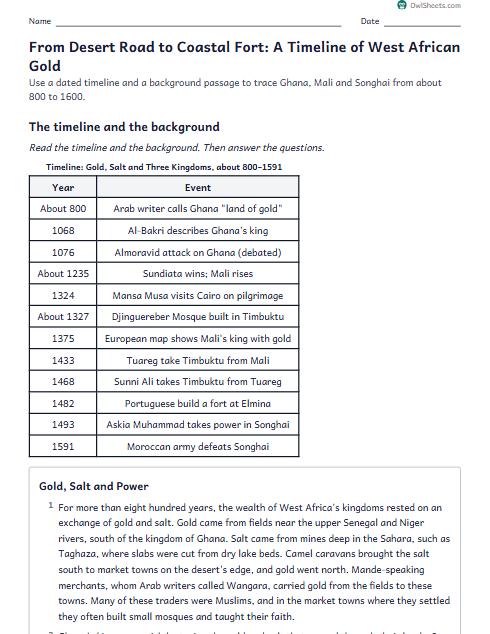
| Year | Event |
|---|---|
| About 800 | Arab writer calls Ghana "land of gold" |
| 1068 | Al-Bakri describes Ghana's king |
| 1076 | Almoravid attack on Ghana (debated) |
| About 1235 | Sundiata wins; Mali rises |
| 1324 | Mansa Musa visits Cairo on pilgrimage |
| About 1327 | Djinguereber Mosque built in Timbuktu |
| 1375 | European map shows Mali's king with gold |
| 1433 | Tuareg take Timbuktu from Mali |
| 1468 | Sunni Ali takes Timbuktu from Tuareg |
| 1482 | Portuguese build a fort at Elmina |
| 1493 | Askia Muhammad takes power in Songhai |
| 1591 | Moroccan army defeats Songhai |
Gold, Salt and Power
1For more than eight hundred years, the wealth of West Africa's kingdoms rested on an exchange of gold and salt. Gold came from fields near the upper Senegal and Niger rivers, south of the kingdom of Ghana. Salt came from mines deep in the Sahara, such as Taghaza, where slabs were cut from dry lake beds. Camel caravans brought the salt south to market towns on the desert's edge, and gold went north. Mande-speaking merchants, whom Arab writers called Wangara, carried gold from the fields to these towns. Many of these traders were Muslims, and in the market towns where they settled they often built small mosques and taught their faith.
2Ghana's kings grew rich by taxing the gold and salt that passed through their lands. In the late 1000s Ghana weakened. Later Arab writers said the Almoravids, Muslim warriors from the western Sahara, conquered it in 1076, but many historians today doubt that a conquest took place. According to the epic that griots still perform, Sundiata united the Malinke people and defeated a rival king about 1235. Mali grew to include gold fields of its own. Its most famous ruler, Mansa Musa, made the pilgrimage to Mecca in 1324 and spent so much gold in Cairo that writers there remembered it for years.
3Timbuktu sits near the great bend of the Niger River, where the desert meets the river. Caravans unloaded salt there, and boats carried it upriver to Djenné and other towns. Under Mali, the city gained the Djinguereber Mosque. Scholars came from North Africa and from across West Africa to teach. Paper and books arrived with the caravans from the north, and local scribes copied them by hand.
4Mali slowly weakened after Musa's time, as family members fought over the throne and outer lands broke away. Songhai, centered on the Niger city of Gao, rose next. Sunni Ali built an empire by conquest. Askia Muhammad, who seized power in 1493, divided the huge empire into provinces, each with a governor he appointed, and kept a full-time army. He made the pilgrimage to Mecca and welcomed scholars to Timbuktu.
5In 1471 Portuguese ships reached the coast Europeans later called the Gold Coast, and in 1482 they built a stone fort there at Elmina. Traders from the forest lands began selling gold to the Portuguese for cloth, brass and other goods, so some gold that had once gone north toward the Sahara now went south to the sea. In 1591 an army sent by the sultan of Morocco crossed the desert, and its soldiers' guns helped defeat Songhai. Songhai broke into smaller states. Moroccan officials ruled Timbuktu, and in 1593 they arrested many of its scholars and sent them north to Marrakesh.
Salt came from mines deep in the Sahara, such as Taghaza, where slabs were cut from dry lake beds.Camel caravans brought the salt south to market towns on the desert's edge, and gold went north.Mande-speaking merchants, whom Arab writers called Wangara, carried gold from the fields to these towns.Many of these traders were Muslims, and in the market towns where they settled they often built small mosques and taught their faith.
The preview shows the first questions. Unlock the worksheet to see all of it.
Related worksheets
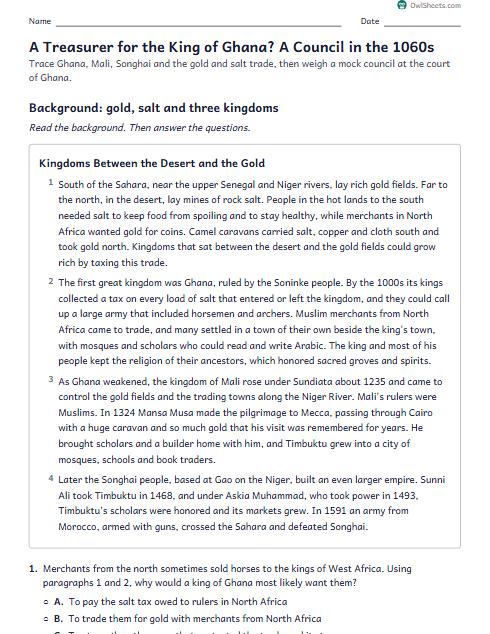
A Treasurer for the King of Ghana? A Council in the 1060s
Grade 7 · HIS.7.3
14 questionsPremium
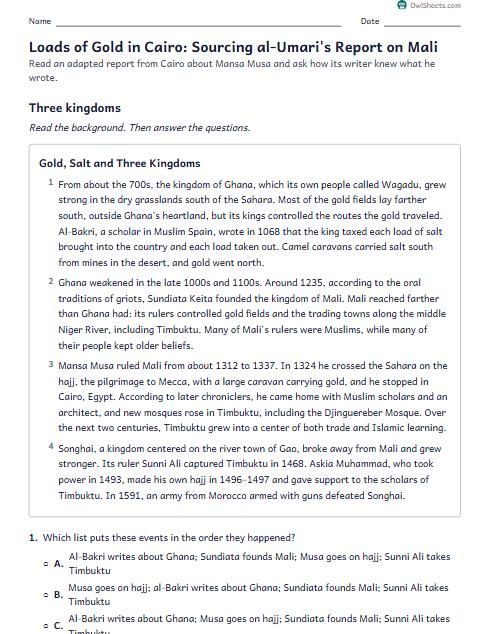
Loads of Gold in Cairo: Sourcing al-Umari's Report on Mali
Grade 7 · HIS.7.3
14 questionsPremium
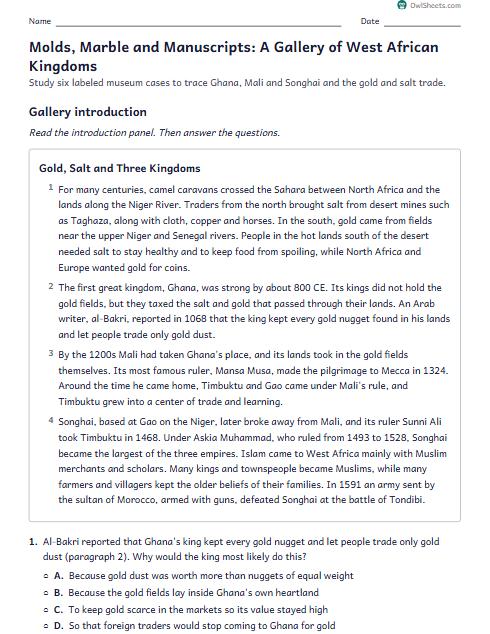
Molds, Marble and Manuscripts: A Gallery of West African Kingdoms
Grade 7 · HIS.7.3
14 questionsPremium
Hero or Tyrant? Two Memories of Sunni Ali
Grade 7 · HIS.7.3
14 questionsPremium
Counting Gold, Salt and Soldiers: Numbers from West African Sources
Grade 7 · HIS.7.3
11 questionsPremium
Mud Brick and Cowrie Shells: A Historian's Notebook from the Niger
Grade 7 · HIS.7.3
11 questionsFree