Grade 7 · Social StudiesHIS.7.3Premium
Hero or Tyrant? Two Memories of Sunni Ali
Grade 7 history: trace Ghana, Mali and Songhai and the gold and salt trade, then corroborate two accounts that remember Sunni Ali very differently.
Preview
OwlSheets.com
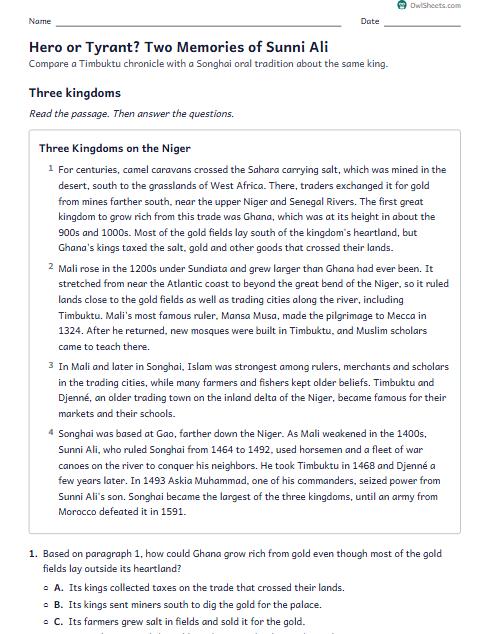
Hero or Tyrant? Two Memories of Sunni Ali
Compare a Timbuktu chronicle with a Songhai oral tradition about the same king.
Three kingdoms
Read the passage. Then answer the questions.
Three Kingdoms on the Niger
1For centuries, camel caravans crossed the Sahara carrying salt, which was mined in the desert, south to the grasslands of West Africa. There, traders exchanged it for gold from mines farther south, near the upper Niger and Senegal Rivers. The first great kingdom to grow rich from this trade was Ghana, which was at its height in about the 900s and 1000s. Most of the gold fields lay south of the kingdom's heartland, but Ghana's kings taxed the salt, gold and other goods that crossed their lands.
2Mali rose in the 1200s under Sundiata and grew larger than Ghana had ever been. It stretched from near the Atlantic coast to beyond the great bend of the Niger, so it ruled lands close to the gold fields as well as trading cities along the river, including Timbuktu. Mali's most famous ruler, Mansa Musa, made the pilgrimage to Mecca in 1324. After he returned, new mosques were built in Timbuktu, and Muslim scholars came to teach there.
3In Mali and later in Songhai, Islam was strongest among rulers, merchants and scholars in the trading cities, while many farmers and fishers kept older beliefs. Timbuktu and Djenné, an older trading town on the inland delta of the Niger, became famous for their markets and their schools.
4Songhai was based at Gao, farther down the Niger. As Mali weakened in the 1400s, Sunni Ali, who ruled Songhai from 1464 to 1492, used horsemen and a fleet of war canoes on the river to conquer his neighbors. He took Timbuktu in 1468 and Djenné a few years later. In 1493 Askia Muhammad, one of his commanders, seized power from Sunni Ali's son. Songhai became the largest of the three kingdoms, until an army from Morocco defeated it in 1591.
- A. Its kings collected taxes on the trade that crossed their lands.
- B. Its kings sent miners south to dig the gold for the palace.
- C. Its farmers grew salt in fields and sold it for the gold.
- D. Its traders carried the gold north across the desert themselves.
- A. It moved the gold trade away from the Niger to the Atlantic coast.
- B. It ruled both lands near the gold fields and the river trading cities.
- C. It found salt mines inside its own lands near the Senegal River.
- D. It ended the salt trade so that gold would be its only export.
The preview shows the first questions. Unlock the worksheet to see all of it.
Related worksheets
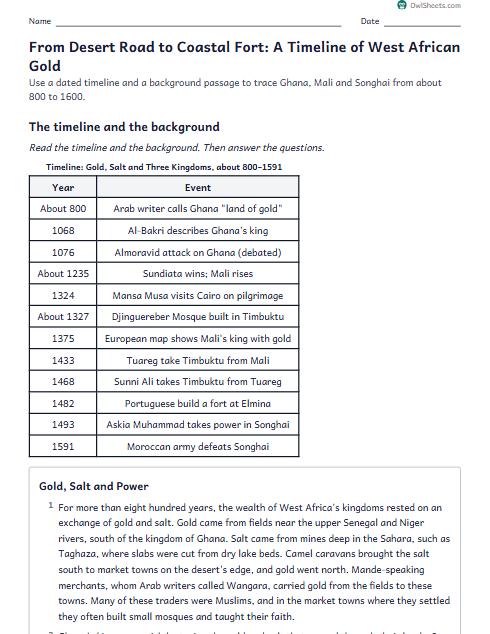
From Desert Road to Coastal Fort: A Timeline of West African Gold
Grade 7 · HIS.7.3
13 questionsPremium
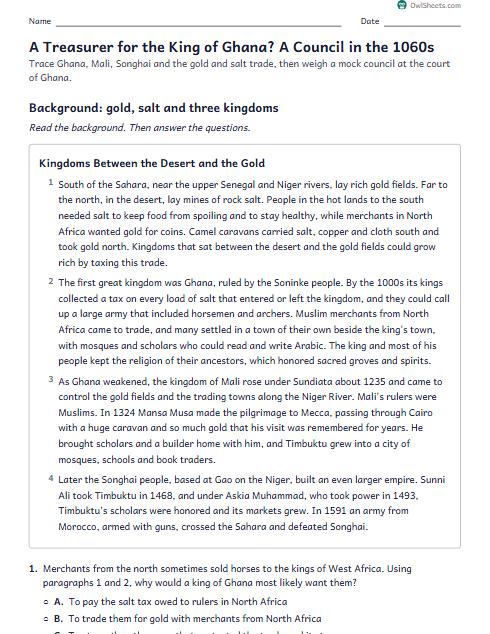
A Treasurer for the King of Ghana? A Council in the 1060s
Grade 7 · HIS.7.3
14 questionsPremium
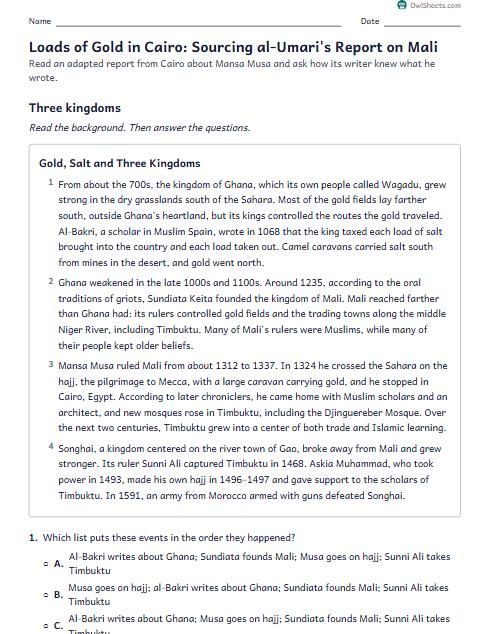
Loads of Gold in Cairo: Sourcing al-Umari's Report on Mali
Grade 7 · HIS.7.3
14 questionsPremium
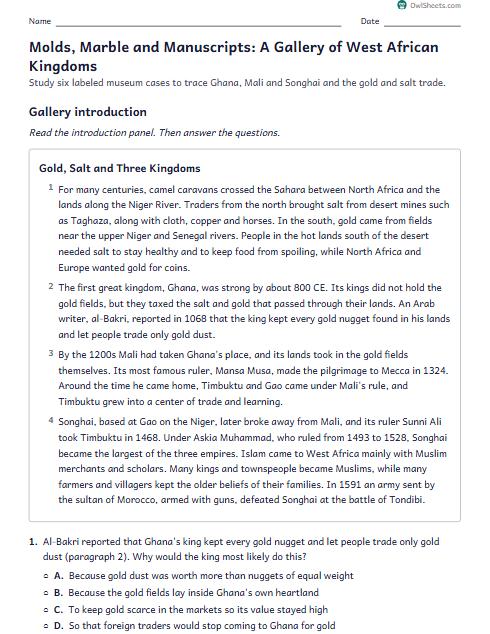
Molds, Marble and Manuscripts: A Gallery of West African Kingdoms
Grade 7 · HIS.7.3
14 questionsPremium
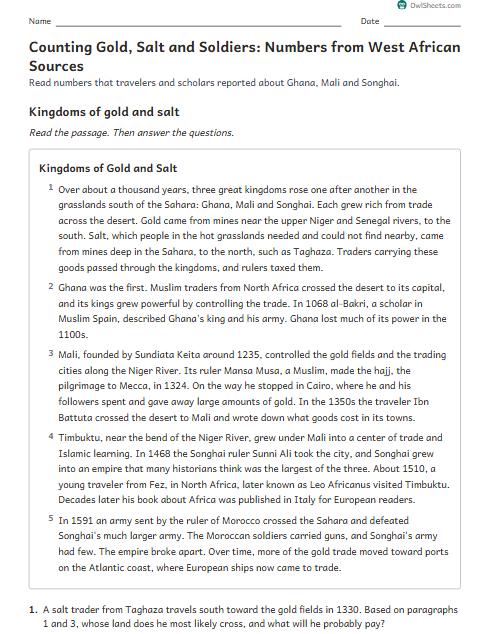
Counting Gold, Salt and Soldiers: Numbers from West African Sources
Grade 7 · HIS.7.3
11 questionsPremium
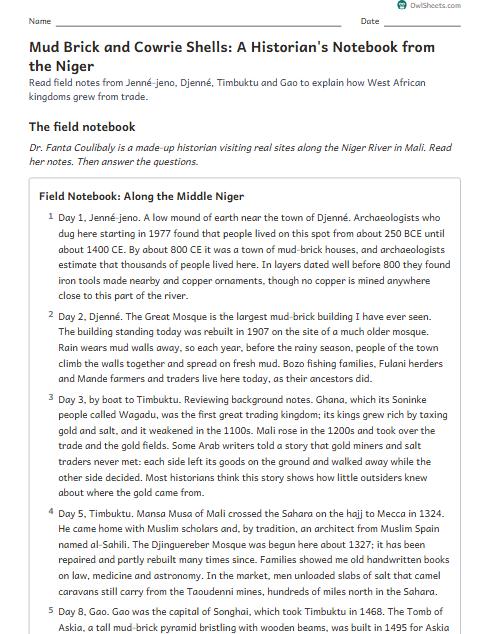
Mud Brick and Cowrie Shells: A Historian's Notebook from the Niger
Grade 7 · HIS.7.3
11 questionsFree