Grade 7 · Social StudiesHIS.7.3Premium
Molds, Marble and Manuscripts: A Gallery of West African Kingdoms
Grade 7 history: six museum cases, from Tadmekka coin molds to a Moroccan gold coin, show Ghana, Mali, Songhai, Mansa Musa, Timbuktu and the gold-salt trade.
Preview
OwlSheets.com
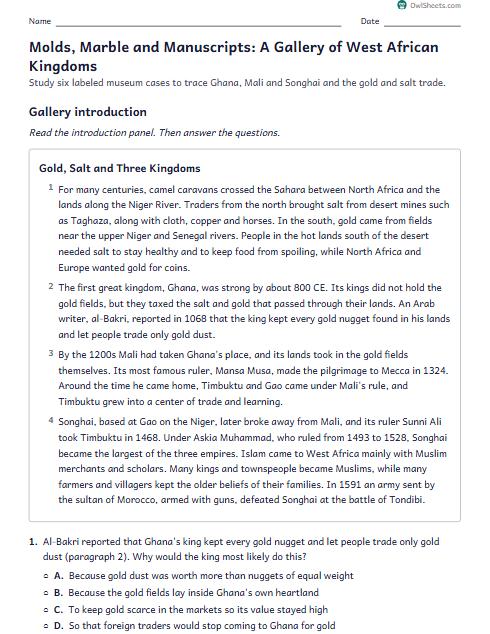
Molds, Marble and Manuscripts: A Gallery of West African Kingdoms
Study six labeled museum cases to trace Ghana, Mali and Songhai and the gold and salt trade.
Gallery introduction
Read the introduction panel. Then answer the questions.
Gold, Salt and Three Kingdoms
1For many centuries, camel caravans crossed the Sahara between North Africa and the lands along the Niger River. Traders from the north brought salt from desert mines such as Taghaza, along with cloth, copper and horses. In the south, gold came from fields near the upper Niger and Senegal rivers. People in the hot lands south of the desert needed salt to stay healthy and to keep food from spoiling, while North Africa and Europe wanted gold for coins.
2The first great kingdom, Ghana, was strong by about 800 CE. Its kings did not hold the gold fields, but they taxed the salt and gold that passed through their lands. An Arab writer, al-Bakri, reported in 1068 that the king kept every gold nugget found in his lands and let people trade only gold dust.
3By the 1200s Mali had taken Ghana's place, and its lands took in the gold fields themselves. Its most famous ruler, Mansa Musa, made the pilgrimage to Mecca in 1324. Around the time he came home, Timbuktu and Gao came under Mali's rule, and Timbuktu grew into a center of trade and learning.
4Songhai, based at Gao on the Niger, later broke away from Mali, and its ruler Sunni Ali took Timbuktu in 1468. Under Askia Muhammad, who ruled from 1493 to 1528, Songhai became the largest of the three empires. Islam came to West Africa mainly with Muslim merchants and scholars. Many kings and townspeople became Muslims, while many farmers and villagers kept the older beliefs of their families. In 1591 an army sent by the sultan of Morocco, armed with guns, defeated Songhai at the battle of Tondibi.
- A. Because gold dust was worth more than nuggets of equal weight
- B. Because the gold fields lay inside Ghana's own heartland
- C. To keep gold scarce in the markets so its value stayed high
- D. So that foreign traders would stop coming to Ghana for gold
Under Askia Muhammad, who ruled from 1493 to 1528, Songhai became the largest of the three empires.Islam came to West Africa mainly with Muslim merchants and scholars.Many kings and townspeople became Muslims, while many farmers and villagers kept the older beliefs of their families.In 1591 an army sent by the sultan of Morocco, armed with guns, defeated Songhai at the battle of Tondibi.
The preview shows the first questions. Unlock the worksheet to see all of it.
Related worksheets
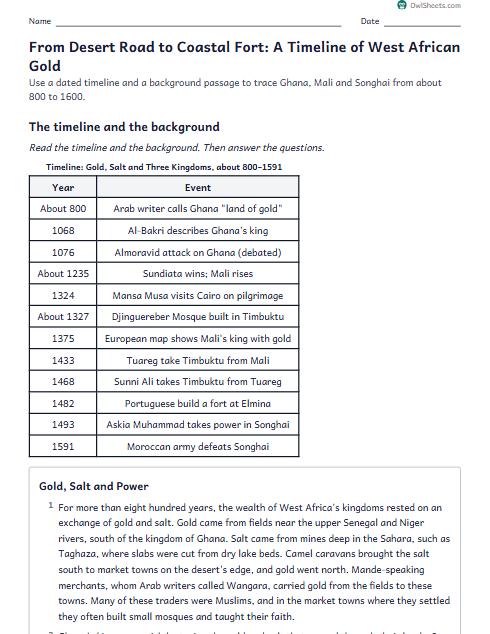
From Desert Road to Coastal Fort: A Timeline of West African Gold
Grade 7 · HIS.7.3
13 questionsPremium
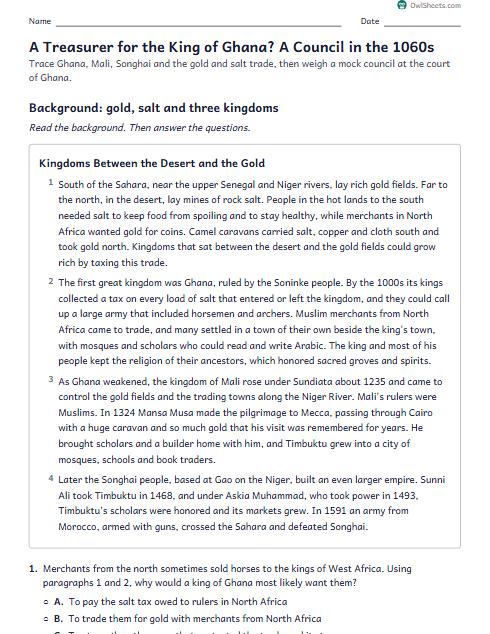
A Treasurer for the King of Ghana? A Council in the 1060s
Grade 7 · HIS.7.3
14 questionsPremium
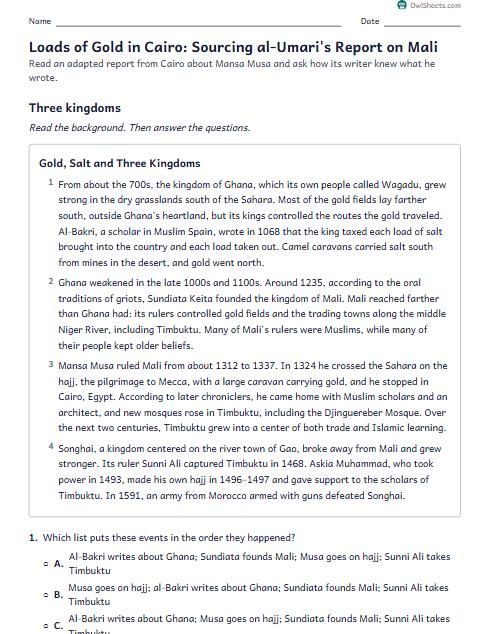
Loads of Gold in Cairo: Sourcing al-Umari's Report on Mali
Grade 7 · HIS.7.3
14 questionsPremium
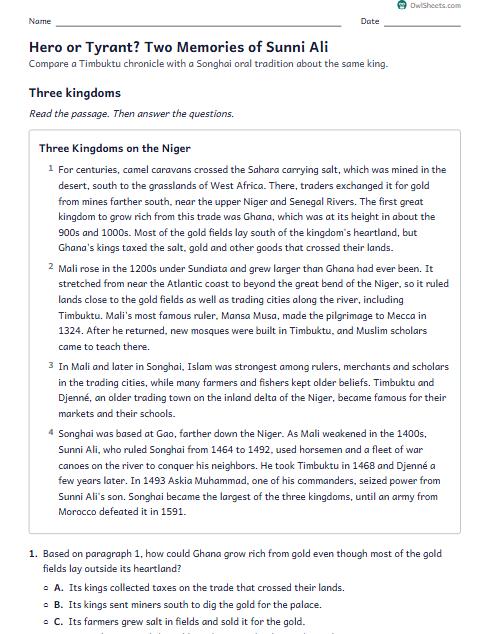
Hero or Tyrant? Two Memories of Sunni Ali
Grade 7 · HIS.7.3
14 questionsPremium
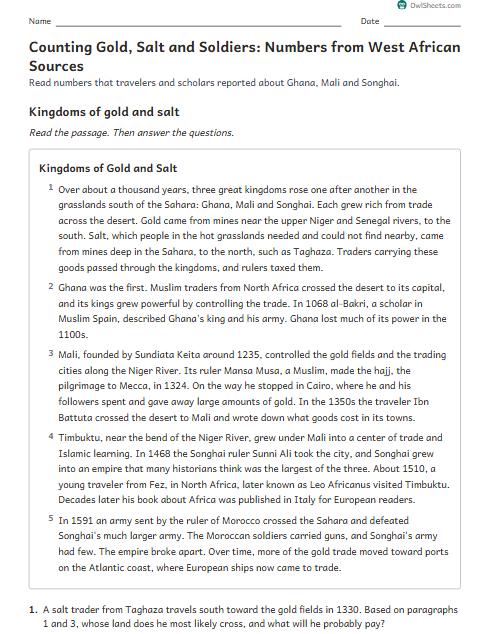
Counting Gold, Salt and Soldiers: Numbers from West African Sources
Grade 7 · HIS.7.3
11 questionsPremium
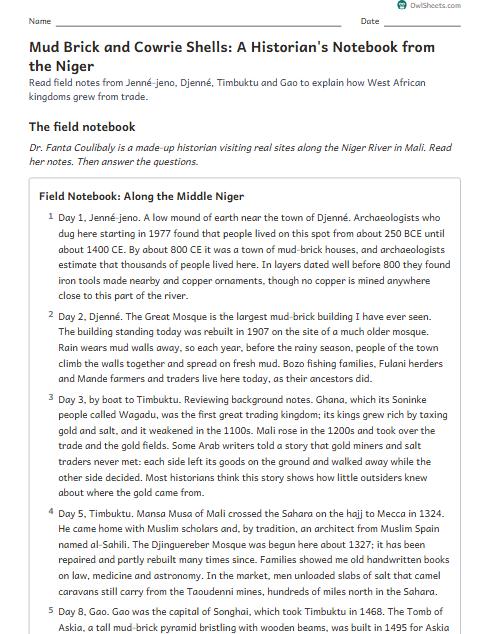
Mud Brick and Cowrie Shells: A Historian's Notebook from the Niger
Grade 7 · HIS.7.3
11 questionsFree