Grade 7 · Social StudiesHIS.7.3Premium
A Treasurer for the King of Ghana? A Council in the 1060s
Grade 7 history: trace Ghana, Mali, Songhai, Mansa Musa and Timbuktu, then weigh a mock Ghana council on naming a Muslim merchant-scholar treasurer.
Preview
OwlSheets.com
A Treasurer for the King of Ghana? A Council in the 1060s
Trace Ghana, Mali, Songhai and the gold and salt trade, then weigh a mock council at the court of Ghana.
Background: gold, salt and three kingdoms
Read the background. Then answer the questions.
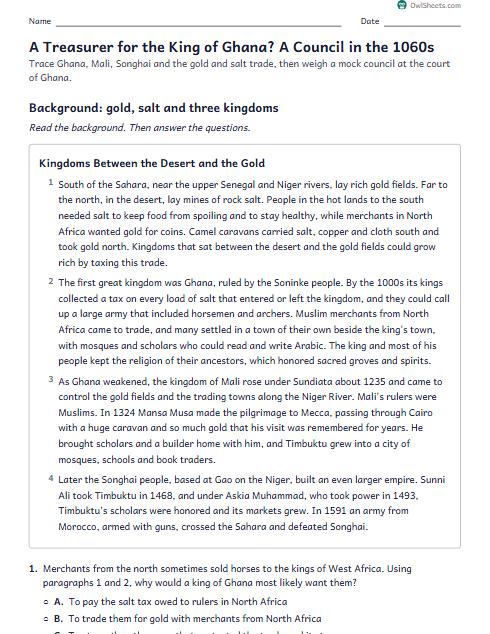
Kingdoms Between the Desert and the Gold
1South of the Sahara, near the upper Senegal and Niger rivers, lay rich gold fields. Far to the north, in the desert, lay mines of rock salt. People in the hot lands to the south needed salt to keep food from spoiling and to stay healthy, while merchants in North Africa wanted gold for coins. Camel caravans carried salt, copper and cloth south and took gold north. Kingdoms that sat between the desert and the gold fields could grow rich by taxing this trade.
2The first great kingdom was Ghana, ruled by the Soninke people. By the 1000s its kings collected a tax on every load of salt that entered or left the kingdom, and they could call up a large army that included horsemen and archers. Muslim merchants from North Africa came to trade, and many settled in a town of their own beside the king's town, with mosques and scholars who could read and write Arabic. The king and most of his people kept the religion of their ancestors, which honored sacred groves and spirits.
3As Ghana weakened, the kingdom of Mali rose under Sundiata about 1235 and came to control the gold fields and the trading towns along the Niger River. Mali's rulers were Muslims. In 1324 Mansa Musa made the pilgrimage to Mecca, passing through Cairo with a huge caravan and so much gold that his visit was remembered for years. He brought scholars and a builder home with him, and Timbuktu grew into a city of mosques, schools and book traders.
4Later the Songhai people, based at Gao on the Niger, built an even larger empire. Sunni Ali took Timbuktu in 1468, and under Askia Muhammad, who took power in 1493, Timbuktu's scholars were honored and its markets grew. In 1591 an army from Morocco, armed with guns, crossed the Sahara and defeated Songhai.
- A. To pay the salt tax owed to rulers in North Africa
- B. To trade them for gold with merchants from North Africa
- C. To strengthen the army that protected the trade and its taxes
- D. To carry the heavy salt slabs across the desert himself
- A. With Mansa Musa when he came home from Mecca
- B. With traders from the north who settled near the king
- C. With Ghana's army when it conquered North Africa
- D. With Sundiata's armies when Mali rose to power
The preview shows the first questions. Unlock the worksheet to see all of it.
Related worksheets
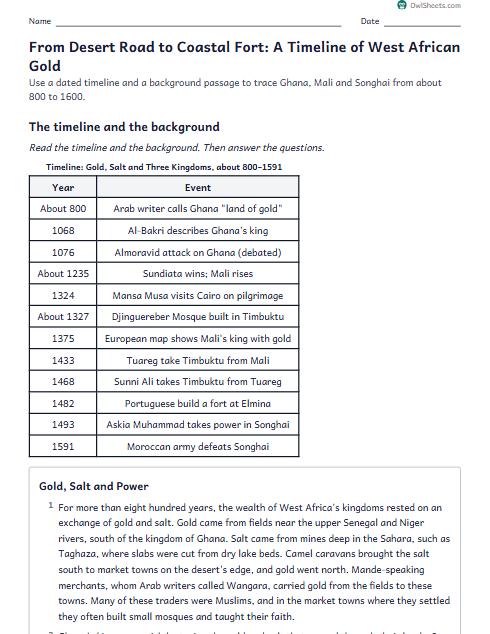
From Desert Road to Coastal Fort: A Timeline of West African Gold
Grade 7 · HIS.7.3
13 questionsPremium
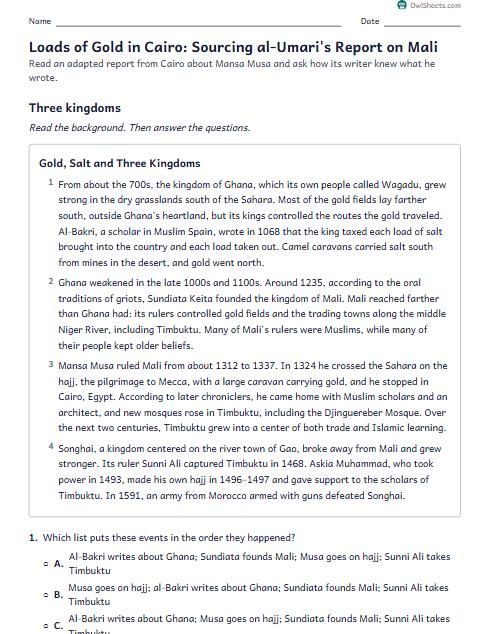
Loads of Gold in Cairo: Sourcing al-Umari's Report on Mali
Grade 7 · HIS.7.3
14 questionsPremium
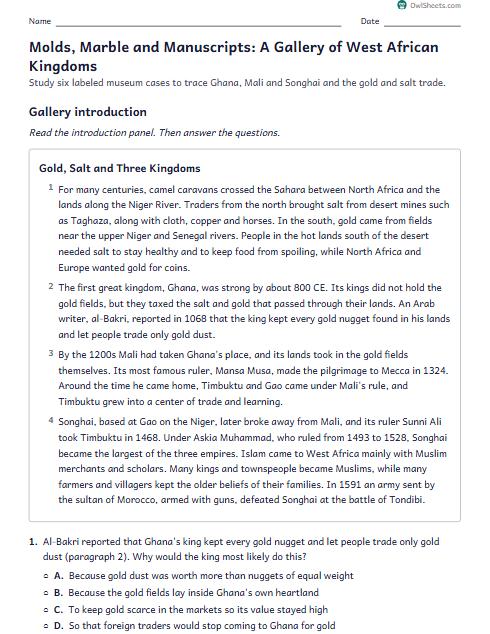
Molds, Marble and Manuscripts: A Gallery of West African Kingdoms
Grade 7 · HIS.7.3
14 questionsPremium
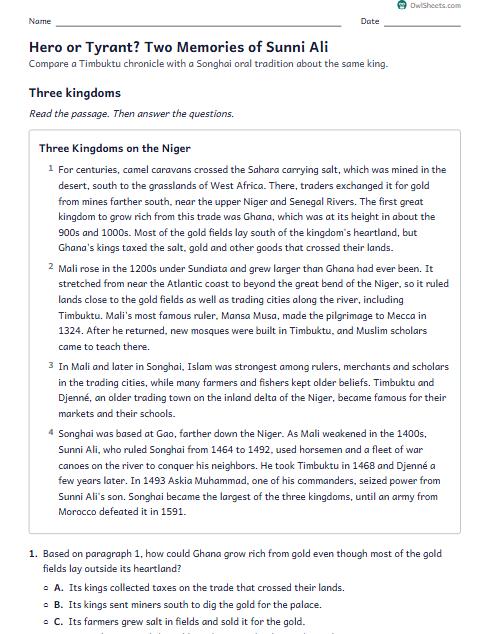
Hero or Tyrant? Two Memories of Sunni Ali
Grade 7 · HIS.7.3
14 questionsPremium
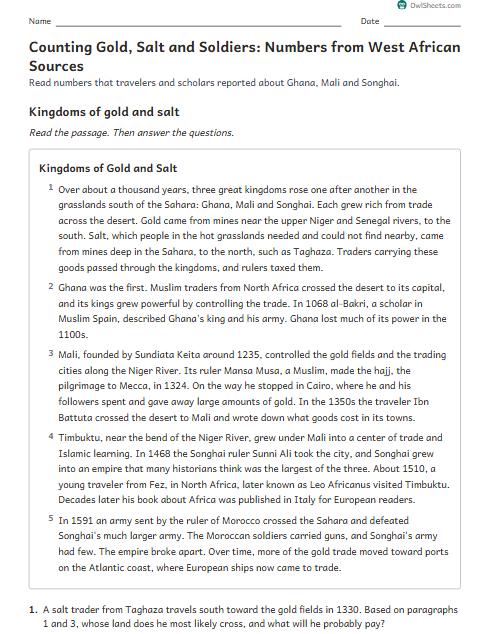
Counting Gold, Salt and Soldiers: Numbers from West African Sources
Grade 7 · HIS.7.3
11 questionsPremium
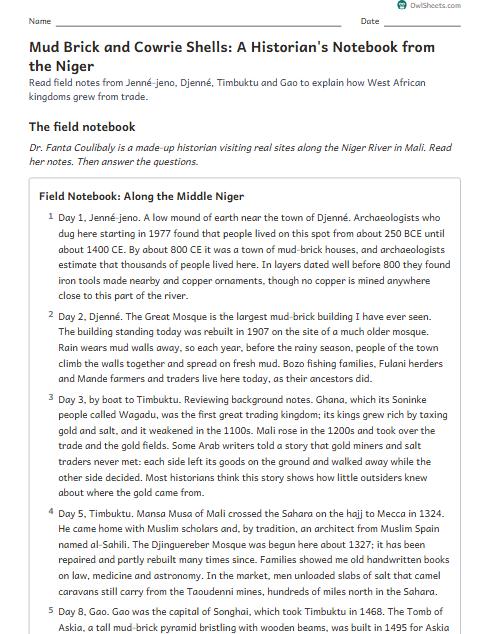
Mud Brick and Cowrie Shells: A Historian's Notebook from the Niger
Grade 7 · HIS.7.3
11 questionsFree