Grade 7 · Social StudiesHIS.7.3Premium
Loads of Gold in Cairo: Sourcing al-Umari's Report on Mali
Grade 7 history: trace Ghana, Mali and Songhai, then source an adapted Cairo report on Mansa Musa's 1324 visit, his gold and the gold and salt trade.
Preview
OwlSheets.com
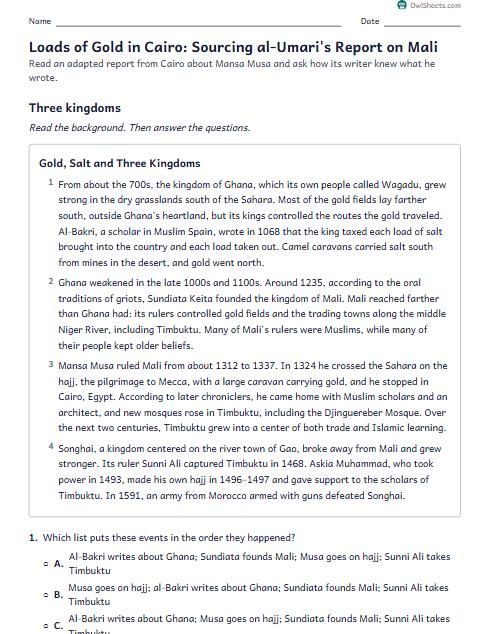
Loads of Gold in Cairo: Sourcing al-Umari's Report on Mali
Read an adapted report from Cairo about Mansa Musa and ask how its writer knew what he wrote.
Three kingdoms
Read the background. Then answer the questions.
Gold, Salt and Three Kingdoms
1From about the 700s, the kingdom of Ghana, which its own people called Wagadu, grew strong in the dry grasslands south of the Sahara. Most of the gold fields lay farther south, outside Ghana's heartland, but its kings controlled the routes the gold traveled. Al-Bakri, a scholar in Muslim Spain, wrote in 1068 that the king taxed each load of salt brought into the country and each load taken out. Camel caravans carried salt south from mines in the desert, and gold went north.
2Ghana weakened in the late 1000s and 1100s. Around 1235, according to the oral traditions of griots, Sundiata Keita founded the kingdom of Mali. Mali reached farther than Ghana had: its rulers controlled gold fields and the trading towns along the middle Niger River, including Timbuktu. Many of Mali's rulers were Muslims, while many of their people kept older beliefs.
3Mansa Musa ruled Mali from about 1312 to 1337. In 1324 he crossed the Sahara on the hajj, the pilgrimage to Mecca, with a large caravan carrying gold, and he stopped in Cairo, Egypt. According to later chroniclers, he came home with Muslim scholars and an architect, and new mosques rose in Timbuktu, including the Djinguereber Mosque. Over the next two centuries, Timbuktu grew into a center of both trade and Islamic learning.
4Songhai, a kingdom centered on the river town of Gao, broke away from Mali and grew stronger. Its ruler Sunni Ali captured Timbuktu in 1468. Askia Muhammad, who took power in 1493, made his own hajj in 1496–1497 and gave support to the scholars of Timbuktu. In 1591, an army from Morocco armed with guns defeated Songhai.
- A. Al-Bakri writes about Ghana; Sundiata founds Mali; Musa goes on hajj; Sunni Ali takes Timbuktu
- B. Musa goes on hajj; al-Bakri writes about Ghana; Sundiata founds Mali; Sunni Ali takes Timbuktu
- C. Al-Bakri writes about Ghana; Musa goes on hajj; Sundiata founds Mali; Sunni Ali takes Timbuktu
- D. Sundiata founds Mali; al-Bakri writes about Ghana; Sunni Ali takes Timbuktu; Musa goes on hajj
- A. A treaty that kept Morocco's army out of their lands
- B. New gold fields in Egypt to add to their own
- C. Control of the salt mines on the way to Mecca
- D. Fame and ties with scholars of distant Muslim lands
The preview shows the first questions. Unlock the worksheet to see all of it.
Related worksheets
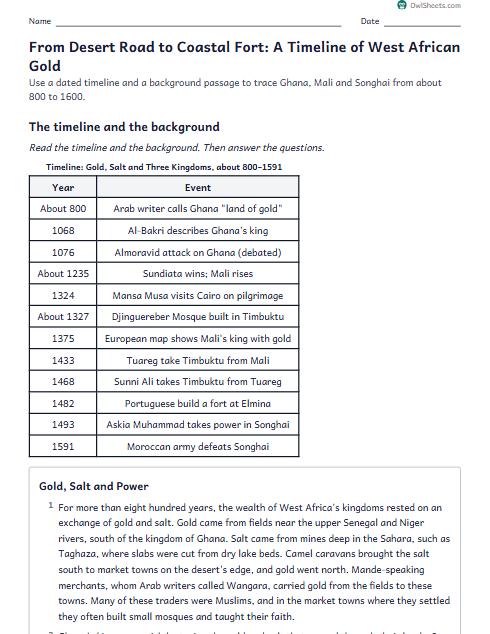
From Desert Road to Coastal Fort: A Timeline of West African Gold
Grade 7 · HIS.7.3
13 questionsPremium
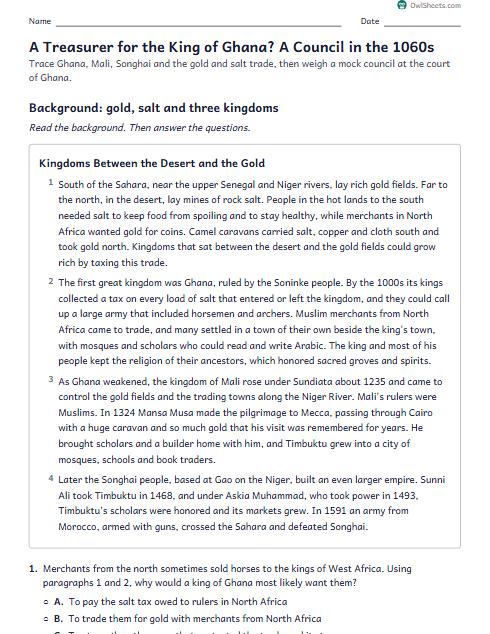
A Treasurer for the King of Ghana? A Council in the 1060s
Grade 7 · HIS.7.3
14 questionsPremium
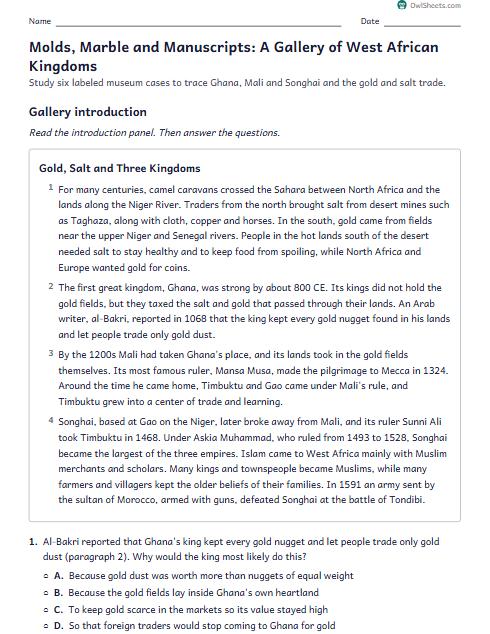
Molds, Marble and Manuscripts: A Gallery of West African Kingdoms
Grade 7 · HIS.7.3
14 questionsPremium
Hero or Tyrant? Two Memories of Sunni Ali
Grade 7 · HIS.7.3
14 questionsPremium
Counting Gold, Salt and Soldiers: Numbers from West African Sources
Grade 7 · HIS.7.3
11 questionsPremium
Mud Brick and Cowrie Shells: A Historian's Notebook from the Niger
Grade 7 · HIS.7.3
11 questionsFree