Grade 7 · Social StudiesHIS.7.4Premium
Loans for Farmers? The Song Court Debates Wang Anshi's Plan
Grade 7 history: review Tang and Song inventions, the Mongols and Japan's shoguns, then weigh a mock Song court debate on Wang Anshi's New Policies.
Preview
OwlSheets.com
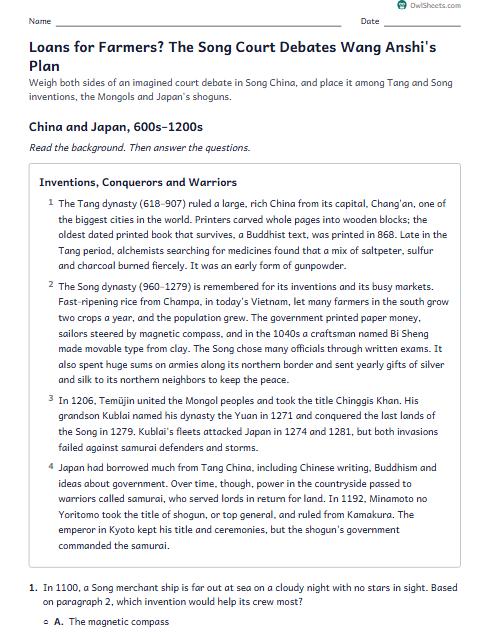
Loans for Farmers? The Song Court Debates Wang Anshi's Plan
Weigh both sides of an imagined court debate in Song China, and place it among Tang and Song inventions, the Mongols and Japan's shoguns.
China and Japan, 600s–1200s
Read the background. Then answer the questions.
Inventions, Conquerors and Warriors
1The Tang dynasty (618–907) ruled a large, rich China from its capital, Chang'an, one of the biggest cities in the world. Printers carved whole pages into wooden blocks; the oldest dated printed book that survives, a Buddhist text, was printed in 868. Late in the Tang period, alchemists searching for medicines found that a mix of saltpeter, sulfur and charcoal burned fiercely. It was an early form of gunpowder.
2The Song dynasty (960–1279) is remembered for its inventions and its busy markets. Fast-ripening rice from Champa, in today's Vietnam, let many farmers in the south grow two crops a year, and the population grew. The government printed paper money, sailors steered by magnetic compass, and in the 1040s a craftsman named Bi Sheng made movable type from clay. The Song chose many officials through written exams. It also spent huge sums on armies along its northern border and sent yearly gifts of silver and silk to its northern neighbors to keep the peace.
3In 1206, Temüjin united the Mongol peoples and took the title Chinggis Khan. His grandson Kublai named his dynasty the Yuan in 1271 and conquered the last lands of the Song in 1279. Kublai's fleets attacked Japan in 1274 and 1281, but both invasions failed against samurai defenders and storms.
4Japan had borrowed much from Tang China, including Chinese writing, Buddhism and ideas about government. Over time, though, power in the countryside passed to warriors called samurai, who served lords in return for land. In 1192, Minamoto no Yoritomo took the title of shogun, or top general, and ruled from Kamakura. The emperor in Kyoto kept his title and ceremonies, but the shogun's government commanded the samurai.
- A. The magnetic compass
- B. Fast-ripening rice
- C. Movable clay type
- D. Printed paper money
After 1192, the in Kyoto kept his title and ceremonies, but the in Kamakura commanded the warriors. These warriors, the , served their lords in return for land.
The preview shows the first questions. Unlock the worksheet to see all of it.
Related worksheets
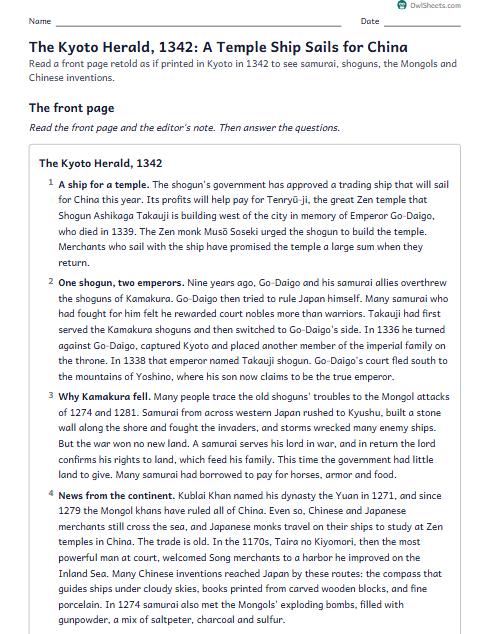
The Kyoto Herald, 1342: A Temple Ship Sails for China
Grade 7 · HIS.7.4
13 questionsPremium
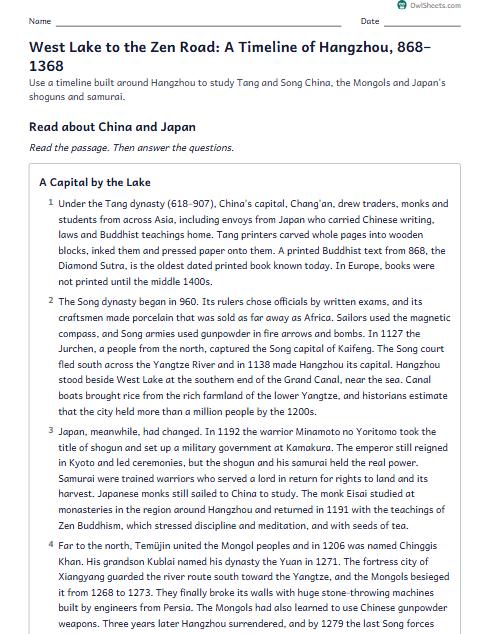
West Lake to the Zen Road: A Timeline of Hangzhou, 868–1368
Grade 7 · HIS.7.4
14 questionsPremium
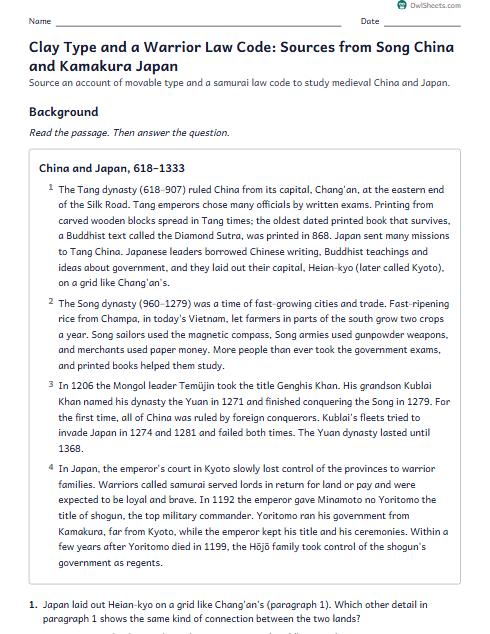
Clay Type and a Warrior Law Code: Sources from Song China and Kamakura Japan
Grade 7 · HIS.7.4
14 questionsPremium
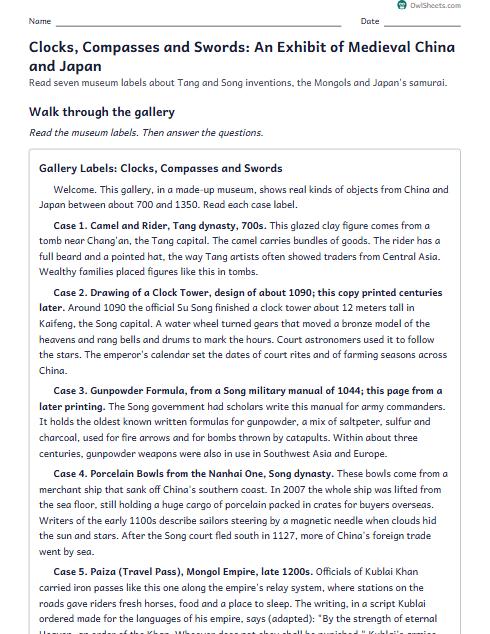
Clocks, Compasses and Swords: An Exhibit of Medieval China and Japan
Grade 7 · HIS.7.4
14 questionsPremium
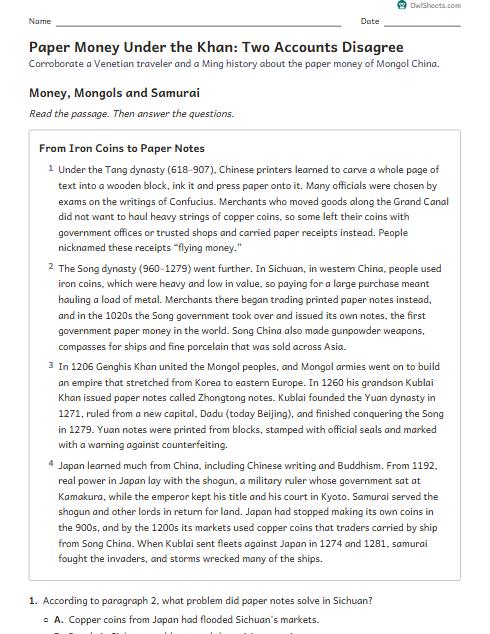
Paper Money Under the Khan: Two Accounts Disagree
Grade 7 · HIS.7.4
12 questionsPremium
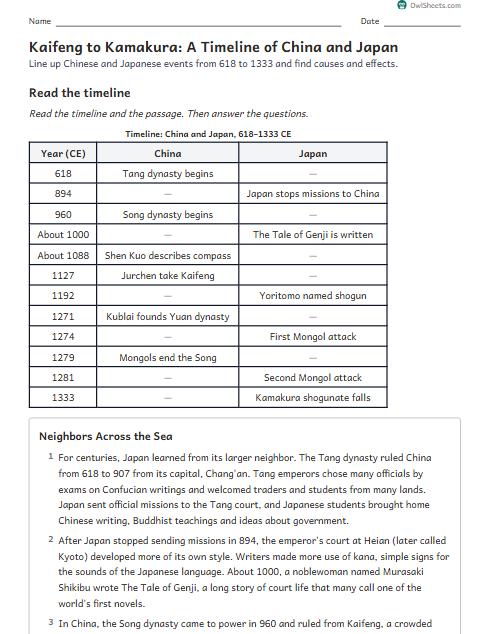
Kaifeng to Kamakura: A Timeline of China and Japan
Grade 7 · HIS.7.4
11 questionsPremium