Grade 7 · Social StudiesHIS.7.4Premium
Clay Type and a Warrior Law Code: Sources from Song China and Kamakura Japan
Grade 7 history: source Shen Kuo's account of Bi Sheng's movable type and the 1232 samurai law code to study Tang, Song, Mongol China and Japan's shoguns.
Preview
OwlSheets.com
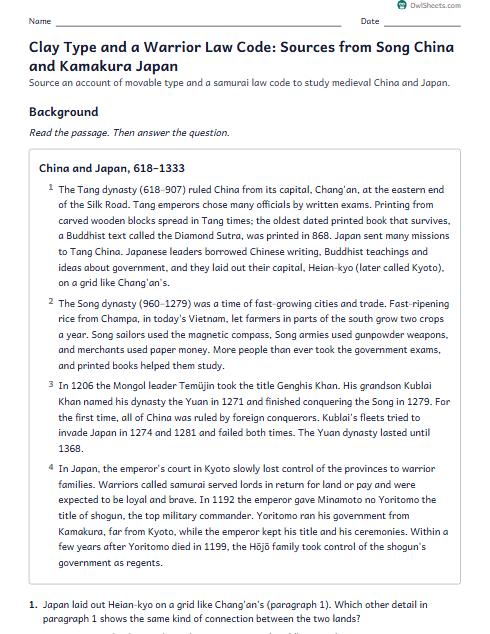
Clay Type and a Warrior Law Code: Sources from Song China and Kamakura Japan
Source an account of movable type and a samurai law code to study medieval China and Japan.
Background
Read the passage. Then answer the question.
China and Japan, 618–1333
1The Tang dynasty (618–907) ruled China from its capital, Chang'an, at the eastern end of the Silk Road. Tang emperors chose many officials by written exams. Printing from carved wooden blocks spread in Tang times; the oldest dated printed book that survives, a Buddhist text called the Diamond Sutra, was printed in 868. Japan sent many missions to Tang China. Japanese leaders borrowed Chinese writing, Buddhist teachings and ideas about government, and they laid out their capital, Heian-kyo (later called Kyoto), on a grid like Chang'an's.
2The Song dynasty (960–1279) was a time of fast-growing cities and trade. Fast-ripening rice from Champa, in today's Vietnam, let farmers in parts of the south grow two crops a year. Song sailors used the magnetic compass, Song armies used gunpowder weapons, and merchants used paper money. More people than ever took the government exams, and printed books helped them study.
3In 1206 the Mongol leader Temüjin took the title Genghis Khan. His grandson Kublai Khan named his dynasty the Yuan in 1271 and finished conquering the Song in 1279. For the first time, all of China was ruled by foreign conquerors. Kublai's fleets tried to invade Japan in 1274 and 1281 and failed both times. The Yuan dynasty lasted until 1368.
4In Japan, the emperor's court in Kyoto slowly lost control of the provinces to warrior families. Warriors called samurai served lords in return for land or pay and were expected to be loyal and brave. In 1192 the emperor gave Minamoto no Yoritomo the title of shogun, the top military commander. Yoritomo ran his government from Kamakura, far from Kyoto, while the emperor kept his title and his ceremonies. Within a few years after Yoritomo died in 1199, the Hōjō family took control of the shogun's government as regents.
- A. Japanese leaders took up Chinese writing and Buddhist teachings.
- B. Chang'an stood at the eastern end of the Silk Road.
- C. The Diamond Sutra was printed in China in the year 868.
- D. Tang emperors chose many officials by written exams.
The preview shows the first questions. Unlock the worksheet to see all of it.
Related worksheets
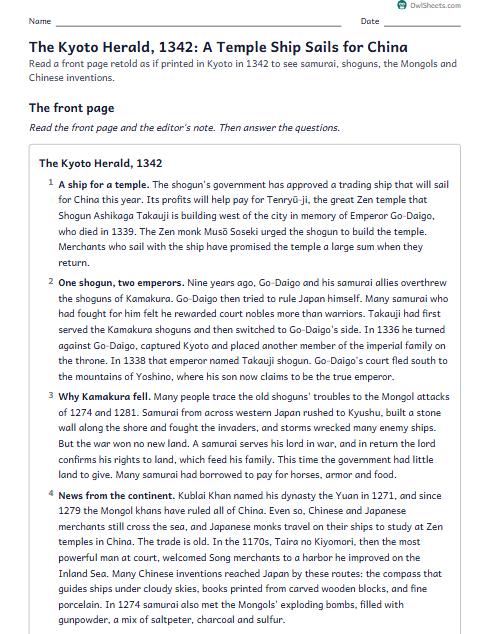
The Kyoto Herald, 1342: A Temple Ship Sails for China
Grade 7 · HIS.7.4
13 questionsPremium
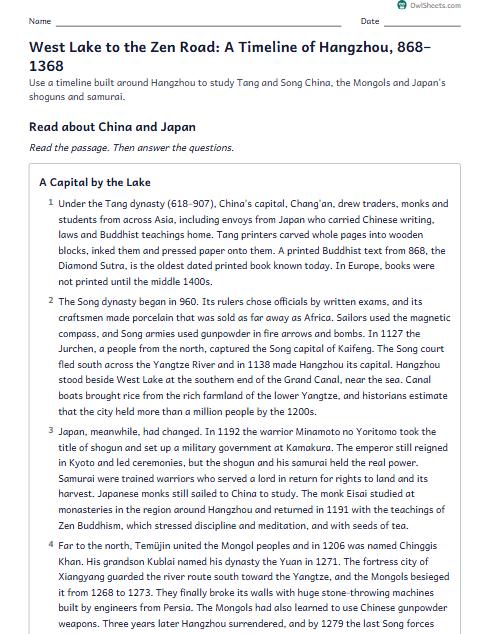
West Lake to the Zen Road: A Timeline of Hangzhou, 868–1368
Grade 7 · HIS.7.4
14 questionsPremium
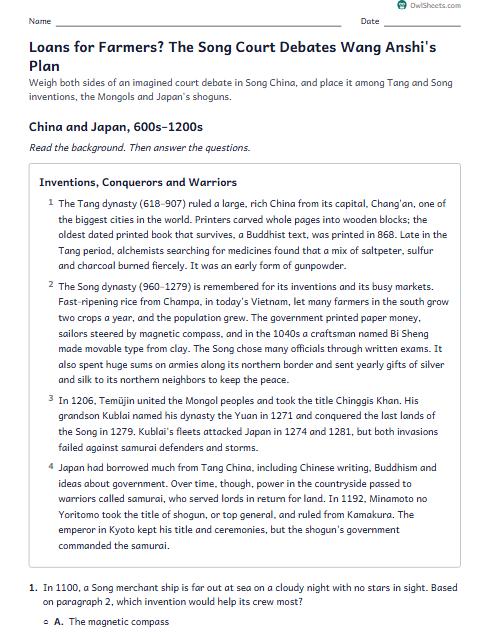
Loans for Farmers? The Song Court Debates Wang Anshi's Plan
Grade 7 · HIS.7.4
14 questionsPremium
Clocks, Compasses and Swords: An Exhibit of Medieval China and Japan
Grade 7 · HIS.7.4
14 questionsPremium
Paper Money Under the Khan: Two Accounts Disagree
Grade 7 · HIS.7.4
12 questionsPremium
Kaifeng to Kamakura: A Timeline of China and Japan
Grade 7 · HIS.7.4
11 questionsPremium