Grade 7 · Social StudiesHIS.7.4Premium
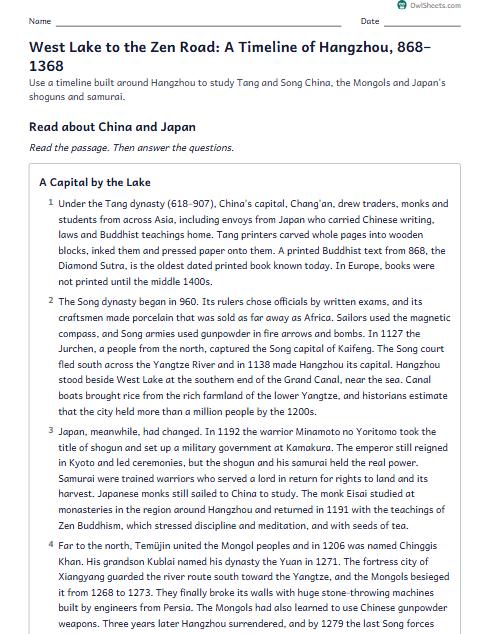
West Lake to the Zen Road: A Timeline of Hangzhou, 868–1368
Grade 7 history: a timeline centered on Hangzhou links Tang printing, Song China, the Mongol conquest and Zen monks in Japan under the shoguns.
Preview
OwlSheets.com
West Lake to the Zen Road: A Timeline of Hangzhou, 868–1368
Use a timeline built around Hangzhou to study Tang and Song China, the Mongols and Japan's shoguns and samurai.
Read about China and Japan
Read the passage. Then answer the questions.
A Capital by the Lake
1Under the Tang dynasty (618–907), China's capital, Chang'an, drew traders, monks and students from across Asia, including envoys from Japan who carried Chinese writing, laws and Buddhist teachings home. Tang printers carved whole pages into wooden blocks, inked them and pressed paper onto them. A printed Buddhist text from 868, the Diamond Sutra, is the oldest dated printed book known today. In Europe, books were not printed until the middle 1400s.
2The Song dynasty began in 960. Its rulers chose officials by written exams, and its craftsmen made porcelain that was sold as far away as Africa. Sailors used the magnetic compass, and Song armies used gunpowder in fire arrows and bombs. In 1127 the Jurchen, a people from the north, captured the Song capital of Kaifeng. The Song court fled south across the Yangtze River and in 1138 made Hangzhou its capital. Hangzhou stood beside West Lake at the southern end of the Grand Canal, near the sea. Canal boats brought rice from the rich farmland of the lower Yangtze, and historians estimate that the city held more than a million people by the 1200s.
3Japan, meanwhile, had changed. In 1192 the warrior Minamoto no Yoritomo took the title of shogun and set up a military government at Kamakura. The emperor still reigned in Kyoto and led ceremonies, but the shogun and his samurai held the real power. Samurai were trained warriors who served a lord in return for rights to land and its harvest. Japanese monks still sailed to China to study. The monk Eisai studied at monasteries in the region around Hangzhou and returned in 1191 with the teachings of Zen Buddhism, which stressed discipline and meditation, and with seeds of tea.
4Far to the north, Temüjin united the Mongol peoples and in 1206 was named Chinggis Khan. His grandson Kublai named his dynasty the Yuan in 1271. The fortress city of Xiangyang guarded the river route south toward the Yangtze, and the Mongols besieged it from 1268 to 1273. They finally broke its walls with huge stone-throwing machines built by engineers from Persia. The Mongols had also learned to use Chinese gunpowder weapons. Three years later Hangzhou surrendered, and by 1279 the last Song forces were defeated. Kublai then sent fleets against Japan, but samurai and storms turned them back. In the 1280s the Venetian Marco Polo described Hangzhou's canals, bridges and markets as the finest he had seen. In 1368 the Ming dynasty drove the Yuan out of China.
- A. Printers could already make many copies of a text centuries before Europe.
- B. Printers already used movable metal type for most books they made.
- C. Printed books were sold mostly to traders from Europe and Persia.
- D. Printing was used for Buddhist texts and was forbidden for others.
- A. It lay north of Kaifeng and close to the Jurchen homeland.
- B. It lay south of the Yangtze and was fed by the Grand Canal.
- C. It lay near Japan and could be defended by the samurai.
- D. It lay in the mountains, far from any river or the sea.
The preview shows the first questions. Unlock the worksheet to see all of it.
Related worksheets
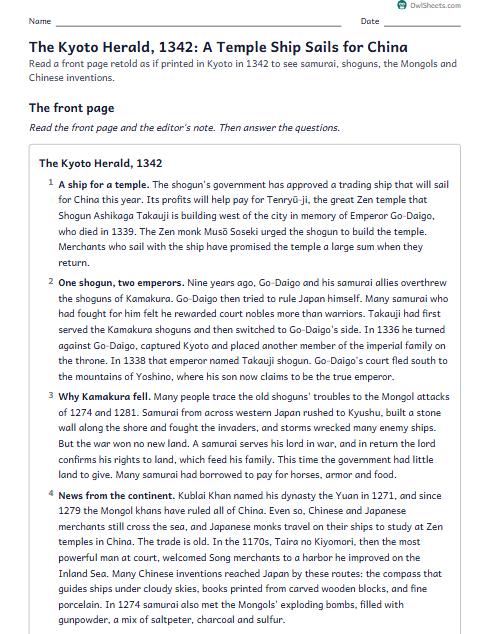
The Kyoto Herald, 1342: A Temple Ship Sails for China
Grade 7 · HIS.7.4
13 questionsPremium
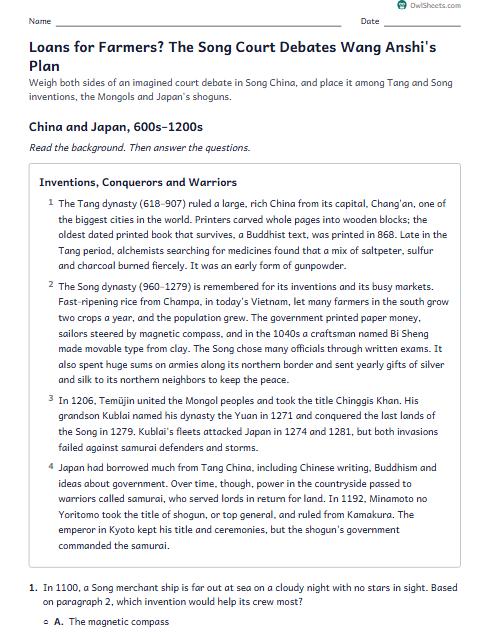
Loans for Farmers? The Song Court Debates Wang Anshi's Plan
Grade 7 · HIS.7.4
14 questionsPremium
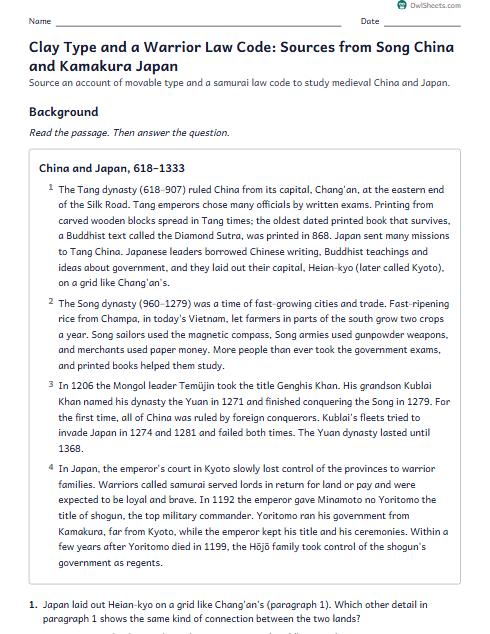
Clay Type and a Warrior Law Code: Sources from Song China and Kamakura Japan
Grade 7 · HIS.7.4
14 questionsPremium
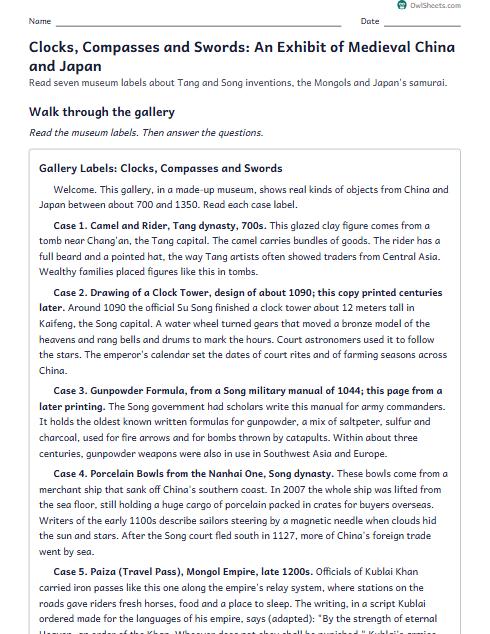
Clocks, Compasses and Swords: An Exhibit of Medieval China and Japan
Grade 7 · HIS.7.4
14 questionsPremium
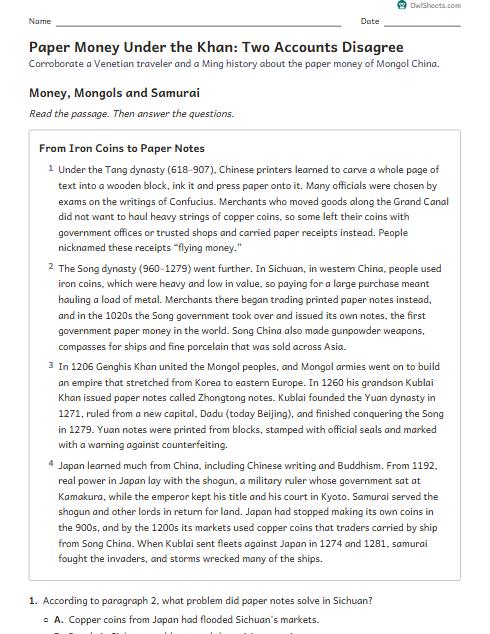
Paper Money Under the Khan: Two Accounts Disagree
Grade 7 · HIS.7.4
12 questionsPremium
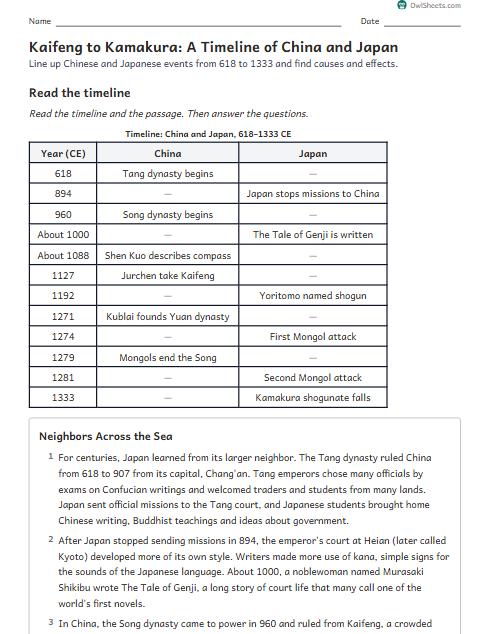
Kaifeng to Kamakura: A Timeline of China and Japan
Grade 7 · HIS.7.4
11 questionsPremium