Grade 7 · Social StudiesHIS.7.4Premium
Clocks, Compasses and Swords: An Exhibit of Medieval China and Japan
Grade 7 history: seven labeled artifacts, from a Tang camel figure to a Mongol travel pass and samurai armor, explain medieval China and Japan.
Preview
OwlSheets.com
Clocks, Compasses and Swords: An Exhibit of Medieval China and Japan
Read seven museum labels about Tang and Song inventions, the Mongols and Japan's samurai.
Walk through the gallery
Read the museum labels. Then answer the questions.
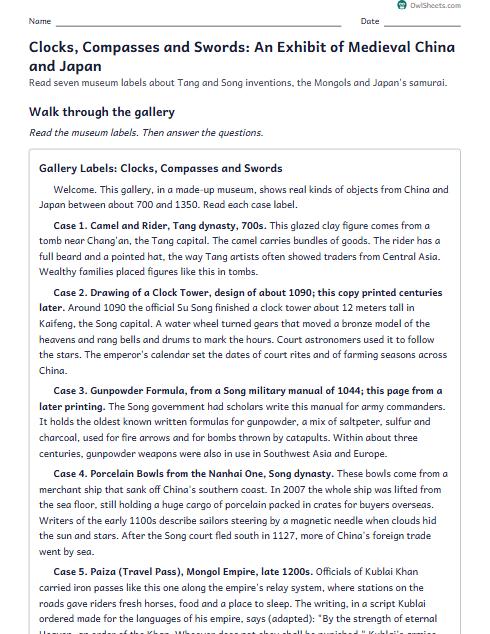
Gallery Labels: Clocks, Compasses and Swords
Welcome. This gallery, in a made-up museum, shows real kinds of objects from China and Japan between about 700 and 1350. Read each case label.
Case 1. Camel and Rider, Tang dynasty, 700s. This glazed clay figure comes from a tomb near Chang'an, the Tang capital. The camel carries bundles of goods. The rider has a full beard and a pointed hat, the way Tang artists often showed traders from Central Asia. Wealthy families placed figures like this in tombs.
Case 2. Drawing of a Clock Tower, design of about 1090; this copy printed centuries later. Around 1090 the official Su Song finished a clock tower about 12 meters tall in Kaifeng, the Song capital. A water wheel turned gears that moved a bronze model of the heavens and rang bells and drums to mark the hours. Court astronomers used it to follow the stars. The emperor's calendar set the dates of court rites and of farming seasons across China.
Case 3. Gunpowder Formula, from a Song military manual of 1044; this page from a later printing. The Song government had scholars write this manual for army commanders. It holds the oldest known written formulas for gunpowder, a mix of saltpeter, sulfur and charcoal, used for fire arrows and for bombs thrown by catapults. Within about three centuries, gunpowder weapons were also in use in Southwest Asia and Europe.
Case 4. Porcelain Bowls from the Nanhai One, Song dynasty. These bowls come from a merchant ship that sank off China's southern coast. In 2007 the whole ship was lifted from the sea floor, still holding a huge cargo of porcelain packed in crates for buyers overseas. Writers of the early 1100s describe sailors steering by a magnetic needle when clouds hid the sun and stars. After the Song court fled south in 1127, more of China's foreign trade went by sea.
Case 5. Paiza (Travel Pass), Mongol Empire, late 1200s. Officials of Kublai Khan carried iron passes like this one along the empire's relay system, where stations on the roads gave riders fresh horses, food and a place to sleep. The writing, in a script Kublai ordered made for the languages of his empire, says (adapted): "By the strength of eternal Heaven, an order of the Khan. Whoever does not obey shall be punished." Kublai's armies finished conquering Song China in 1279. His fleets attacked Japan in 1274 and 1281 but failed.
Case 6. Samurai Armor, Japan, Kamakura period (1185–1333). Small plates of iron and leather are laced together with silk cords. Broad shoulder guards protected a warrior who fought mainly with bow and arrow from horseback. Armor like this was costly, and many samurai paid for it with income from land.
Case 7. Portrait of a Seated Lord, Japan, 1200s or 1300s. For centuries this hanging scroll, kept at a temple in Kyoto, was said to show Minamoto no Yoritomo. In 1192 the emperor gave Yoritomo the title of shogun. The emperor stayed in Kyoto and led court ceremonies, but the shogun, ruling from Kamakura, commanded the samurai and rewarded loyal warriors with rights to land. Some scholars now argue that the portrait shows a different lord who lived about a century later.
- A. Traders from Central Asia were a familiar sight in Tang lands.
- B. Tang artists had never seen people from outside China.
- C. Tang rulers did not allow camels inside the capital city.
- D. Most Tang families earned their living by raising camels.
- A. To show foreign traders how to build water wheels
- B. To keep the calendar exact for rites and farm seasons
- C. To warn the city of Kaifeng when enemies came near
- D. To tell sailors at sea the exact hour of the day
The preview shows the first questions. Unlock the worksheet to see all of it.
Related worksheets
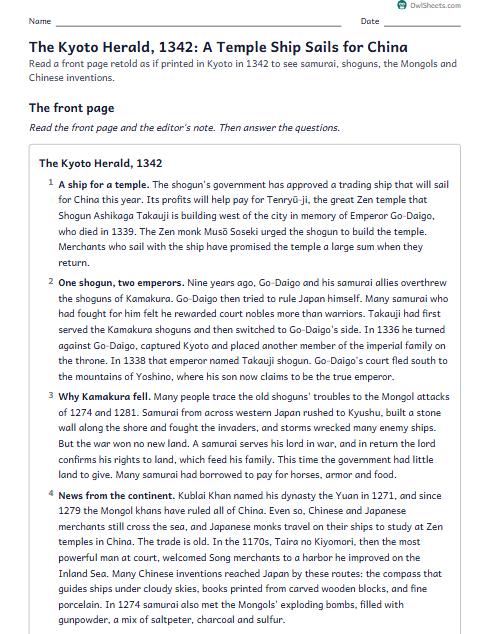
The Kyoto Herald, 1342: A Temple Ship Sails for China
Grade 7 · HIS.7.4
13 questionsPremium
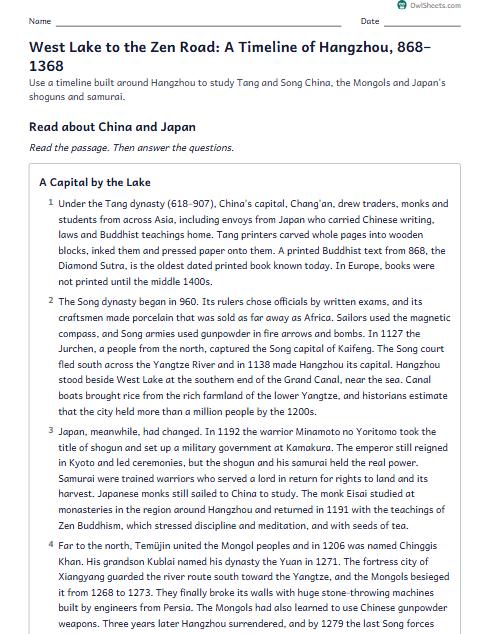
West Lake to the Zen Road: A Timeline of Hangzhou, 868–1368
Grade 7 · HIS.7.4
14 questionsPremium
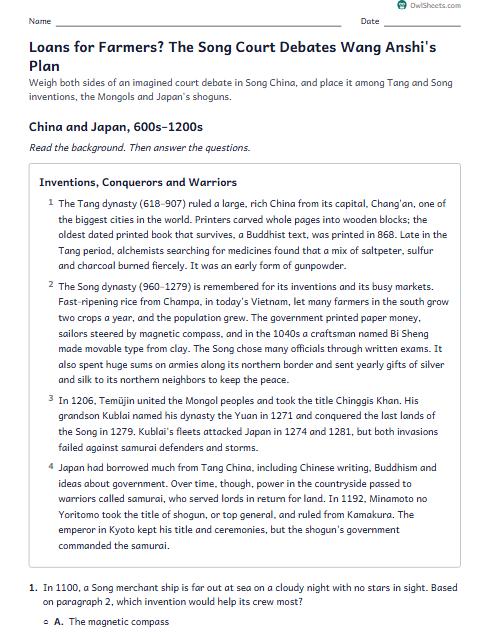
Loans for Farmers? The Song Court Debates Wang Anshi's Plan
Grade 7 · HIS.7.4
14 questionsPremium
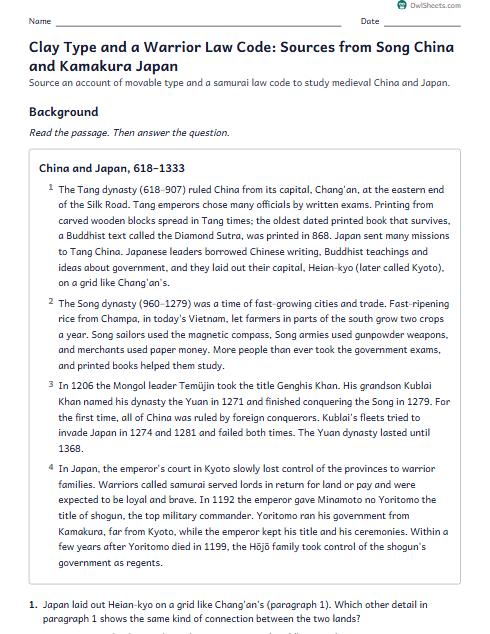
Clay Type and a Warrior Law Code: Sources from Song China and Kamakura Japan
Grade 7 · HIS.7.4
14 questionsPremium
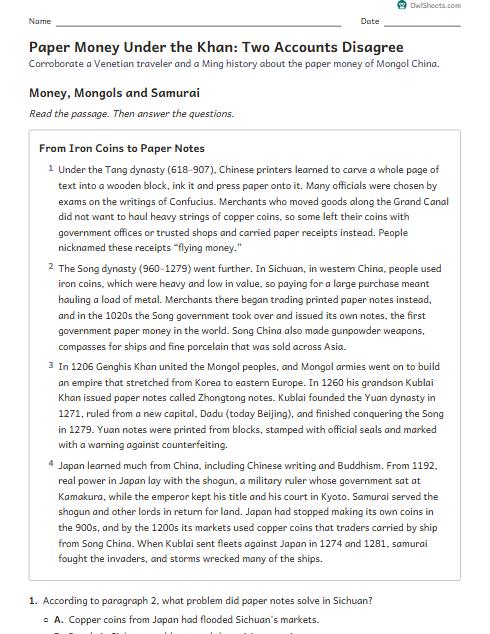
Paper Money Under the Khan: Two Accounts Disagree
Grade 7 · HIS.7.4
12 questionsPremium
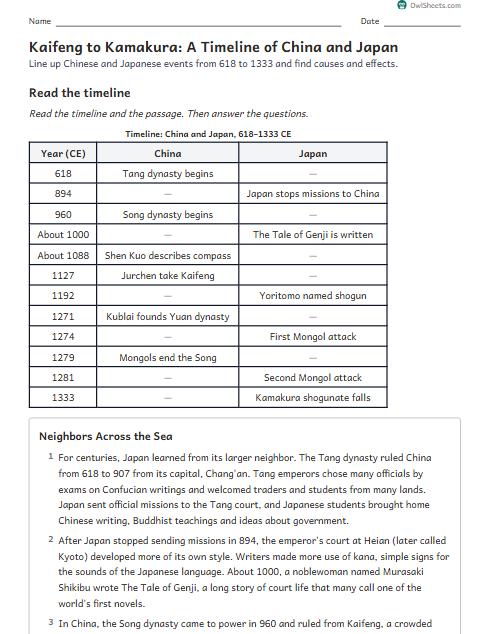
Kaifeng to Kamakura: A Timeline of China and Japan
Grade 7 · HIS.7.4
11 questionsPremium