Grade 7 · Social StudiesHIS.7.4Premium
The Kyoto Herald, 1342: A Temple Ship Sails for China
Grade 7 history: a front page retold from Kyoto in 1342 covers a new shogun, samurai, the Mongol attacks, Yuan China and Tang and Song inventions.
Preview
OwlSheets.com
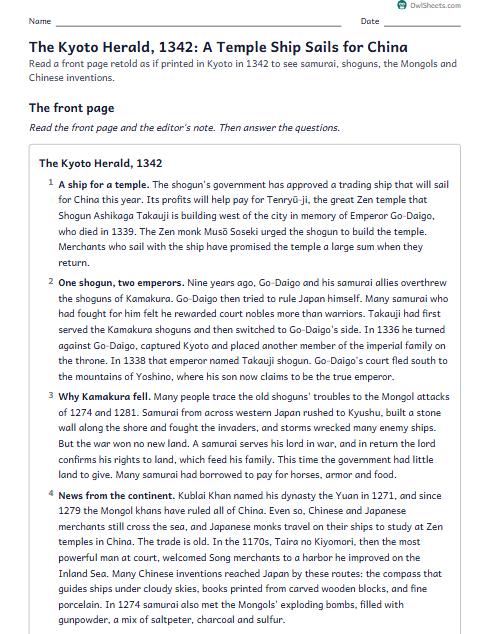
The Kyoto Herald, 1342: A Temple Ship Sails for China
Read a front page retold as if printed in Kyoto in 1342 to see samurai, shoguns, the Mongols and Chinese inventions.
The front page
Read the front page and the editor's note. Then answer the questions.
The Kyoto Herald, 1342
1A ship for a temple. The shogun's government has approved a trading ship that will sail for China this year. Its profits will help pay for Tenryū-ji, the great Zen temple that Shogun Ashikaga Takauji is building west of the city in memory of Emperor Go-Daigo, who died in 1339. The Zen monk Musō Soseki urged the shogun to build the temple. Merchants who sail with the ship have promised the temple a large sum when they return.
2One shogun, two emperors. Nine years ago, Go-Daigo and his samurai allies overthrew the shoguns of Kamakura. Go-Daigo then tried to rule Japan himself. Many samurai who had fought for him felt he rewarded court nobles more than warriors. Takauji had first served the Kamakura shoguns and then switched to Go-Daigo's side. In 1336 he turned against Go-Daigo, captured Kyoto and placed another member of the imperial family on the throne. In 1338 that emperor named Takauji shogun. Go-Daigo's court fled south to the mountains of Yoshino, where his son now claims to be the true emperor.
3Why Kamakura fell. Many people trace the old shoguns' troubles to the Mongol attacks of 1274 and 1281. Samurai from across western Japan rushed to Kyushu, built a stone wall along the shore and fought the invaders, and storms wrecked many enemy ships. But the war won no new land. A samurai serves his lord in war, and in return the lord confirms his rights to land, which feed his family. This time the government had little land to give. Many samurai had borrowed to pay for horses, armor and food.
4News from the continent. Kublai Khan named his dynasty the Yuan in 1271, and since 1279 the Mongol khans have ruled all of China. Even so, Chinese and Japanese merchants still cross the sea, and Japanese monks travel on their ships to study at Zen temples in China. The trade is old. In the 1170s, Taira no Kiyomori, then the most powerful man at court, welcomed Song merchants to a harbor he improved on the Inland Sea. Many Chinese inventions reached Japan by these routes: the compass that guides ships under cloudy skies, books printed from carved wooden blocks, and fine porcelain. In 1274 samurai also met the Mongols' exploding bombs, filled with gunpowder, a mix of saltpeter, charcoal and sulfur.
- A. Trade went on even though Mongol-led fleets had attacked Japan.
- B. Japan's emperor now needed the Yuan khan's leave to trade.
- C. Japan had won land in China after defeating the Mongol fleets.
- D. The shogun planned to build Tenryū-ji in China with Chinese workers.
The preview shows the first questions. Unlock the worksheet to see all of it.
Related worksheets
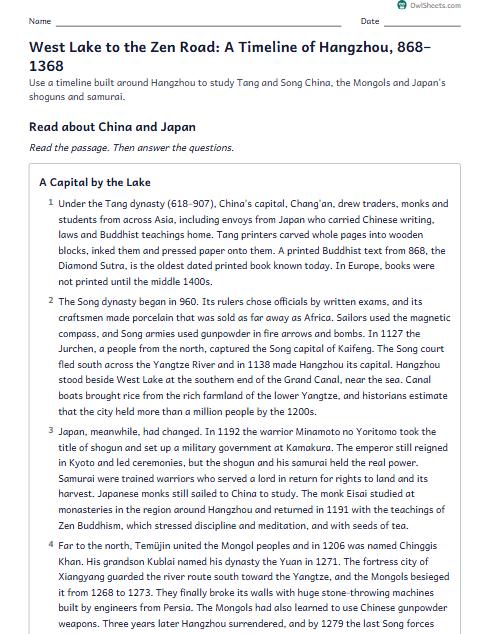
West Lake to the Zen Road: A Timeline of Hangzhou, 868–1368
Grade 7 · HIS.7.4
14 questionsPremium
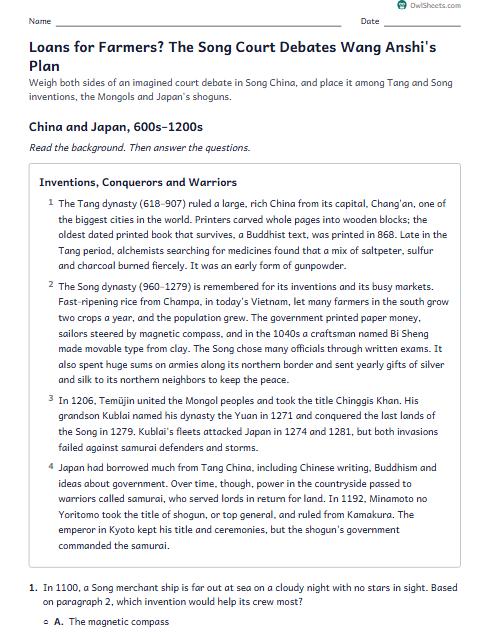
Loans for Farmers? The Song Court Debates Wang Anshi's Plan
Grade 7 · HIS.7.4
14 questionsPremium
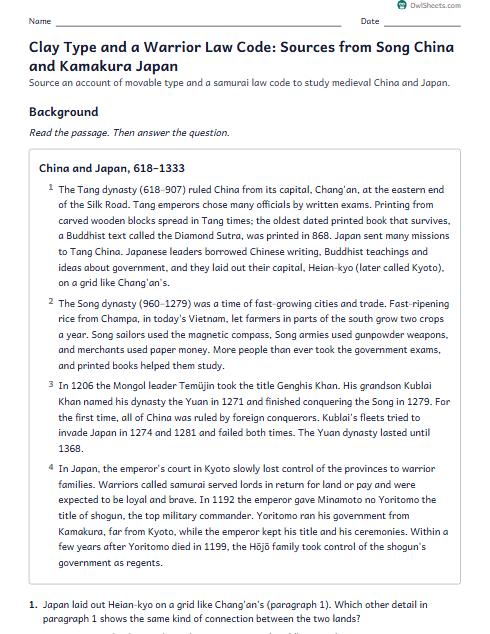
Clay Type and a Warrior Law Code: Sources from Song China and Kamakura Japan
Grade 7 · HIS.7.4
14 questionsPremium
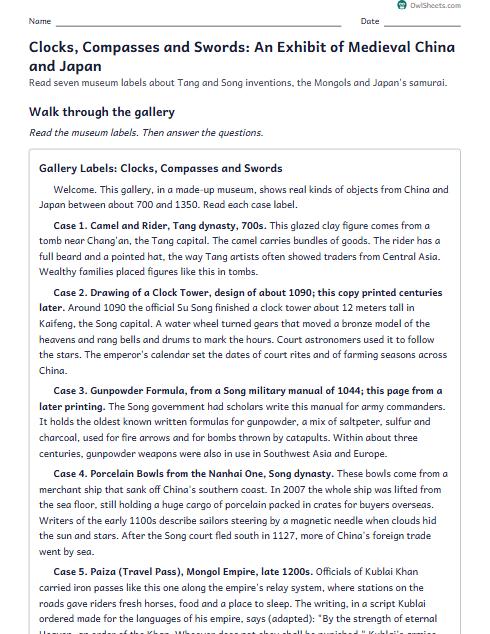
Clocks, Compasses and Swords: An Exhibit of Medieval China and Japan
Grade 7 · HIS.7.4
14 questionsPremium
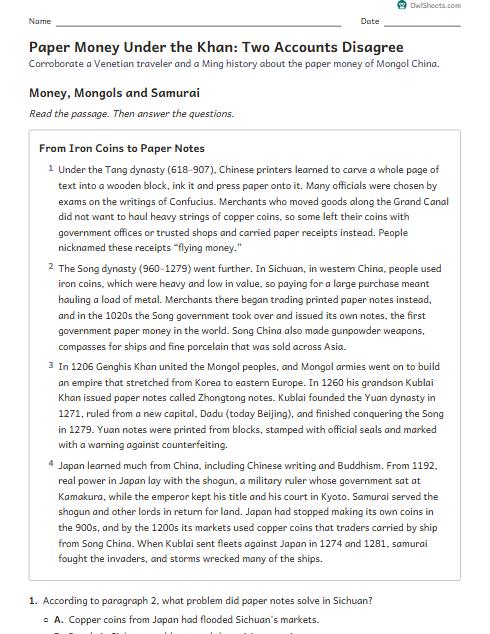
Paper Money Under the Khan: Two Accounts Disagree
Grade 7 · HIS.7.4
12 questionsPremium
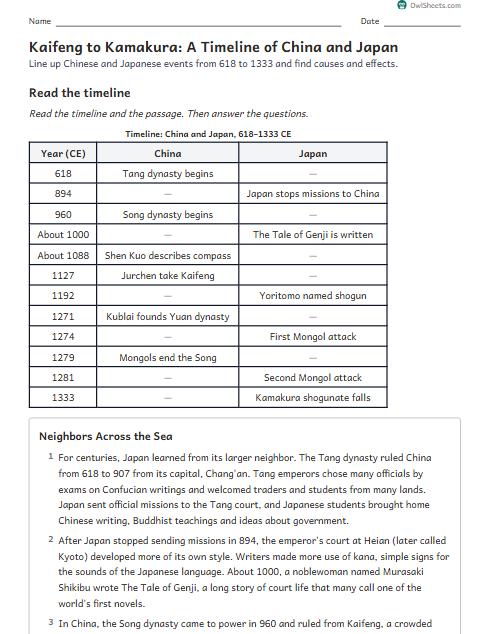
Kaifeng to Kamakura: A Timeline of China and Japan
Grade 7 · HIS.7.4
11 questionsPremium