Grade 7 · Social StudiesGEO.7.2Premium
From Salvador to Istanbul: A Voyage Through the Columbian Exchange, 1692
Grade 7 geography: follow an imagined clerk's voyage from Brazil to Lisbon, Naples and Istanbul to trace the Columbian Exchange and what it changed.
Preview
OwlSheets.com
From Salvador to Istanbul: A Voyage Through the Columbian Exchange, 1692
Follow a ship's clerk across a described map to see plants, animals, people and diseases that crossed the Atlantic.
The map and the journal
Read the map description and the journal. Then answer the questions.
Note: Bento Rocha and his journal are imagined. The journal was written for this worksheet, but the places, goods and events it describes are based on real history.
Journal of Bento Rocha, Ship's Clerk, 1692–1693
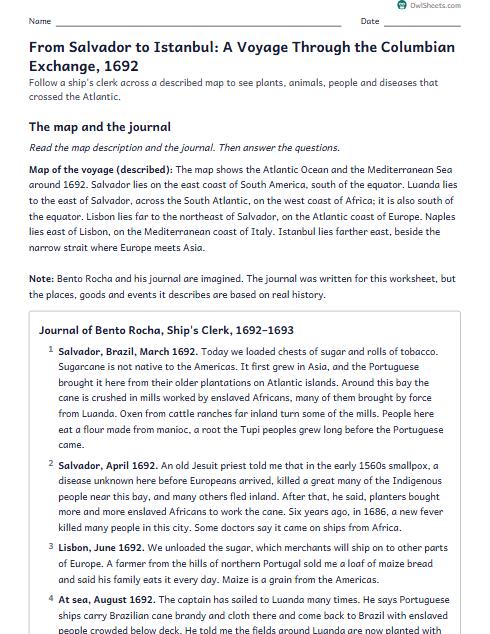
1Salvador, Brazil, March 1692. Today we loaded chests of sugar and rolls of tobacco. Sugarcane is not native to the Americas. It first grew in Asia, and the Portuguese brought it here from their older plantations on Atlantic islands. Around this bay the cane is crushed in mills worked by enslaved Africans, many of them brought by force from Luanda. Oxen from cattle ranches far inland turn some of the mills. People here eat a flour made from manioc, a root the Tupi peoples grew long before the Portuguese came.
2Salvador, April 1692. An old Jesuit priest told me that in the early 1560s smallpox, a disease unknown here before Europeans arrived, killed a great many of the Indigenous people near this bay, and many others fled inland. After that, he said, planters bought more and more enslaved Africans to work the cane. Six years ago, in 1686, a new fever killed many people in this city. Some doctors say it came on ships from Africa.
3Lisbon, June 1692. We unloaded the sugar, which merchants will ship on to other parts of Europe. A farmer from the hills of northern Portugal sold me a loaf of maize bread and said his family eats it every day. Maize is a grain from the Americas.
4At sea, August 1692. The captain has sailed to Luanda many times. He says Portuguese ships carry Brazilian cane brandy and cloth there and come back to Brazil with enslaved people crowded below deck. He told me the fields around Luanda are now planted with maize and manioc, crops from the Americas.
5Naples, October 1692. Naples is ruled by the king of Spain. A cook showed me a cookbook printed here this year with a sauce of tomatoes made "in the Spanish style." Tomatoes first grew in the Americas, and the Spanish came to know them in Mexico. At dinner he served a roast turkey, a bird first raised by the peoples of Mexico.
6Istanbul, May 1693. Pipe smoke drifts through the coffeehouses. Merchants told me tobacco, an American plant, first reached the city less than a hundred years ago. Some farmers in the lands around the Black Sea now grow maize as well.
- A. West
- B. Northeast
- C. Southeast
- D. Northwest
The preview shows the first questions. Unlock the worksheet to see all of it.
Related worksheets
Cattle, Wheat and Smallpox: Lima's News, 1555
Grade 7 · GEO.7.2
13 questionsPremium
Horses Come Back: The Columbian Exchange on the Plains, 1493–1782
Grade 7 · GEO.7.2
14 questionsPremium
Wild Herds on the Pampas: A Buenos Aires Council Debates, 1715
Grade 7 · GEO.7.2
14 questionsPremium
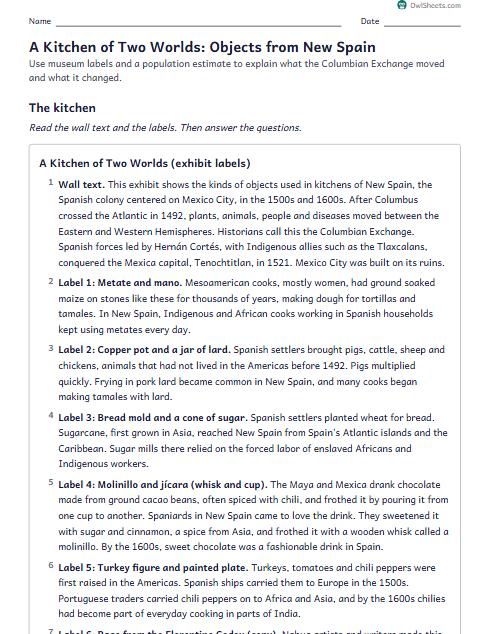
A Kitchen of Two Worlds: Objects from New Spain
Grade 7 · GEO.7.2
14 questionsPremium
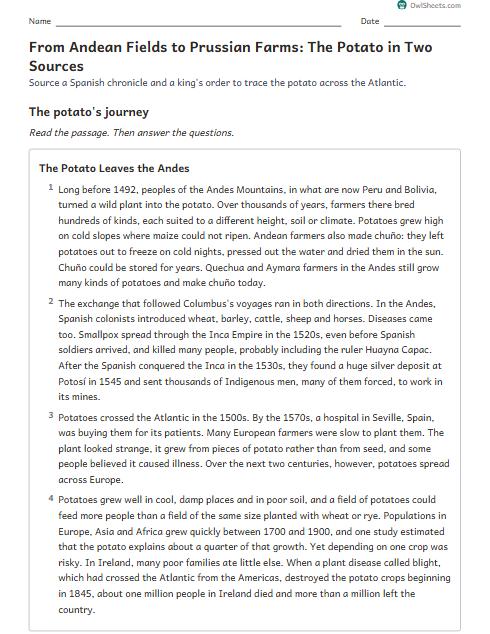
From Andean Fields to Prussian Farms: The Potato in Two Sources
Grade 7 · GEO.7.2
12 questionsFree
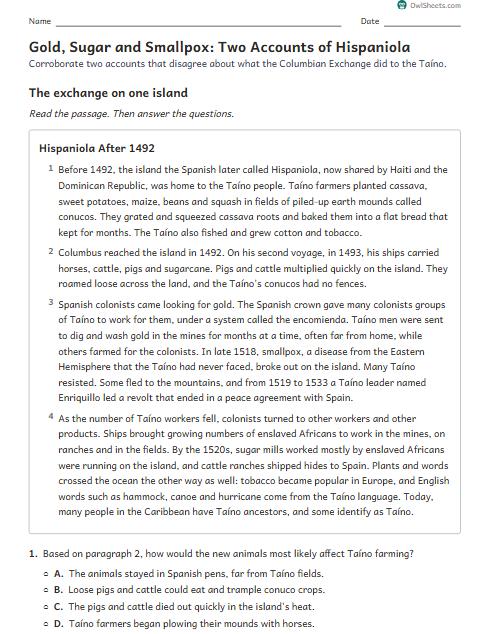
Gold, Sugar and Smallpox: Two Accounts of Hispaniola
Grade 7 · GEO.7.2
12 questionsPremium