Grade 7 · Social StudiesGEO.7.2Premium
Horses Come Back: The Columbian Exchange on the Plains, 1493–1782
Grade 7 geography: a timeline follows horses, herds and smallpox from Hispaniola to the Great Plains to show what the Columbian Exchange changed.
Preview
OwlSheets.com
Horses Come Back: The Columbian Exchange on the Plains, 1493–1782
Follow horses, herds and smallpox north from the Caribbean to the Great Plains on a dated timeline.
Horses on the move
Read the passage. Then answer the questions.
From Hispaniola to the Great Plains
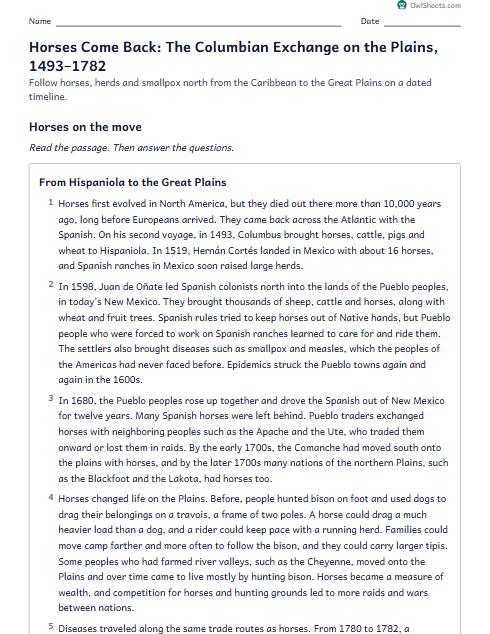
1Horses first evolved in North America, but they died out there more than 10,000 years ago, long before Europeans arrived. They came back across the Atlantic with the Spanish. On his second voyage, in 1493, Columbus brought horses, cattle, pigs and wheat to Hispaniola. In 1519, Hernán Cortés landed in Mexico with about 16 horses, and Spanish ranches in Mexico soon raised large herds.
2In 1598, Juan de Oñate led Spanish colonists north into the lands of the Pueblo peoples, in today's New Mexico. They brought thousands of sheep, cattle and horses, along with wheat and fruit trees. Spanish rules tried to keep horses out of Native hands, but Pueblo people who were forced to work on Spanish ranches learned to care for and ride them. The settlers also brought diseases such as smallpox and measles, which the peoples of the Americas had never faced before. Epidemics struck the Pueblo towns again and again in the 1600s.
3In 1680, the Pueblo peoples rose up together and drove the Spanish out of New Mexico for twelve years. Many Spanish horses were left behind. Pueblo traders exchanged horses with neighboring peoples such as the Apache and the Ute, who traded them onward or lost them in raids. By the early 1700s, the Comanche had moved south onto the plains with horses, and by the later 1700s many nations of the northern Plains, such as the Blackfoot and the Lakota, had horses too.
4Horses changed life on the Plains. Before, people hunted bison on foot and used dogs to drag their belongings on a travois, a frame of two poles. A horse could drag a much heavier load than a dog, and a rider could keep pace with a running herd. Families could move camp farther and more often to follow the bison, and they could carry larger tipis. Some peoples who had farmed river valleys, such as the Cheyenne, moved onto the Plains and over time came to live mostly by hunting bison. Horses became a measure of wealth, and competition for horses and hunting grounds led to more raids and wars between nations.
5Diseases traveled along the same trade routes as horses. From 1780 to 1782, a smallpox epidemic swept across the Plains and far beyond, killing many people in nations from the Comanche in the south to the Blackfoot in the north. Meanwhile, crops from the Americas, such as maize, had long been crossing the Atlantic the other way, to farms in Europe and Africa.
- A. How to protect people from smallpox
- B. How to care for horses and ride them
- C. How to grow maize in fields beside the river
- D. How to hunt bison on foot with dogs
- A. Horses had never died out in the lands of the Pueblo.
- B. Native people who worked with the herds learned to handle them.
- C. The Spanish sold most of their horses to the Comanche.
- D. Cortés gave his 16 horses to the Pueblo towns in 1519.
The preview shows the first questions. Unlock the worksheet to see all of it.
Related worksheets
Cattle, Wheat and Smallpox: Lima's News, 1555
Grade 7 · GEO.7.2
13 questionsPremium
Wild Herds on the Pampas: A Buenos Aires Council Debates, 1715
Grade 7 · GEO.7.2
14 questionsPremium
A Kitchen of Two Worlds: Objects from New Spain
Grade 7 · GEO.7.2
14 questionsPremium
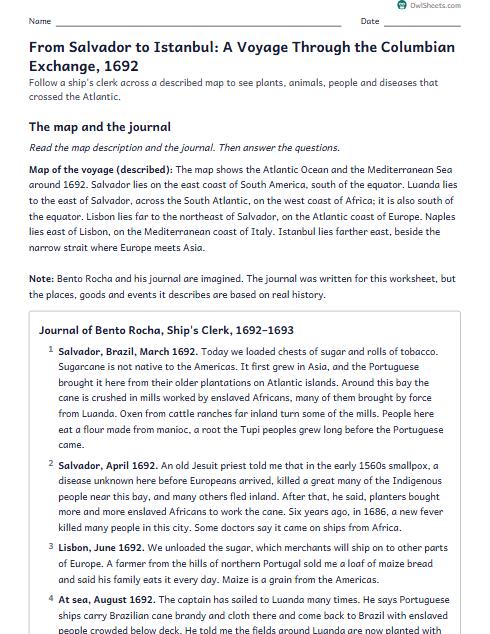
From Salvador to Istanbul: A Voyage Through the Columbian Exchange, 1692
Grade 7 · GEO.7.2
13 questionsPremium
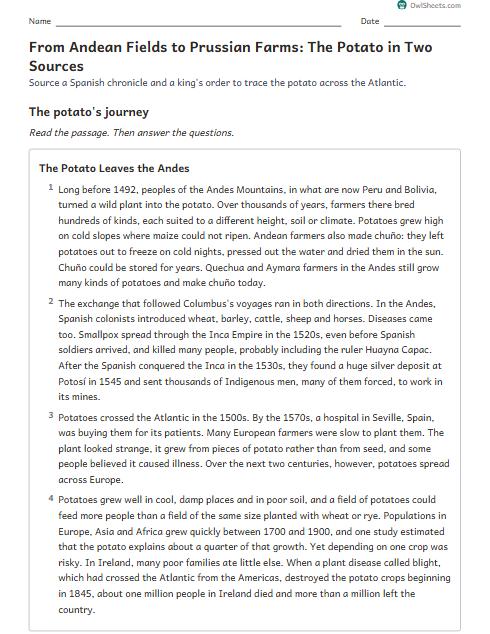
From Andean Fields to Prussian Farms: The Potato in Two Sources
Grade 7 · GEO.7.2
12 questionsFree
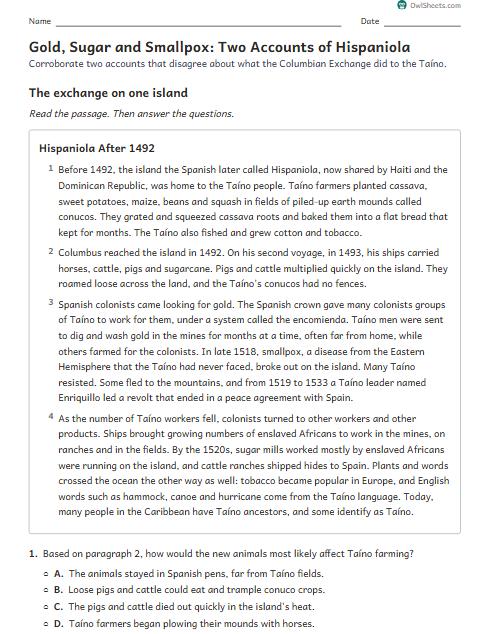
Gold, Sugar and Smallpox: Two Accounts of Hispaniola
Grade 7 · GEO.7.2
12 questionsPremium