Grade 7 · Social StudiesGEO.7.2Premium
A Kitchen of Two Worlds: Objects from New Spain
Grade 7 geography: museum labels on kitchen objects from New Spain trace the plants, animals, people and diseases of the Columbian Exchange.
Preview
OwlSheets.com
A Kitchen of Two Worlds: Objects from New Spain
Use museum labels and a population estimate to explain what the Columbian Exchange moved and what it changed.
The kitchen
Read the wall text and the labels. Then answer the questions.
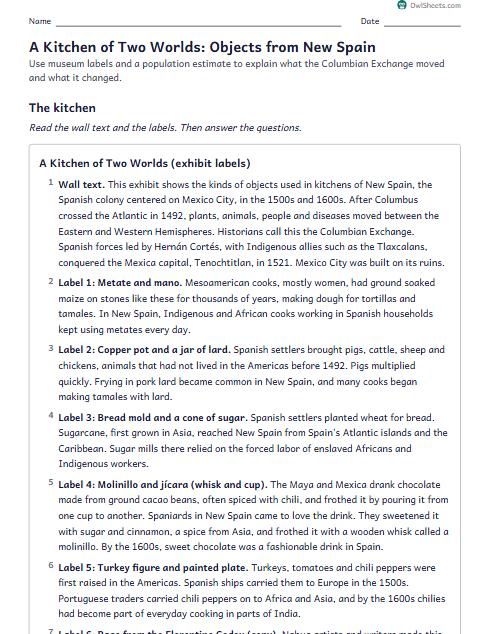
A Kitchen of Two Worlds (exhibit labels)
1Wall text. This exhibit shows the kinds of objects used in kitchens of New Spain, the Spanish colony centered on Mexico City, in the 1500s and 1600s. After Columbus crossed the Atlantic in 1492, plants, animals, people and diseases moved between the Eastern and Western Hemispheres. Historians call this the Columbian Exchange. Spanish forces led by Hernán Cortés, with Indigenous allies such as the Tlaxcalans, conquered the Mexica capital, Tenochtitlan, in 1521. Mexico City was built on its ruins.
2Label 1: Metate and mano. Mesoamerican cooks, mostly women, had ground soaked maize on stones like these for thousands of years, making dough for tortillas and tamales. In New Spain, Indigenous and African cooks working in Spanish households kept using metates every day.
3Label 2: Copper pot and a jar of lard. Spanish settlers brought pigs, cattle, sheep and chickens, animals that had not lived in the Americas before 1492. Pigs multiplied quickly. Frying in pork lard became common in New Spain, and many cooks began making tamales with lard.
4Label 3: Bread mold and a cone of sugar. Spanish settlers planted wheat for bread. Sugarcane, first grown in Asia, reached New Spain from Spain's Atlantic islands and the Caribbean. Sugar mills there relied on the forced labor of enslaved Africans and Indigenous workers.
5Label 4: Molinillo and jícara (whisk and cup). The Maya and Mexica drank chocolate made from ground cacao beans, often spiced with chili, and frothed it by pouring it from one cup to another. Spaniards in New Spain came to love the drink. They sweetened it with sugar and cinnamon, a spice from Asia, and frothed it with a wooden whisk called a molinillo. By the 1600s, sweet chocolate was a fashionable drink in Spain.
6Label 5: Turkey figure and painted plate. Turkeys, tomatoes and chili peppers were first raised in the Americas. Spanish ships carried them to Europe in the 1500s. Portuguese traders carried chili peppers on to Africa and Asia, and by the 1600s chilies had become part of everyday cooking in parts of India.
7Label 6: Page from the Florentine Codex (copy). Nahua artists and writers made this book in the 1570s with the Spanish friar Bernardino de Sahagún, based on interviews with Nahua elders who remembered the conquest. This page shows Nahua people sick with smallpox, which reached Mexico in 1520 with Spanish forces arriving from Cuba. The disease had never been in the Americas, so no one there had immunity to it. Later epidemics that the Nahua called cocoliztli, in 1545 and 1576, killed many more people; scientists still debate what caused them.
8Label 7: Wool shears and a sheep bell. Sheep spread quickly across the highlands of New Spain. As epidemics emptied many villages, ranchers' flocks moved onto abandoned fields. In the Mezquital Valley north of Mexico City, huge flocks grazed the land in the late 1500s, and some historians suggest this helped turn farmland into dry scrub.
| Mesoamerican, from before 1519 | From across the ocean | A blend of both worlds |
|---|---|---|
- A. African cooks brought the metate with them across the ocean.
- B. An old Mesoamerican tool stayed in use, even in Spanish homes.
- C. Maize stopped being an everyday food once wheat arrived.
- D. Spanish cooks replaced the metate with tools from Europe.
The preview shows the first questions. Unlock the worksheet to see all of it.
Related worksheets
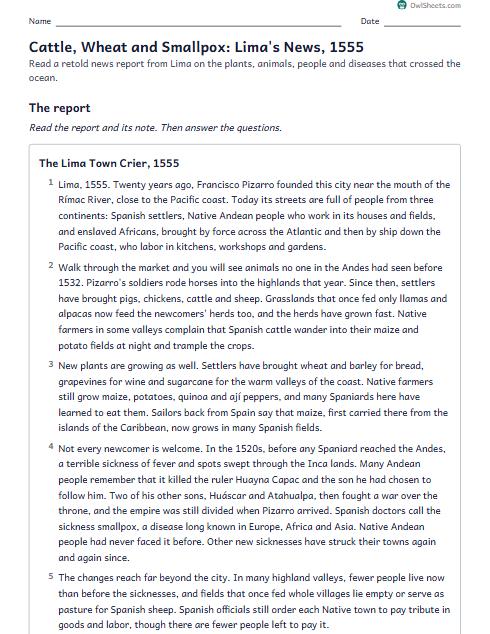
Cattle, Wheat and Smallpox: Lima's News, 1555
Grade 7 · GEO.7.2
13 questionsPremium
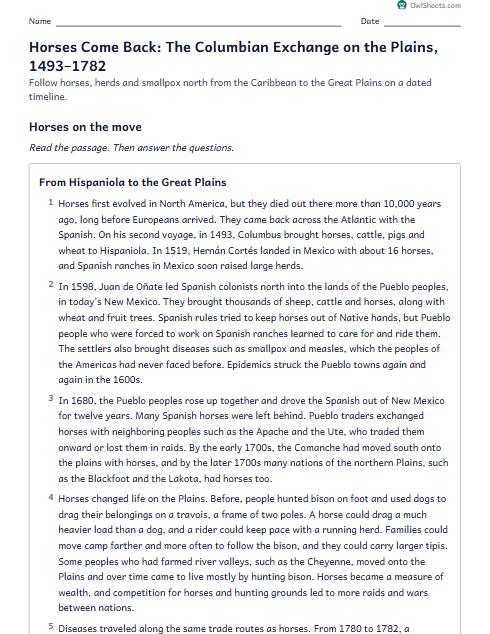
Horses Come Back: The Columbian Exchange on the Plains, 1493–1782
Grade 7 · GEO.7.2
14 questionsPremium
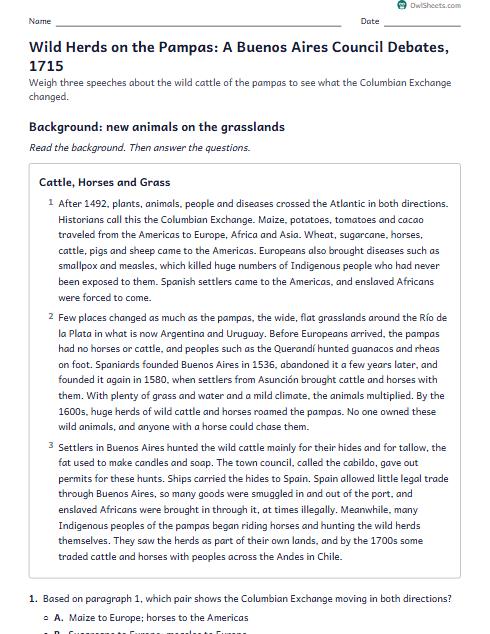
Wild Herds on the Pampas: A Buenos Aires Council Debates, 1715
Grade 7 · GEO.7.2
14 questionsPremium
From Salvador to Istanbul: A Voyage Through the Columbian Exchange, 1692
Grade 7 · GEO.7.2
13 questionsPremium
From Andean Fields to Prussian Farms: The Potato in Two Sources
Grade 7 · GEO.7.2
12 questionsFree
Gold, Sugar and Smallpox: Two Accounts of Hispaniola
Grade 7 · GEO.7.2
12 questionsPremium