Grade 7 · Social StudiesCIV.7.1Premium
A Crown Given Up or Taken? Two Accounts of 1399
Grade 7 civics: compare the official Parliament record and a French eyewitness on Richard II's fall in 1399 to see how law and Parliament limited kings.
Preview
OwlSheets.com
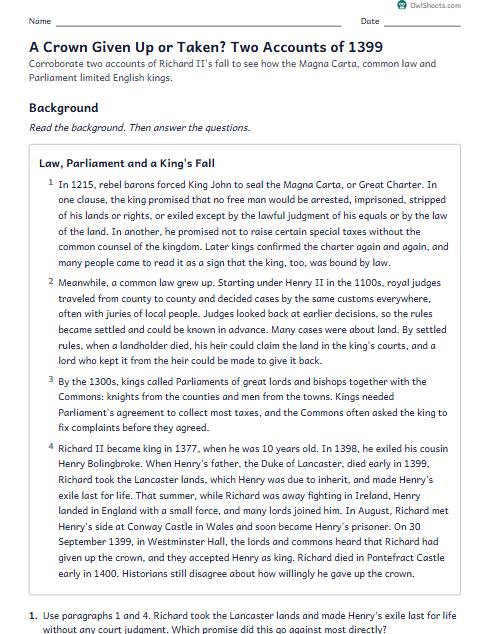
A Crown Given Up or Taken? Two Accounts of 1399
Corroborate two accounts of Richard II's fall to see how the Magna Carta, common law and Parliament limited English kings.
Background
Read the background. Then answer the questions.
Law, Parliament and a King's Fall
1In 1215, rebel barons forced King John to seal the Magna Carta, or Great Charter. In one clause, the king promised that no free man would be arrested, imprisoned, stripped of his lands or rights, or exiled except by the lawful judgment of his equals or by the law of the land. In another, he promised not to raise certain special taxes without the common counsel of the kingdom. Later kings confirmed the charter again and again, and many people came to read it as a sign that the king, too, was bound by law.
2Meanwhile, a common law grew up. Starting under Henry II in the 1100s, royal judges traveled from county to county and decided cases by the same customs everywhere, often with juries of local people. Judges looked back at earlier decisions, so the rules became settled and could be known in advance. Many cases were about land. By settled rules, when a landholder died, his heir could claim the land in the king's courts, and a lord who kept it from the heir could be made to give it back.
3By the 1300s, kings called Parliaments of great lords and bishops together with the Commons: knights from the counties and men from the towns. Kings needed Parliament's agreement to collect most taxes, and the Commons often asked the king to fix complaints before they agreed.
4Richard II became king in 1377, when he was 10 years old. In 1398, he exiled his cousin Henry Bolingbroke. When Henry's father, the Duke of Lancaster, died early in 1399, Richard took the Lancaster lands, which Henry was due to inherit, and made Henry's exile last for life. That summer, while Richard was away fighting in Ireland, Henry landed in England with a small force, and many lords joined him. In August, Richard met Henry's side at Conway Castle in Wales and soon became Henry's prisoner. On 30 September 1399, in Westminster Hall, the lords and commons heard that Richard had given up the crown, and they accepted Henry as king. Richard died in Pontefract Castle early in 1400. Historians still disagree about how willingly he gave up the crown.
- A. The custom that royal judges rode from county to county to hear cases
- B. The custom that the Commons could ask the king to fix all their complaints
- C. The promise that no free man would lose lands or be exiled except by law
- D. The promise that special taxes needed the common counsel of the kingdom
- A. If the king could ignore inheritance rules, their lands were at risk.
- B. The common law said that most lands belonged to the Commons, not the king.
- C. The Lancaster lands paid most of the taxes Parliament had agreed to.
- D. Richard planned to give the Lancaster lands to the king of France.
The preview shows the first questions. Unlock the worksheet to see all of it.
Related worksheets
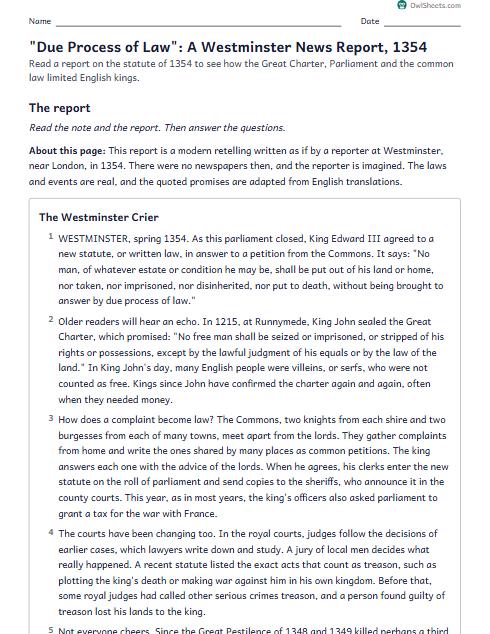
"Due Process of Law": A Westminster News Report, 1354
Grade 7 · CIV.7.1
13 questionsPremium
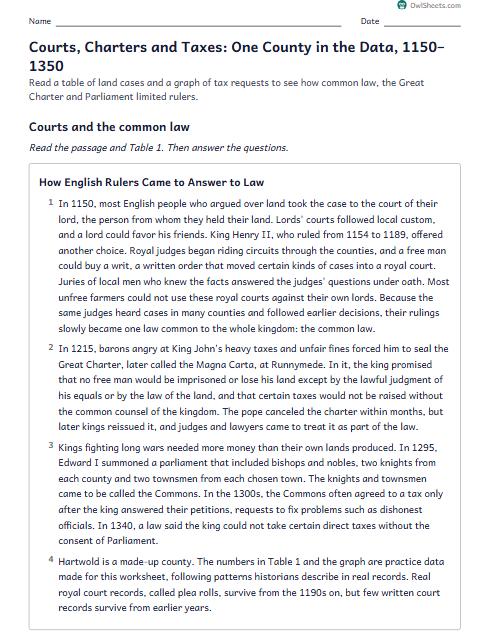
Courts, Charters and Taxes: One County in the Data, 1150–1350
Grade 7 · CIV.7.1
13 questionsPremium
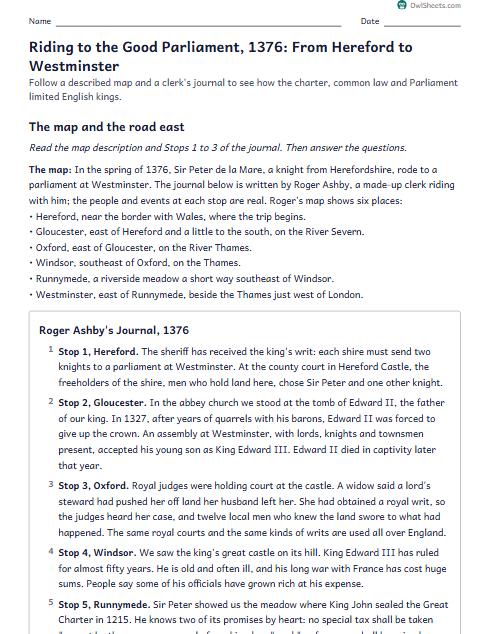
Riding to the Good Parliament, 1376: From Hereford to Westminster
Grade 7 · CIV.7.1
14 questionsPremium
Charters, Rolls and Battles: A Historian's Notes from Salisbury to Marlborough
Grade 7 · CIV.7.1
13 questionsPremium
Iron, Ink and Summons: How English Law Bound the Crown
Grade 7 · CIV.7.1
11 questionsPremium
Showdown at Oxford, 1258: Should the King Answer to a Council?
Grade 7 · CIV.7.1
10 questionsPremium