Grade 7 · Social StudiesCIV.7.1Premium
Riding to the Good Parliament, 1376: From Hereford to Westminster
Grade 7 civics: ride with a knight of the shire to the Good Parliament of 1376 to see how the Magna Carta, common law and Parliament limited English kings.
Preview
OwlSheets.com
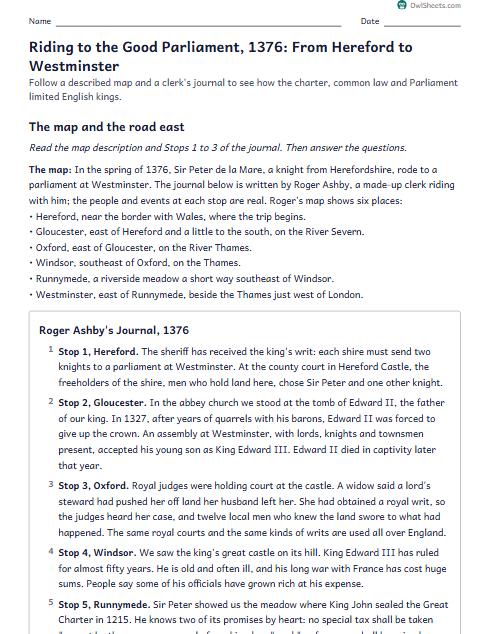
Riding to the Good Parliament, 1376: From Hereford to Westminster
Follow a described map and a clerk's journal to see how the charter, common law and Parliament limited English kings.
The map and the road east
Read the map description and Stops 1 to 3 of the journal. Then answer the questions.
• Hereford, near the border with Wales, where the trip begins.
• Gloucester, east of Hereford and a little to the south, on the River Severn.
• Oxford, east of Gloucester, on the River Thames.
• Windsor, southeast of Oxford, on the Thames.
• Runnymede, a riverside meadow a short way southeast of Windsor.
• Westminster, east of Runnymede, beside the Thames just west of London.
Roger Ashby's Journal, 1376
1Stop 1, Hereford. The sheriff has received the king's writ: each shire must send two knights to a parliament at Westminster. At the county court in Hereford Castle, the freeholders of the shire, men who hold land here, chose Sir Peter and one other knight.
2Stop 2, Gloucester. In the abbey church we stood at the tomb of Edward II, the father of our king. In 1327, after years of quarrels with his barons, Edward II was forced to give up the crown. An assembly at Westminster, with lords, knights and townsmen present, accepted his young son as King Edward III. Edward II died in captivity later that year.
3Stop 3, Oxford. Royal judges were holding court at the castle. A widow said a lord's steward had pushed her off land her husband left her. She had obtained a royal writ, so the judges heard her case, and twelve local men who knew the land swore to what had happened. The same royal courts and the same kinds of writs are used all over England.
4Stop 4, Windsor. We saw the king's great castle on its hill. King Edward III has ruled for almost fifty years. He is old and often ill, and his long war with France has cost huge sums. People say some of his officials have grown rich at his expense.
5Stop 5, Runnymede. Sir Peter showed us the meadow where King John sealed the Great Charter in 1215. He knows two of its promises by heart: no special tax shall be taken "except by the common counsel of our kingdom," and "no free man shall be seized or imprisoned … except by the lawful judgment of his peers or by the law of the land." Kings after John confirmed the charter again and again, often in return for taxes.
6Stop 6, Westminster, April to July. The knights and townsmen, called the Commons, met in the chapter house of the abbey, apart from the lords, and chose Sir Peter to speak for all of them. When the king's officers asked for a new tax, Sir Peter answered that the Commons' complaints must be heard first. He then accused Lord Latimer, the king's chamberlain, and Richard Lyons, a London merchant, of cheating the king and the people. The lords heard the charges and found them guilty, and the king removed them from his service. Londoners called it the Good Parliament.
7Afterword. Months later, the king's son John of Gaunt, the most powerful lord in England, undid many of these acts. In 1377, Sir Peter was held in Nottingham Castle without a trial. After Edward III died that June, Sir Peter was set free, and that autumn the Commons chose him to speak for them again.
- A. Northwest
- B. Southwest
- C. Southeast
- D. Northeast
The preview shows the first questions. Unlock the worksheet to see all of it.
Related worksheets
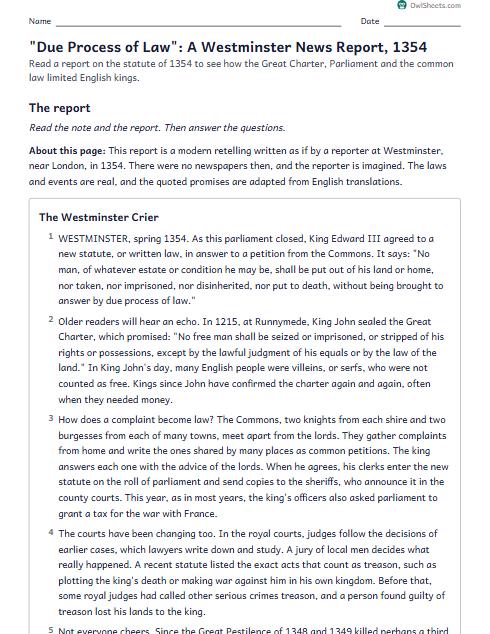
"Due Process of Law": A Westminster News Report, 1354
Grade 7 · CIV.7.1
13 questionsPremium
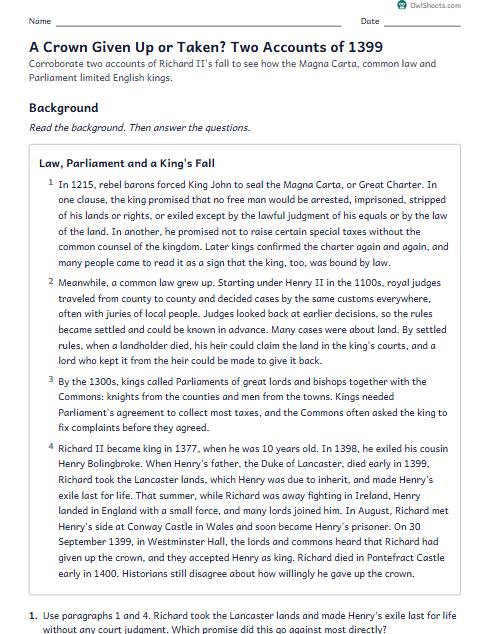
A Crown Given Up or Taken? Two Accounts of 1399
Grade 7 · CIV.7.1
15 questionsPremium
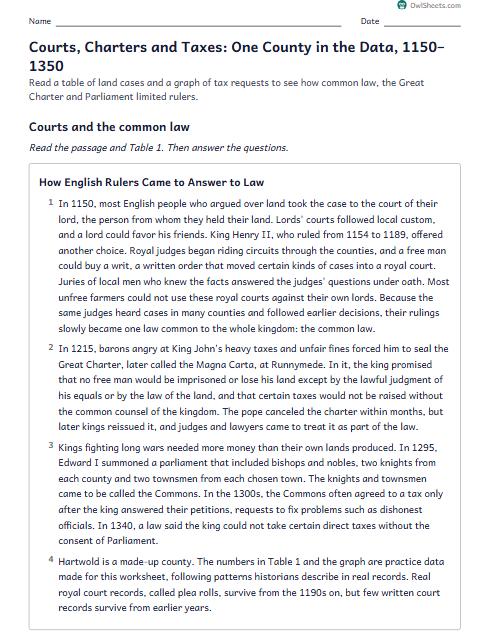
Courts, Charters and Taxes: One County in the Data, 1150–1350
Grade 7 · CIV.7.1
13 questionsPremium
Charters, Rolls and Battles: A Historian's Notes from Salisbury to Marlborough
Grade 7 · CIV.7.1
13 questionsPremium
Iron, Ink and Summons: How English Law Bound the Crown
Grade 7 · CIV.7.1
11 questionsPremium
Showdown at Oxford, 1258: Should the King Answer to a Council?
Grade 7 · CIV.7.1
10 questionsPremium