Grade 7 · Social StudiesCIV.7.1Premium
Charters, Rolls and Battles: A Historian's Notes from Salisbury to Marlborough
Grade 7 civics: a historian's notes from Salisbury to Marlborough show how charters, courts and early parliaments limited English kings.
Preview
OwlSheets.com
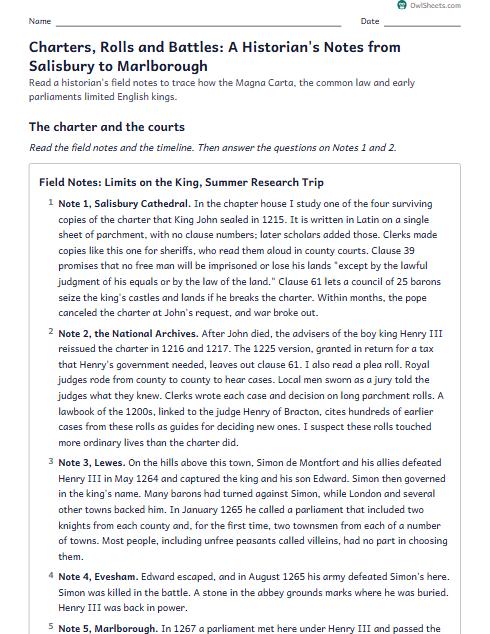
Charters, Rolls and Battles: A Historian's Notes from Salisbury to Marlborough
Read a historian's field notes to trace how the Magna Carta, the common law and early parliaments limited English kings.
The charter and the courts
Read the field notes and the timeline. Then answer the questions on Notes 1 and 2.
Field Notes: Limits on the King, Summer Research Trip
1Note 1, Salisbury Cathedral. In the chapter house I study one of the four surviving copies of the charter that King John sealed in 1215. It is written in Latin on a single sheet of parchment, with no clause numbers; later scholars added those. Clerks made copies like this one for sheriffs, who read them aloud in county courts. Clause 39 promises that no free man will be imprisoned or lose his lands "except by the lawful judgment of his equals or by the law of the land." Clause 61 lets a council of 25 barons seize the king's castles and lands if he breaks the charter. Within months, the pope canceled the charter at John's request, and war broke out.
2Note 2, the National Archives. After John died, the advisers of the boy king Henry III reissued the charter in 1216 and 1217. The 1225 version, granted in return for a tax that Henry's government needed, leaves out clause 61. I also read a plea roll. Royal judges rode from county to county to hear cases. Local men sworn as a jury told the judges what they knew. Clerks wrote each case and decision on long parchment rolls. A lawbook of the 1200s, linked to the judge Henry of Bracton, cites hundreds of earlier cases from these rolls as guides for deciding new ones. I suspect these rolls touched more ordinary lives than the charter did.
3Note 3, Lewes. On the hills above this town, Simon de Montfort and his allies defeated Henry III in May 1264 and captured the king and his son Edward. Simon then governed in the king's name. Many barons had turned against Simon, while London and several other towns backed him. In January 1265 he called a parliament that included two knights from each county and, for the first time, two townsmen from each of a number of towns. Most people, including unfree peasants called villeins, had no part in choosing them.
4Note 4, Evesham. Edward escaped, and in August 1265 his army defeated Simon's here. Simon was killed in the battle. A stone in the abbey grounds marks where he was buried. Henry III was back in power.
5Note 5, Marlborough. In 1267 a parliament met here under Henry III and passed the Statute of Marlborough. It turned many of the reforms the barons had demanded into law. One part says that no one may seize another person's goods or cattle to force a payment "by his own authority, without the judgment of a court." Parts of it are still law in England today, making it the oldest English statute still in force. Henry most likely kept the reforms to calm the country after years of war.
| Date | Event |
|---|---|
| 1215 | King John seals the charter |
| 1216 | John dies; Henry III becomes king |
| 1225 | Charter reissued in return for a tax |
| May 1264 | Battle of Lewes |
| January 1265 | Simon's parliament with townsmen |
| August 1265 | Battle of Evesham |
| 1267 | Statute of Marlborough |
- A. People in each county could learn what the king had promised.
- B. It let the king add new clauses as it was read.
- C. It meant no written copies had to be kept.
- D. It let the pope approve the charter in each county.
The preview shows the first questions. Unlock the worksheet to see all of it.
Related worksheets
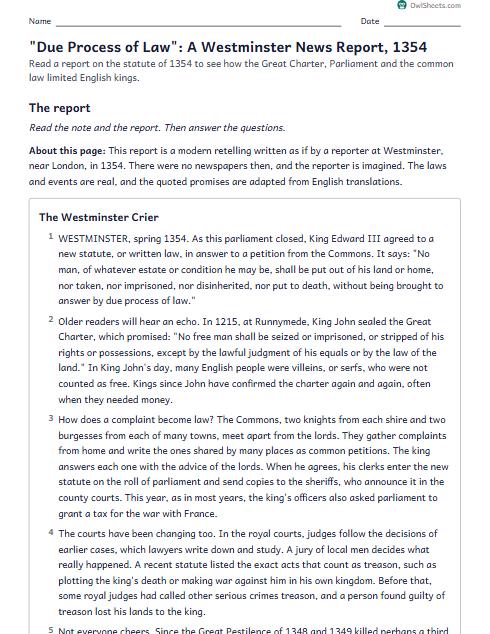
"Due Process of Law": A Westminster News Report, 1354
Grade 7 · CIV.7.1
13 questionsPremium
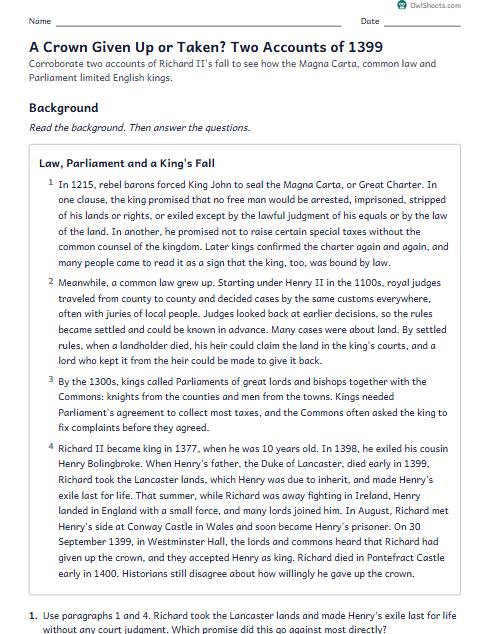
A Crown Given Up or Taken? Two Accounts of 1399
Grade 7 · CIV.7.1
15 questionsPremium
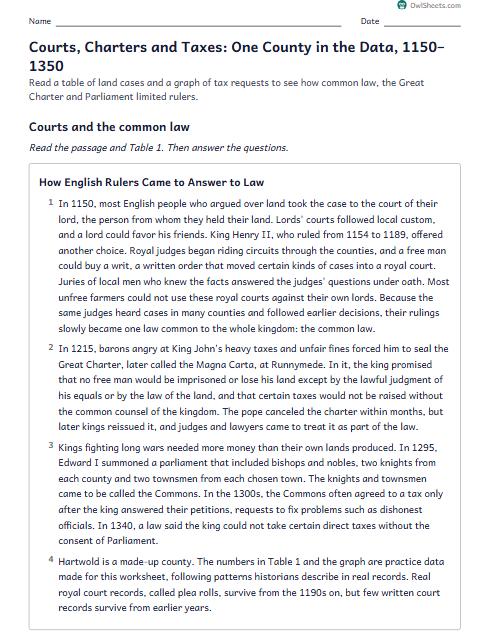
Courts, Charters and Taxes: One County in the Data, 1150–1350
Grade 7 · CIV.7.1
13 questionsPremium
Riding to the Good Parliament, 1376: From Hereford to Westminster
Grade 7 · CIV.7.1
14 questionsPremium
Iron, Ink and Summons: How English Law Bound the Crown
Grade 7 · CIV.7.1
11 questionsPremium
Showdown at Oxford, 1258: Should the King Answer to a Council?
Grade 7 · CIV.7.1
10 questionsPremium