Grade 7 · Social StudiesCIV.7.1Premium
Courts, Charters and Taxes: One County in the Data, 1150–1350
Grade 7 civics: use a land-case table and a tax-request graph from a model English county to explain how common law, Magna Carta and Parliament limited rulers.
Preview
OwlSheets.com
Courts, Charters and Taxes: One County in the Data, 1150–1350
Read a table of land cases and a graph of tax requests to see how common law, the Great Charter and Parliament limited rulers.
Courts and the common law
Read the passage and Table 1. Then answer the questions.
How English Rulers Came to Answer to Law
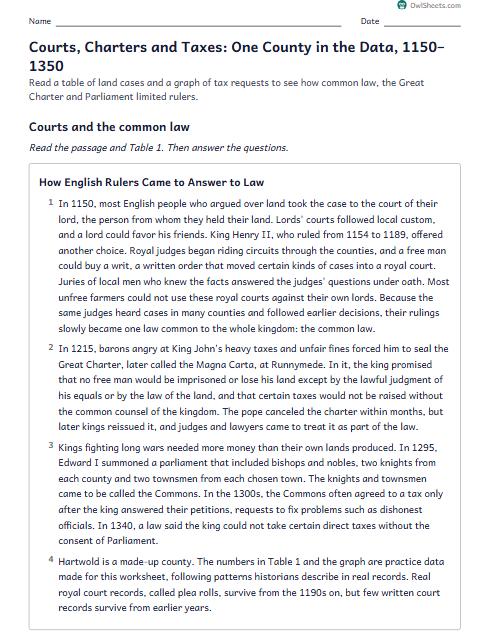
1In 1150, most English people who argued over land took the case to the court of their lord, the person from whom they held their land. Lords' courts followed local custom, and a lord could favor his friends. King Henry II, who ruled from 1154 to 1189, offered another choice. Royal judges began riding circuits through the counties, and a free man could buy a writ, a written order that moved certain kinds of cases into a royal court. Juries of local men who knew the facts answered the judges' questions under oath. Most unfree farmers could not use these royal courts against their own lords. Because the same judges heard cases in many counties and followed earlier decisions, their rulings slowly became one law common to the whole kingdom: the common law.
2In 1215, barons angry at King John's heavy taxes and unfair fines forced him to seal the Great Charter, later called the Magna Carta, at Runnymede. In it, the king promised that no free man would be imprisoned or lose his land except by the lawful judgment of his equals or by the law of the land, and that certain taxes would not be raised without the common counsel of the kingdom. The pope canceled the charter within months, but later kings reissued it, and judges and lawyers came to treat it as part of the law.
3Kings fighting long wars needed more money than their own lands produced. In 1295, Edward I summoned a parliament that included bishops and nobles, two knights from each county and two townsmen from each chosen town. The knights and townsmen came to be called the Commons. In the 1300s, the Commons often agreed to a tax only after the king answered their petitions, requests to fix problems such as dishonest officials. In 1340, a law said the king could not take certain direct taxes without the consent of Parliament.
4Hartwold is a made-up county. The numbers in Table 1 and the graph are practice data made for this worksheet, following patterns historians describe in real records. Real royal court records, called plea rolls, survive from the 1190s on, but few written court records survive from earlier years.
| Years | In a lord's court | In a royal court |
|---|---|---|
| 1150s | 72 | 28 |
| 1190s | 45 | 55 |
| 1250s | 30 | 70 |
| 1300s | 20 | 80 |
Out of 100 cases, more were heard in a royal court in the 1300s than in the 1150s.
The preview shows the first questions. Unlock the worksheet to see all of it.
Related worksheets
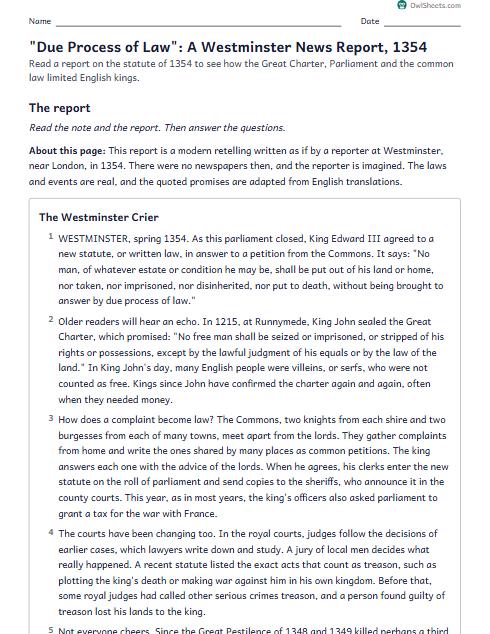
"Due Process of Law": A Westminster News Report, 1354
Grade 7 · CIV.7.1
13 questionsPremium
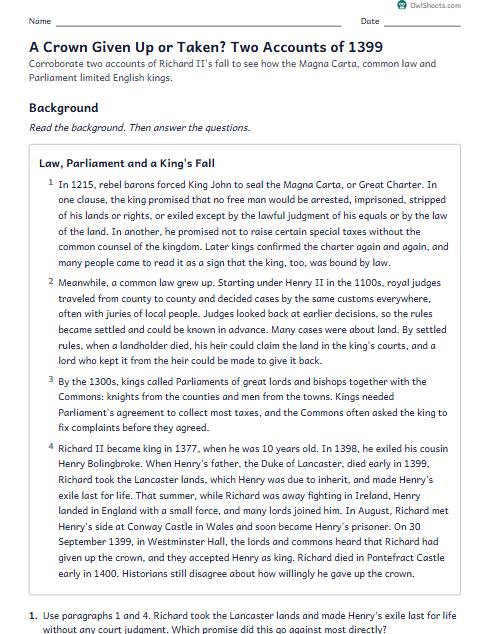
A Crown Given Up or Taken? Two Accounts of 1399
Grade 7 · CIV.7.1
15 questionsPremium
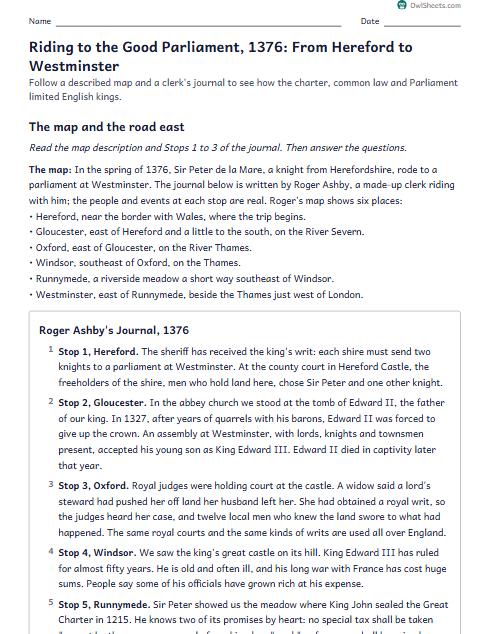
Riding to the Good Parliament, 1376: From Hereford to Westminster
Grade 7 · CIV.7.1
14 questionsPremium
Charters, Rolls and Battles: A Historian's Notes from Salisbury to Marlborough
Grade 7 · CIV.7.1
13 questionsPremium
Iron, Ink and Summons: How English Law Bound the Crown
Grade 7 · CIV.7.1
11 questionsPremium
Showdown at Oxford, 1258: Should the King Answer to a Council?
Grade 7 · CIV.7.1
10 questionsPremium