Grade 6 · Social StudiesHIS.6.5Premium
Bells, Bamboo and Earth Walls: A Museum Hall of Ancient China
Grade 6 ancient China: read museum labels on the Zeng bells, Qin bamboo slips, a rammed-earth wall, Han silk and early paper, with a dynasty timeline.
Preview
OwlSheets.com
Bells, Bamboo and Earth Walls: A Museum Hall of Ancient China
Read five artifact labels and a dynasty timeline to study Confucius, Qin law, the walls, silk and paper.
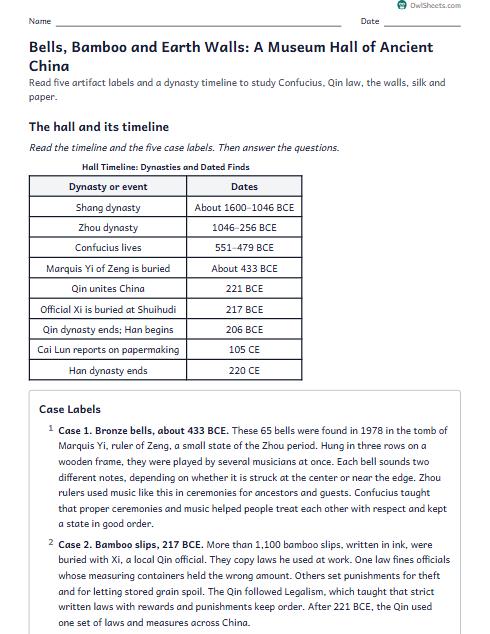
The hall and its timeline
Read the timeline and the five case labels. Then answer the questions.
| Dynasty or event | Dates |
|---|---|
| Shang dynasty | About 1600–1046 BCE |
| Zhou dynasty | 1046–256 BCE |
| Confucius lives | 551–479 BCE |
| Marquis Yi of Zeng is buried | About 433 BCE |
| Qin unites China | 221 BCE |
| Official Xi is buried at Shuihudi | 217 BCE |
| Qin dynasty ends; Han begins | 206 BCE |
| Cai Lun reports on papermaking | 105 CE |
| Han dynasty ends | 220 CE |
Case Labels
1Case 1. Bronze bells, about 433 BCE. These 65 bells were found in 1978 in the tomb of Marquis Yi, ruler of Zeng, a small state of the Zhou period. Hung in three rows on a wooden frame, they were played by several musicians at once. Each bell sounds two different notes, depending on whether it is struck at the center or near the edge. Zhou rulers used music like this in ceremonies for ancestors and guests. Confucius taught that proper ceremonies and music helped people treat each other with respect and kept a state in good order.
2Case 2. Bamboo slips, 217 BCE. More than 1,100 bamboo slips, written in ink, were buried with Xi, a local Qin official. They copy laws he used at work. One law fines officials whose measuring containers held the wrong amount. Others set punishments for theft and for letting stored grain spoil. The Qin followed Legalism, which taught that strict written laws with rewards and punishments keep order. After 221 BCE, the Qin used one set of laws and measures across China.
3Case 3. Rammed earth from a northern wall, 200s BCE. Long before the Qin, northern states such as Zhao and Yan built walls against horse-riding raiders from the steppe. After 221 BCE, the Qin joined and extended some of these walls. Workers pounded damp earth in layers about 10 centimeters thick inside wooden frames. Watchtowers along the walls sent warnings with smoke by day and fire at night. Most of the brick wall that visitors see near Beijing today was built more than 1,500 years later.
4Case 4. Silk from Palmyra, 1st–2nd century CE. This patterned silk was woven in Han China and found in a tomb at Palmyra, a caravan city in the Syrian desert more than 6,000 kilometers away. Silk passed from trader to trader along the routes later called the Silk Road, and few merchants traveled the whole way. Silk making in China goes back at least to Shang times. Raising silkworms on mulberry leaves and reeling their thread was skilled work, done mostly by women in farm households.
5Case 5. Paper with a map, 100s BCE. This thin scrap of paper, found in a Han tomb at Fangmatan, shows lines that look like part of a map. Historians date it to the 100s BCE, though some debate the exact date. In 105 CE, the court official Cai Lun reported a method for making paper from tree bark, hemp, old rags and fishing nets. Before paper, Chinese writers mostly used bamboo slips, which were heavy, or silk, which was costly.
- A. Court music like the kind Confucius praised still mattered after he died.
- B. Zeng's rulers gave up court ceremonies soon after Confucius died.
- C. Confucius had these bells made so that rulers would honor his teachings.
- D. The bells show that Qin rulers used music in place of written laws.
The preview shows the first questions. Unlock the worksheet to see all of it.
Related worksheets
Envoy Back from the Western Sea: A Han Capital Report, About 98 CE
Grade 6 · HIS.6.5
13 questionsPremium
Students, Households and Bamboo: Ancient China in the Tables
Grade 6 · HIS.6.5
14 questionsPremium
Rails Through the Old Capitals: A Map Journey Across Ancient China
Grade 6 · HIS.6.5
14 questionsPremium
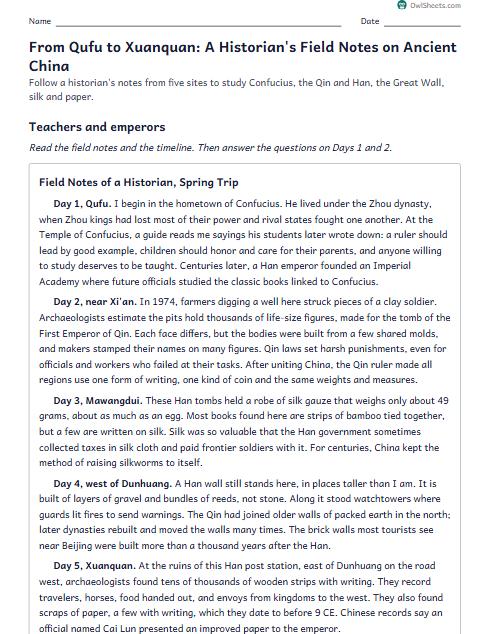
From Qufu to Xuanquan: A Historian's Field Notes on Ancient China
Grade 6 · HIS.6.5
14 questionsPremium
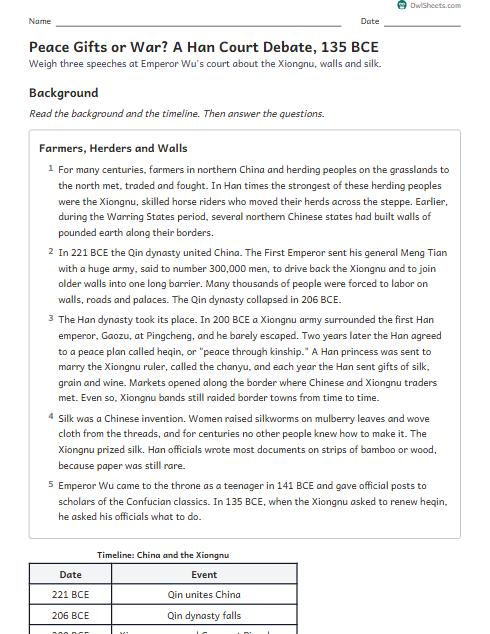
Peace Gifts or War? A Han Court Debate, 135 BCE
Grade 6 · HIS.6.5
11 questionsFree
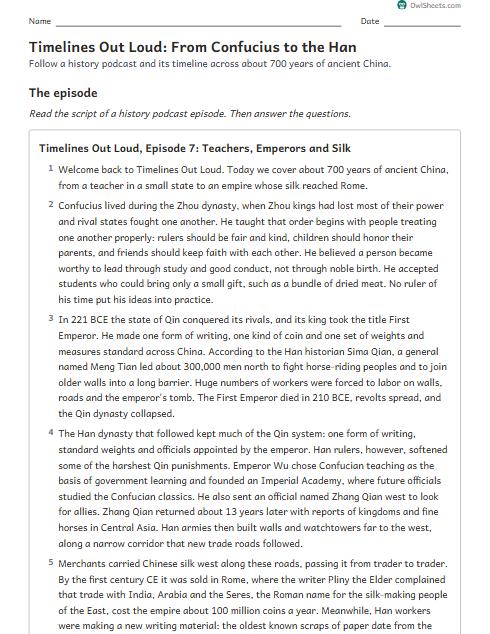
Timelines Out Loud: From Confucius to the Han
Grade 6 · HIS.6.5
11 questionsPremium