Grade 6 · Social StudiesHIS.6.5Premium
From Qufu to Xuanquan: A Historian's Field Notes on Ancient China
Grade 6 ancient China: a historian's notes from Qufu, the terracotta army, Mawangdui, a Han wall and a Han post station, with a dynasty timeline.
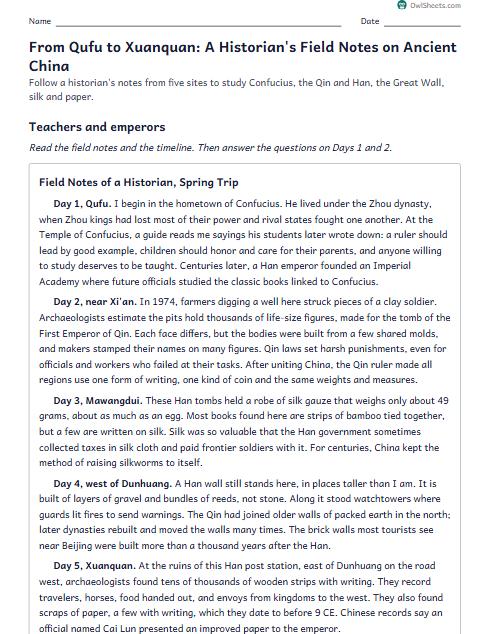
Preview
OwlSheets.com
From Qufu to Xuanquan: A Historian's Field Notes on Ancient China
Follow a historian's notes from five sites to study Confucius, the Qin and Han, the Great Wall, silk and paper.
Teachers and emperors
Read the field notes and the timeline. Then answer the questions on Days 1 and 2.
Field Notes of a Historian, Spring Trip
Day 1, Qufu. I begin in the hometown of Confucius. He lived under the Zhou dynasty, when Zhou kings had lost most of their power and rival states fought one another. At the Temple of Confucius, a guide reads me sayings his students later wrote down: a ruler should lead by good example, children should honor and care for their parents, and anyone willing to study deserves to be taught. Centuries later, a Han emperor founded an Imperial Academy where future officials studied the classic books linked to Confucius.
Day 2, near Xi'an. In 1974, farmers digging a well here struck pieces of a clay soldier. Archaeologists estimate the pits hold thousands of life-size figures, made for the tomb of the First Emperor of Qin. Each face differs, but the bodies were built from a few shared molds, and makers stamped their names on many figures. Qin laws set harsh punishments, even for officials and workers who failed at their tasks. After uniting China, the Qin ruler made all regions use one form of writing, one kind of coin and the same weights and measures.
Day 3, Mawangdui. These Han tombs held a robe of silk gauze that weighs only about 49 grams, about as much as an egg. Most books found here are strips of bamboo tied together, but a few are written on silk. Silk was so valuable that the Han government sometimes collected taxes in silk cloth and paid frontier soldiers with it. For centuries, China kept the method of raising silkworms to itself.
Day 4, west of Dunhuang. A Han wall still stands here, in places taller than I am. It is built of layers of gravel and bundles of reeds, not stone. Along it stood watchtowers where guards lit fires to send warnings. The Qin had joined older walls of packed earth in the north; later dynasties rebuilt and moved the walls many times. The brick walls most tourists see near Beijing were built more than a thousand years after the Han.
Day 5, Xuanquan. At the ruins of this Han post station, east of Dunhuang on the road west, archaeologists found tens of thousands of wooden strips with writing. They record travelers, horses, food handed out, and envoys from kingdoms to the west. They also found scraps of paper, a few with writing, which they date to before 9 CE. Chinese records say an official named Cai Lun presented an improved paper to the emperor.
| Date | Event |
|---|---|
| About 1046–256 BCE | Zhou dynasty |
| 551–479 BCE | Confucius lives |
| 221 BCE | Qin unites China |
| 210 BCE | First Emperor of Qin dies |
| 206 BCE–220 CE | Han dynasty |
| About 168 BCE | Mawangdui tombs sealed |
| 124 BCE | Imperial Academy founded |
| About 100 BCE | Han wall built west of Dunhuang |
| 105 CE | Cai Lun presents improved paper |
- A. Stay and care for his father, then seek a post later
- B. Send money home but stop writing to his family
- C. Leave home and keep his father's illness a secret
- D. Take the post at once, since his career comes first
The preview shows the first questions. Unlock the worksheet to see all of it.
Related worksheets
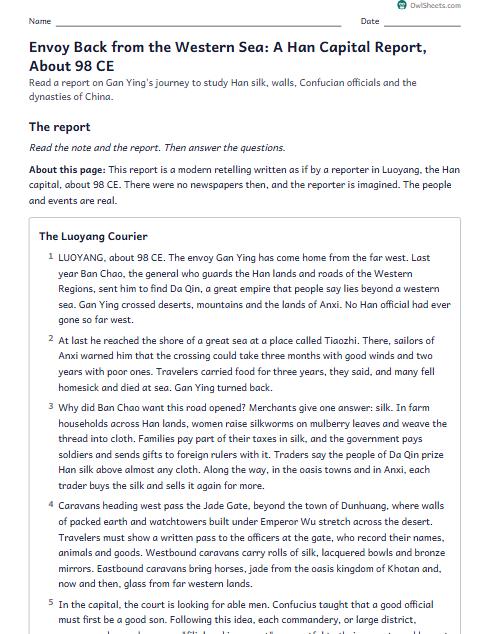
Envoy Back from the Western Sea: A Han Capital Report, About 98 CE
Grade 6 · HIS.6.5
13 questionsPremium
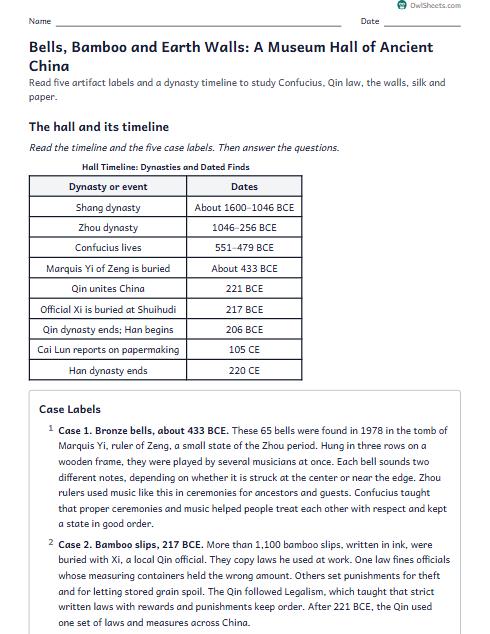
Bells, Bamboo and Earth Walls: A Museum Hall of Ancient China
Grade 6 · HIS.6.5
15 questionsPremium
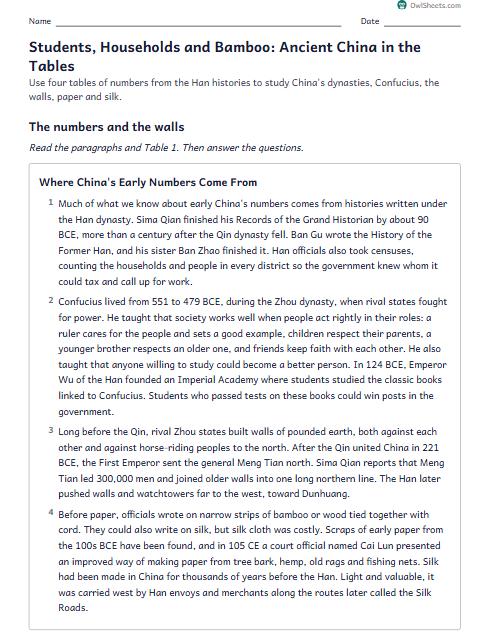
Students, Households and Bamboo: Ancient China in the Tables
Grade 6 · HIS.6.5
14 questionsPremium
Rails Through the Old Capitals: A Map Journey Across Ancient China
Grade 6 · HIS.6.5
14 questionsPremium
Peace Gifts or War? A Han Court Debate, 135 BCE
Grade 6 · HIS.6.5
11 questionsFree
Timelines Out Loud: From Confucius to the Han
Grade 6 · HIS.6.5
11 questionsPremium