Grade 6 · Social StudiesHIS.6.5Premium
Students, Households and Bamboo: Ancient China in the Tables
Grade 6 ancient China: read tables of dynasties, Imperial Academy students, Han census counts and bamboo records to study Confucius, the walls, paper and silk.
Preview
OwlSheets.com
Students, Households and Bamboo: Ancient China in the Tables
Use four tables of numbers from the Han histories to study China's dynasties, Confucius, the walls, paper and silk.
The numbers and the walls
Read the paragraphs and Table 1. Then answer the questions.
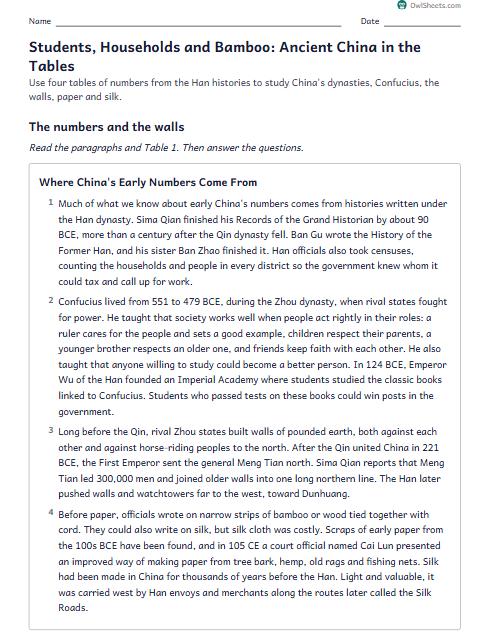
Where China's Early Numbers Come From
1Much of what we know about early China's numbers comes from histories written under the Han dynasty. Sima Qian finished his Records of the Grand Historian by about 90 BCE, more than a century after the Qin dynasty fell. Ban Gu wrote the History of the Former Han, and his sister Ban Zhao finished it. Han officials also took censuses, counting the households and people in every district so the government knew whom it could tax and call up for work.
2Confucius lived from 551 to 479 BCE, during the Zhou dynasty, when rival states fought for power. He taught that society works well when people act rightly in their roles: a ruler cares for the people and sets a good example, children respect their parents, a younger brother respects an older one, and friends keep faith with each other. He also taught that anyone willing to study could become a better person. In 124 BCE, Emperor Wu of the Han founded an Imperial Academy where students studied the classic books linked to Confucius. Students who passed tests on these books could win posts in the government.
3Long before the Qin, rival Zhou states built walls of pounded earth, both against each other and against horse-riding peoples to the north. After the Qin united China in 221 BCE, the First Emperor sent the general Meng Tian north. Sima Qian reports that Meng Tian led 300,000 men and joined older walls into one long northern line. The Han later pushed walls and watchtowers far to the west, toward Dunhuang.
4Before paper, officials wrote on narrow strips of bamboo or wood tied together with cord. They could also write on silk, but silk cloth was costly. Scraps of early paper from the 100s BCE have been found, and in 105 CE a court official named Cai Lun presented an improved way of making paper from tree bark, hemp, old rags and fishing nets. Silk had been made in China for thousands of years before the Han. Light and valuable, it was carried west by Han envoys and merchants along the routes later called the Silk Roads.
| Dynasty | About when it ruled | One development |
|---|---|---|
| Shang | about 1600–1046 BCE | Oracle bones with early writing |
| Zhou | 1046–256 BCE | Confucius teaches; states build walls |
| Qin | 221–206 BCE | China united; walls joined |
| Han | 206 BCE–220 CE | Imperial Academy; paper improved |
- A. Walls of pounded earth stood for only a few years.
- B. Horse-riding peoples had moved into southern China.
- C. The Han had already torn those inner walls down.
- D. One ruler now held the lands on both sides of them.
The preview shows the first questions. Unlock the worksheet to see all of it.
Related worksheets
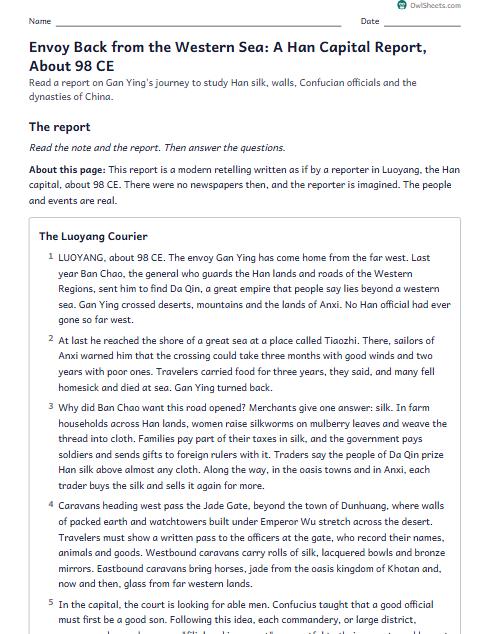
Envoy Back from the Western Sea: A Han Capital Report, About 98 CE
Grade 6 · HIS.6.5
13 questionsPremium
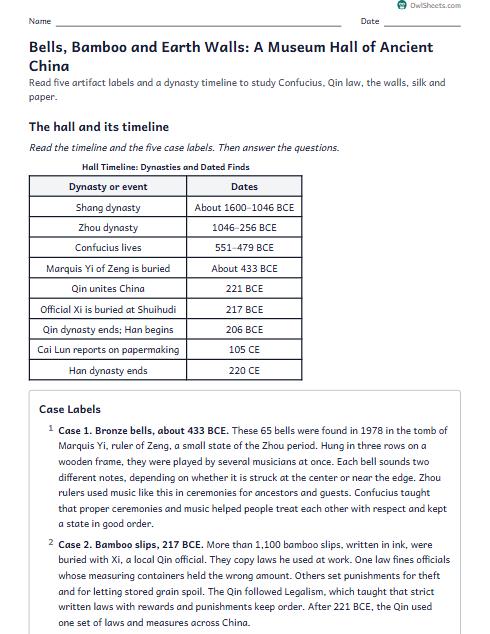
Bells, Bamboo and Earth Walls: A Museum Hall of Ancient China
Grade 6 · HIS.6.5
15 questionsPremium
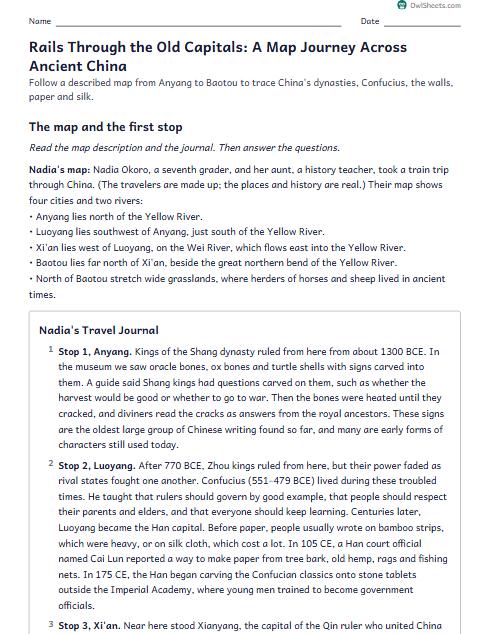
Rails Through the Old Capitals: A Map Journey Across Ancient China
Grade 6 · HIS.6.5
14 questionsPremium
From Qufu to Xuanquan: A Historian's Field Notes on Ancient China
Grade 6 · HIS.6.5
14 questionsPremium
Peace Gifts or War? A Han Court Debate, 135 BCE
Grade 6 · HIS.6.5
11 questionsFree
Timelines Out Loud: From Confucius to the Han
Grade 6 · HIS.6.5
11 questionsPremium