Grade 6 · Social StudiesHIS.6.5Premium
Rails Through the Old Capitals: A Map Journey Across Ancient China
Grade 6 ancient China: follow a train trip on a described map from Shang Anyang to Han Luoyang, Qin Xi'an and the northern walls at Baotou.
Preview
OwlSheets.com
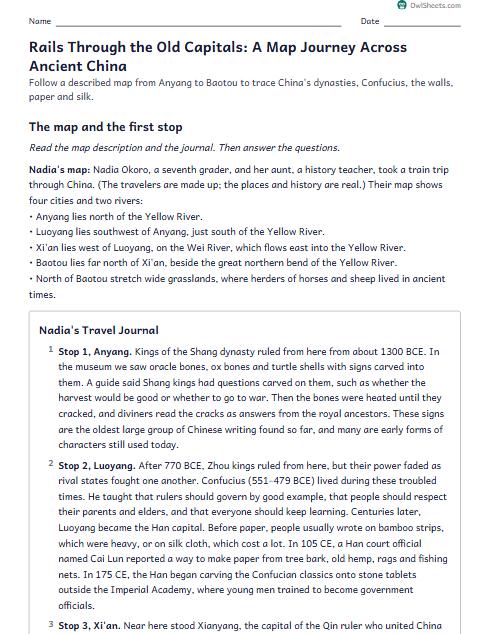
Rails Through the Old Capitals: A Map Journey Across Ancient China
Follow a described map from Anyang to Baotou to trace China's dynasties, Confucius, the walls, paper and silk.
The map and the first stop
Read the map description and the journal. Then answer the questions.
• Anyang lies north of the Yellow River.
• Luoyang lies southwest of Anyang, just south of the Yellow River.
• Xi'an lies west of Luoyang, on the Wei River, which flows east into the Yellow River.
• Baotou lies far north of Xi'an, beside the great northern bend of the Yellow River.
• North of Baotou stretch wide grasslands, where herders of horses and sheep lived in ancient times.
Nadia's Travel Journal
1Stop 1, Anyang. Kings of the Shang dynasty ruled from here from about 1300 BCE. In the museum we saw oracle bones, ox bones and turtle shells with signs carved into them. A guide said Shang kings had questions carved on them, such as whether the harvest would be good or whether to go to war. Then the bones were heated until they cracked, and diviners read the cracks as answers from the royal ancestors. These signs are the oldest large group of Chinese writing found so far, and many are early forms of characters still used today.
2Stop 2, Luoyang. After 770 BCE, Zhou kings ruled from here, but their power faded as rival states fought one another. Confucius (551–479 BCE) lived during these troubled times. He taught that rulers should govern by good example, that people should respect their parents and elders, and that everyone should keep learning. Centuries later, Luoyang became the Han capital. Before paper, people usually wrote on bamboo strips, which were heavy, or on silk cloth, which cost a lot. In 105 CE, a Han court official named Cai Lun reported a way to make paper from tree bark, old hemp, rags and fishing nets. In 175 CE, the Han began carving the Confucian classics onto stone tablets outside the Imperial Academy, where young men trained to become government officials.
3Stop 3, Xi'an. Near here stood Xianyang, the capital of the Qin ruler who united China in 221 BCE and called himself the First Emperor. The rival states had each used their own coins and their own ways of writing. The Qin made the whole empire use one writing system, one kind of coin and the same weights. After the Qin fell, the Han built their first capital, Chang'an, here. Silk, woven from the threads of silkworm cocoons, became one of China's most valued goods in distant lands.
4Stop 4, Baotou. Around 214 BCE, the First Emperor sent his general Meng Tian north with a large army to drive back the Xiongnu, horse-riding herders of the grasslands, and to join older walls into one long line of defense. Meng Tian also built the Straight Road, which ran more than 700 kilometers from near the Qin capital to this bend of the river. These early walls were mostly pounded earth and stone, not brick.
- A. Northeast
- B. Southwest
- C. Southeast
- D. Northwest
The preview shows the first questions. Unlock the worksheet to see all of it.
Related worksheets
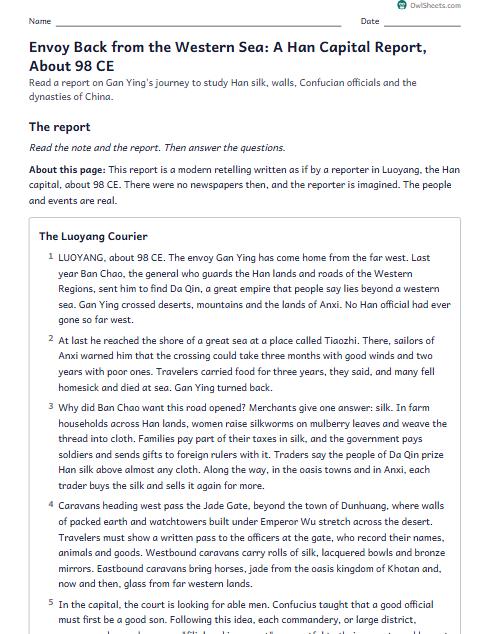
Envoy Back from the Western Sea: A Han Capital Report, About 98 CE
Grade 6 · HIS.6.5
13 questionsPremium
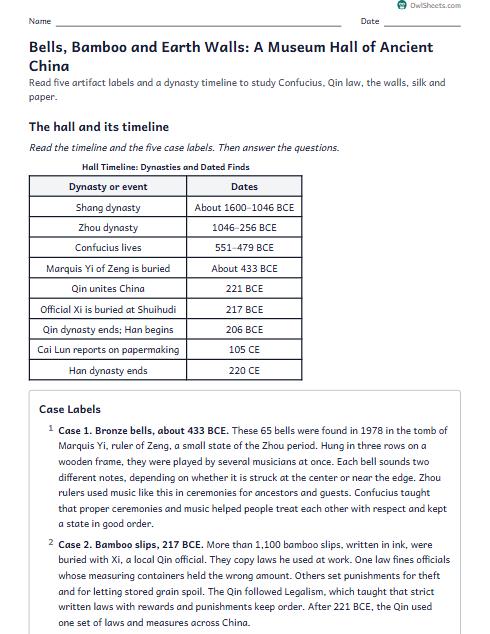
Bells, Bamboo and Earth Walls: A Museum Hall of Ancient China
Grade 6 · HIS.6.5
15 questionsPremium
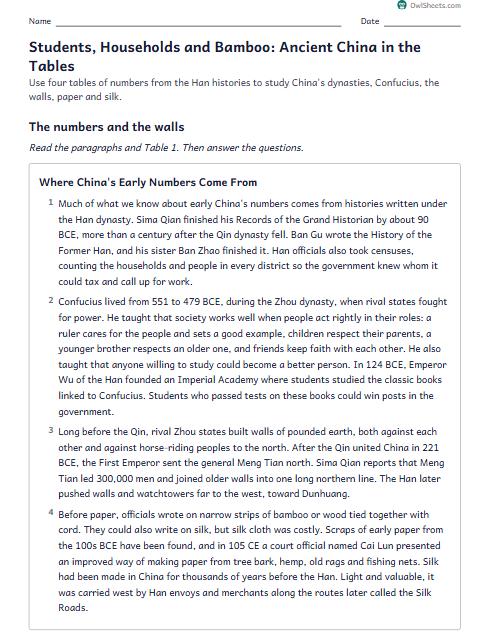
Students, Households and Bamboo: Ancient China in the Tables
Grade 6 · HIS.6.5
14 questionsPremium
From Qufu to Xuanquan: A Historian's Field Notes on Ancient China
Grade 6 · HIS.6.5
14 questionsPremium
Peace Gifts or War? A Han Court Debate, 135 BCE
Grade 6 · HIS.6.5
11 questionsFree
Timelines Out Loud: From Confucius to the Han
Grade 6 · HIS.6.5
11 questionsPremium