Grade 6 · Social StudiesECO.6.3Premium
Clay, Reeds, Skins and Rags: A Gallery of Scarce Pages
Grade 6 economics: museum labels on ancient writing materials, from clay to early paper, show scarcity and opportunity cost, then a library choice today.
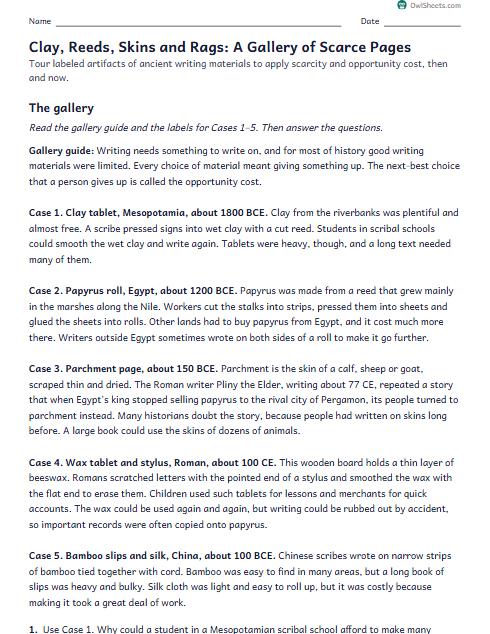
Preview
OwlSheets.com
Name Date
Clay, Reeds, Skins and Rags: A Gallery of Scarce Pages
Tour labeled artifacts of ancient writing materials to apply scarcity and opportunity cost, then and now.
The gallery
Read the gallery guide and the labels for Cases 1–5. Then answer the questions.
Gallery guide: Writing needs something to write on, and for most of history good writing materials were limited. Every choice of material meant giving something up. The next-best choice that a person gives up is called the opportunity cost.
Case 1. Clay tablet, Mesopotamia, about 1800 BCE. Clay from the riverbanks was plentiful and almost free. A scribe pressed signs into wet clay with a cut reed. Students in scribal schools could smooth the wet clay and write again. Tablets were heavy, though, and a long text needed many of them.
Case 2. Papyrus roll, Egypt, about 1200 BCE. Papyrus was made from a reed that grew mainly in the marshes along the Nile. Workers cut the stalks into strips, pressed them into sheets and glued the sheets into rolls. Other lands had to buy papyrus from Egypt, and it cost much more there. Writers outside Egypt sometimes wrote on both sides of a roll to make it go further.
Case 3. Parchment page, about 150 BCE. Parchment is the skin of a calf, sheep or goat, scraped thin and dried. The Roman writer Pliny the Elder, writing about 77 CE, repeated a story that when Egypt's king stopped selling papyrus to the rival city of Pergamon, its people turned to parchment instead. Many historians doubt the story, because people had written on skins long before. A large book could use the skins of dozens of animals.
Case 4. Wax tablet and stylus, Roman, about 100 CE. This wooden board holds a thin layer of beeswax. Romans scratched letters with the pointed end of a stylus and smoothed the wax with the flat end to erase them. Children used such tablets for lessons and merchants for quick accounts. The wax could be used again and again, but writing could be rubbed out by accident, so important records were often copied onto papyrus.
Case 5. Bamboo slips and silk, China, about 100 BCE. Chinese scribes wrote on narrow strips of bamboo tied together with cord. Bamboo was easy to find in many areas, but a long book of slips was heavy and bulky. Silk cloth was light and easy to roll up, but it was costly because making it took a great deal of work.
1.
Use Case 1. Why could a student in a Mesopotamian scribal school afford to make many mistakes?
- A. Tablets were light, so spoiled ones were easy to carry away.
- B. Students wrote on papyrus that was brought cheaply from Egypt.
- C. Teachers paid for each new tablet out of their own silver.
- D. Clay was plentiful, and wet clay could be smoothed and reused.
2.
Use Case 2. Why was papyrus scarce and costly in lands outside Egypt?
- A. It was made from animal skins that took months to prepare.
- B. It could be written on only once and then had to be thrown away.
- C. Its reed grew mainly by the Nile, so others had to buy it.
- D. Egypt's scribes used up nearly all of it for their own records.
The preview shows the first questions. Unlock the worksheet to see all of it.
Related worksheets
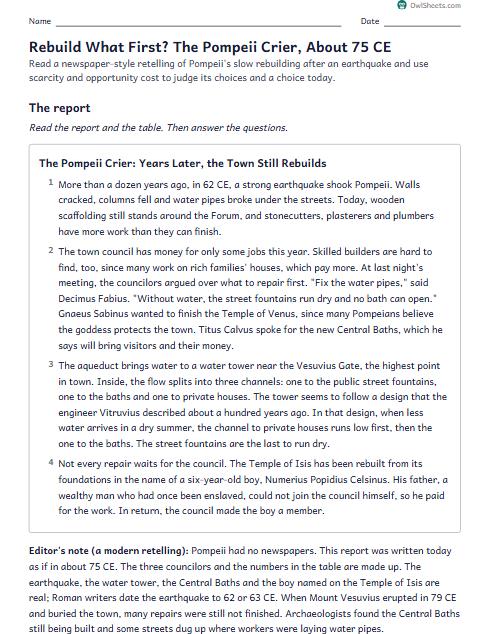
Rebuild What First? The Pompeii Crier, About 75 CE
Grade 6 · ECO.6.3
14 questionsPremium
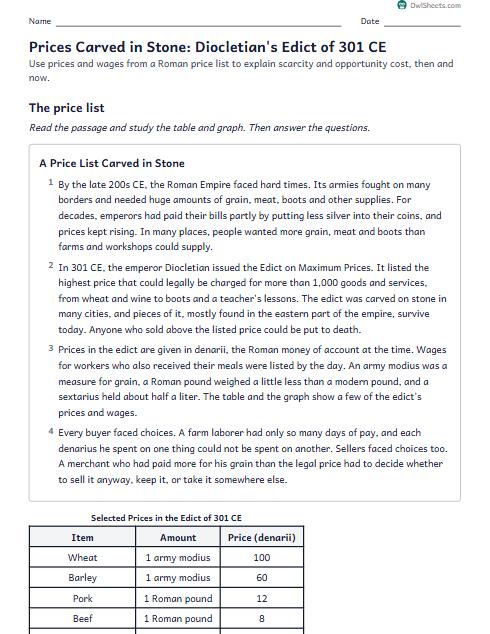
Prices Carved in Stone: Diocletian's Edict of 301 CE
Grade 6 · ECO.6.3
15 questionsPremium
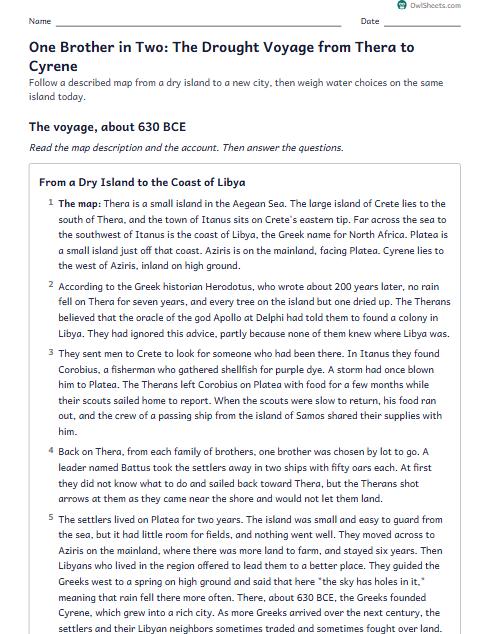
One Brother in Two: The Drought Voyage from Thera to Cyrene
Grade 6 · ECO.6.3
14 questionsPremium
Water Turns in the Desert: Field Notes from Nazca, Peru
Grade 6 · ECO.6.3
13 questionsPremium
The Salt and Iron Debate of 81 BCE
Grade 6 · ECO.6.3
11 questionsPremium
Bread for a Million: Rome's Grain Choices
Grade 6 · ECO.6.3
11 questionsPremium