Grade 6 · Social StudiesECO.6.3Premium
One Brother in Two: The Drought Voyage from Thera to Cyrene
Grade 6 economics: follow the Therans' voyage to found Cyrene and a guesthouse's water budget on Santorini today to apply scarcity and opportunity cost.
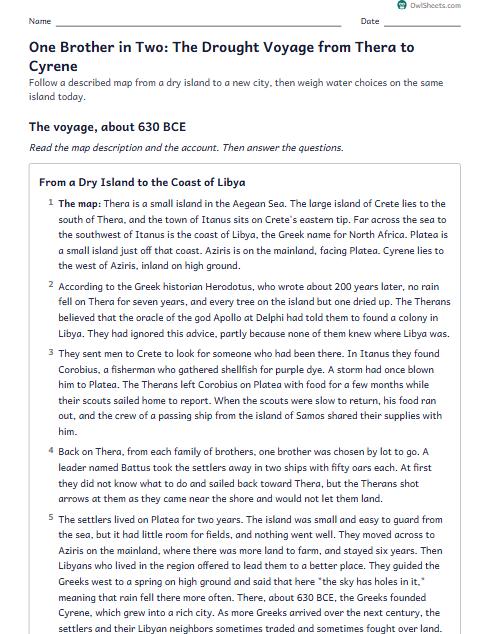
Preview
OwlSheets.com
One Brother in Two: The Drought Voyage from Thera to Cyrene
Follow a described map from a dry island to a new city, then weigh water choices on the same island today.
The voyage, about 630 BCE
Read the map description and the account. Then answer the questions.
From a Dry Island to the Coast of Libya
1The map: Thera is a small island in the Aegean Sea. The large island of Crete lies to the south of Thera, and the town of Itanus sits on Crete's eastern tip. Far across the sea to the southwest of Itanus is the coast of Libya, the Greek name for North Africa. Platea is a small island just off that coast. Aziris is on the mainland, facing Platea. Cyrene lies to the west of Aziris, inland on high ground.
2According to the Greek historian Herodotus, who wrote about 200 years later, no rain fell on Thera for seven years, and every tree on the island but one dried up. The Therans believed that the oracle of the god Apollo at Delphi had told them to found a colony in Libya. They had ignored this advice, partly because none of them knew where Libya was.
3They sent men to Crete to look for someone who had been there. In Itanus they found Corobius, a fisherman who gathered shellfish for purple dye. A storm had once blown him to Platea. The Therans left Corobius on Platea with food for a few months while their scouts sailed home to report. When the scouts were slow to return, his food ran out, and the crew of a passing ship from the island of Samos shared their supplies with him.
4Back on Thera, from each family of brothers, one brother was chosen by lot to go. A leader named Battus took the settlers away in two ships with fifty oars each. At first they did not know what to do and sailed back toward Thera, but the Therans shot arrows at them as they came near the shore and would not let them land.
5The settlers lived on Platea for two years. The island was small and easy to guard from the sea, but it had little room for fields, and nothing went well. They moved across to Aziris on the mainland, where there was more land to farm, and stayed six years. Then Libyans who lived in the region offered to lead them to a better place. They guided the Greeks west to a spring on high ground and said that here "the sky has holes in it," meaning that rain fell there more often. There, about 630 BCE, the Greeks founded Cyrene, which grew into a rich city. As more Greeks arrived over the next century, the settlers and their Libyan neighbors sometimes traded and sometimes fought over land.
- A. A shortage of ships to carry their goods to Crete
- B. A shortage of guides who knew the way to Delphi
- C. A shortage of rain, which left the island's land dry
- D. A shortage of purple dye to trade with Samos
- A. The work he would have done on the family's land
- B. The land in Libya that he may farm someday
- C. The food that Corobius ate while waiting on Platea
- D. The arrows the Therans shot at the returning ships
The preview shows the first questions. Unlock the worksheet to see all of it.
Related worksheets
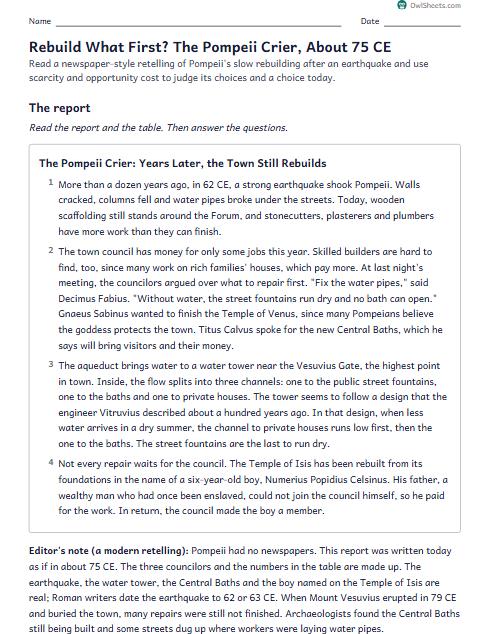
Rebuild What First? The Pompeii Crier, About 75 CE
Grade 6 · ECO.6.3
14 questionsPremium
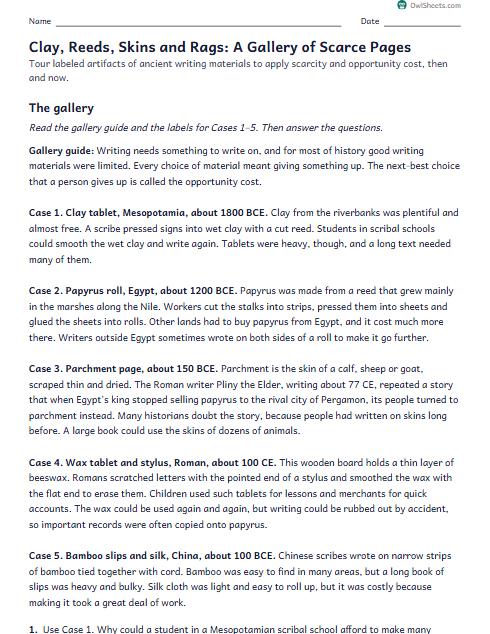
Clay, Reeds, Skins and Rags: A Gallery of Scarce Pages
Grade 6 · ECO.6.3
14 questionsPremium
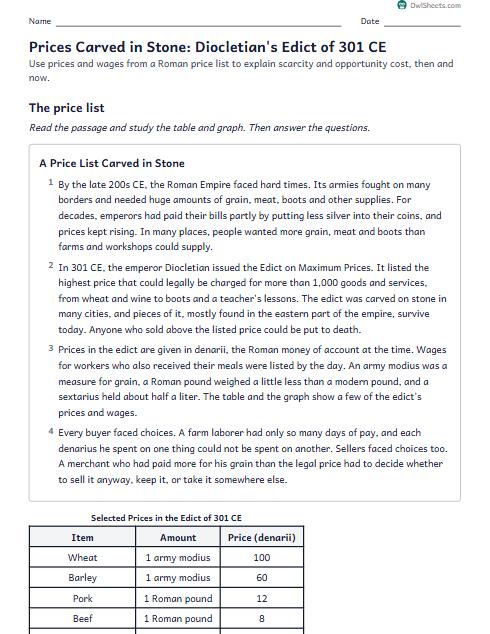
Prices Carved in Stone: Diocletian's Edict of 301 CE
Grade 6 · ECO.6.3
15 questionsPremium
Water Turns in the Desert: Field Notes from Nazca, Peru
Grade 6 · ECO.6.3
13 questionsPremium
The Salt and Iron Debate of 81 BCE
Grade 6 · ECO.6.3
11 questionsPremium
Bread for a Million: Rome's Grain Choices
Grade 6 · ECO.6.3
11 questionsPremium