Grade 6 · Social StudiesECO.6.3Premium
Prices Carved in Stone: Diocletian's Edict of 301 CE
Grade 6 economics: use prices and wages from Diocletian's Edict of 301 CE, a source by Lactantius and a teen's budget to explain scarcity and opportunity cost.
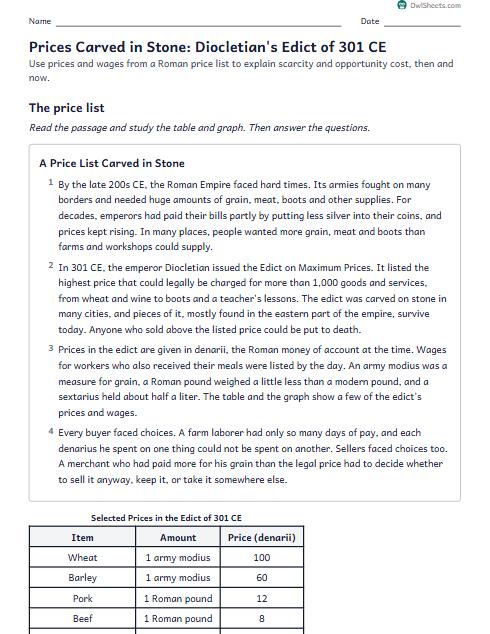
Preview
OwlSheets.com
Prices Carved in Stone: Diocletian's Edict of 301 CE
Use prices and wages from a Roman price list to explain scarcity and opportunity cost, then and now.
The price list
Read the passage and study the table and graph. Then answer the questions.
A Price List Carved in Stone
1By the late 200s CE, the Roman Empire faced hard times. Its armies fought on many borders and needed huge amounts of grain, meat, boots and other supplies. For decades, emperors had paid their bills partly by putting less silver into their coins, and prices kept rising. In many places, people wanted more grain, meat and boots than farms and workshops could supply.
2In 301 CE, the emperor Diocletian issued the Edict on Maximum Prices. It listed the highest price that could legally be charged for more than 1,000 goods and services, from wheat and wine to boots and a teacher's lessons. The edict was carved on stone in many cities, and pieces of it, mostly found in the eastern part of the empire, survive today. Anyone who sold above the listed price could be put to death.
3Prices in the edict are given in denarii, the Roman money of account at the time. Wages for workers who also received their meals were listed by the day. An army modius was a measure for grain, a Roman pound weighed a little less than a modern pound, and a sextarius held about half a liter. The table and the graph show a few of the edict's prices and wages.
4Every buyer faced choices. A farm laborer had only so many days of pay, and each denarius he spent on one thing could not be spent on another. Sellers faced choices too. A merchant who had paid more for his grain than the legal price had to decide whether to sell it anyway, keep it, or take it somewhere else.
| Item | Amount | Price (denarii) |
|---|---|---|
| Wheat | 1 army modius | 100 |
| Barley | 1 army modius | 60 |
| Pork | 1 Roman pound | 12 |
| Beef | 1 Roman pound | 8 |
| Ordinary wine | 1 sextarius | 8 |
| Farm workers' boots | 1 pair | 120 |
The preview shows the first questions. Unlock the worksheet to see all of it.
Related worksheets
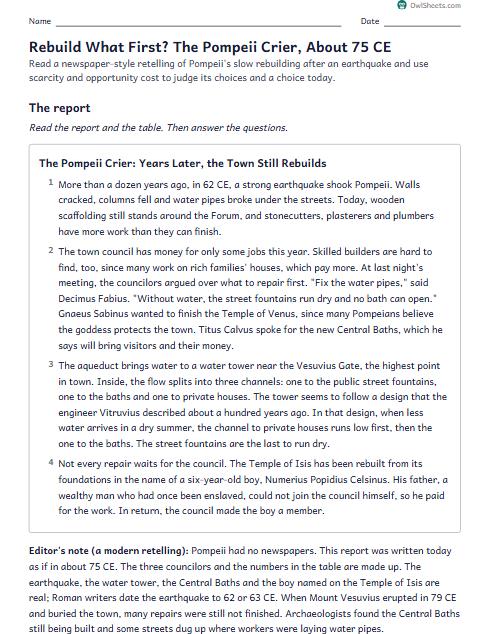
Rebuild What First? The Pompeii Crier, About 75 CE
Grade 6 · ECO.6.3
14 questionsPremium
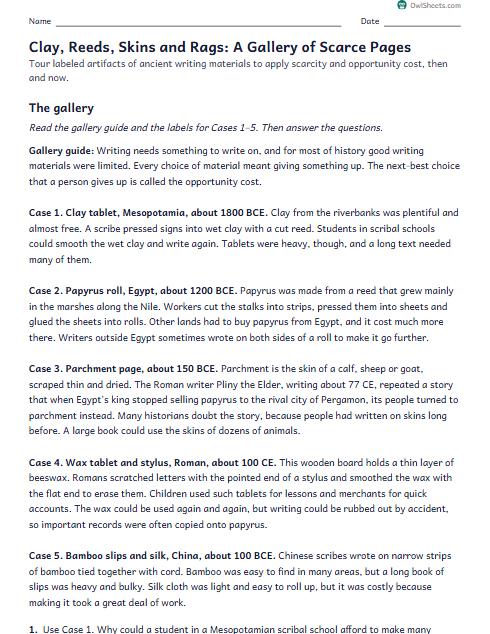
Clay, Reeds, Skins and Rags: A Gallery of Scarce Pages
Grade 6 · ECO.6.3
14 questionsPremium
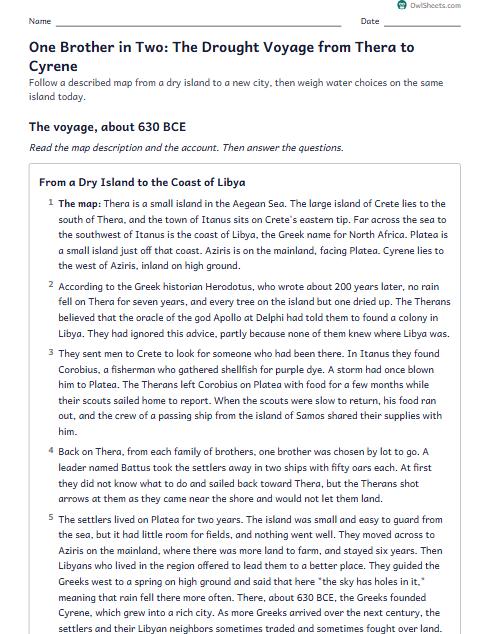
One Brother in Two: The Drought Voyage from Thera to Cyrene
Grade 6 · ECO.6.3
14 questionsPremium
Water Turns in the Desert: Field Notes from Nazca, Peru
Grade 6 · ECO.6.3
13 questionsPremium
The Salt and Iron Debate of 81 BCE
Grade 6 · ECO.6.3
11 questionsPremium
Bread for a Million: Rome's Grain Choices
Grade 6 · ECO.6.3
11 questionsPremium