Grade 6 · Social StudiesECO.6.3Premium
Water Turns in the Desert: Field Notes from Nazca, Peru
Grade 6 economics: field notes on the ancient Nazca and a farmer's water plan today show how scarcity and opportunity cost shape choices about water and time.
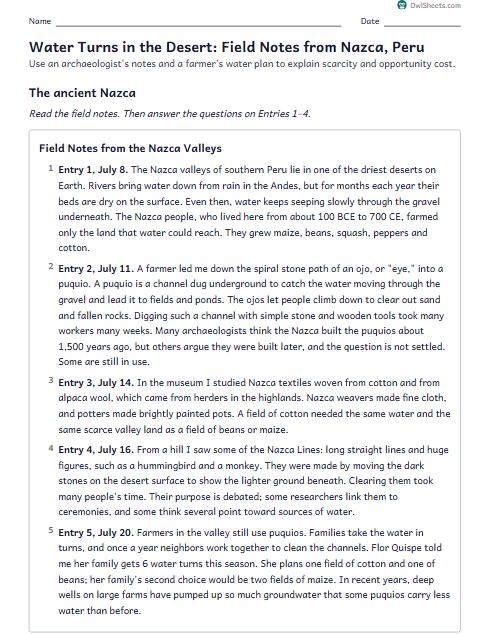
Preview
OwlSheets.com
Water Turns in the Desert: Field Notes from Nazca, Peru
Use an archaeologist's notes and a farmer's water plan to explain scarcity and opportunity cost.
The ancient Nazca
Read the field notes. Then answer the questions on Entries 1–4.
Field Notes from the Nazca Valleys
1Entry 1, July 8. The Nazca valleys of southern Peru lie in one of the driest deserts on Earth. Rivers bring water down from rain in the Andes, but for months each year their beds are dry on the surface. Even then, water keeps seeping slowly through the gravel underneath. The Nazca people, who lived here from about 100 BCE to 700 CE, farmed only the land that water could reach. They grew maize, beans, squash, peppers and cotton.
2Entry 2, July 11. A farmer led me down the spiral stone path of an ojo, or "eye," into a puquio. A puquio is a channel dug underground to catch the water moving through the gravel and lead it to fields and ponds. The ojos let people climb down to clear out sand and fallen rocks. Digging such a channel with simple stone and wooden tools took many workers many weeks. Many archaeologists think the Nazca built the puquios about 1,500 years ago, but others argue they were built later, and the question is not settled. Some are still in use.
3Entry 3, July 14. In the museum I studied Nazca textiles woven from cotton and from alpaca wool, which came from herders in the highlands. Nazca weavers made fine cloth, and potters made brightly painted pots. A field of cotton needed the same water and the same scarce valley land as a field of beans or maize.
4Entry 4, July 16. From a hill I saw some of the Nazca Lines: long straight lines and huge figures, such as a hummingbird and a monkey. They were made by moving the dark stones on the desert surface to show the lighter ground beneath. Clearing them took many people's time. Their purpose is debated; some researchers link them to ceremonies, and some think several point toward sources of water.
5Entry 5, July 20. Farmers in the valley still use puquios. Families take the water in turns, and once a year neighbors work together to clean the channels. Flor Quispe told me her family gets 6 water turns this season. She plans one field of cotton and one of beans; her family's second choice would be two fields of maize. In recent years, deep wells on large farms have pumped up so much groundwater that some puquios carry less water than before.
Rivers bring water down from rain in the Andes, but for months each year their beds are dry on the surface.Even then, water keeps seeping slowly through the gravel underneath.The Nazca people, who lived here from about 100 BCE to 700 CE, farmed only the land that water could reach.They grew maize, beans, squash, peppers and cotton.
The preview shows the first questions. Unlock the worksheet to see all of it.
Related worksheets
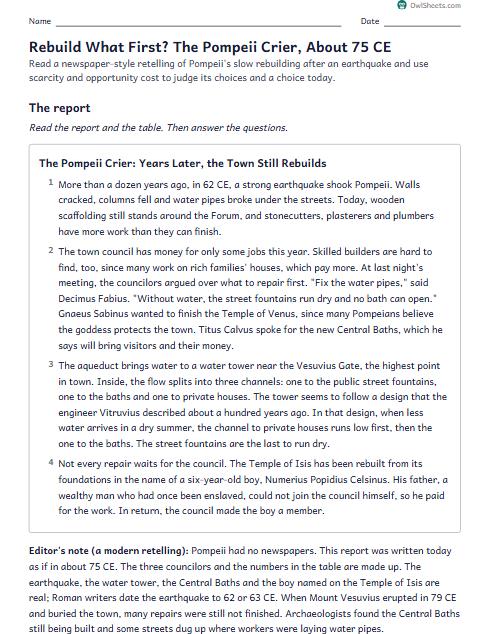
Rebuild What First? The Pompeii Crier, About 75 CE
Grade 6 · ECO.6.3
14 questionsPremium
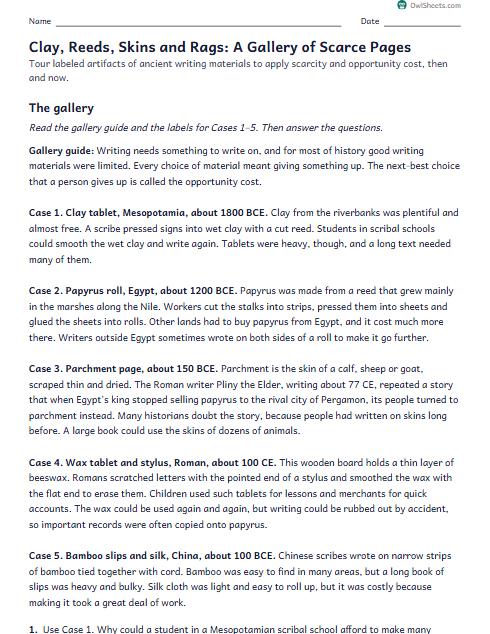
Clay, Reeds, Skins and Rags: A Gallery of Scarce Pages
Grade 6 · ECO.6.3
14 questionsPremium

Prices Carved in Stone: Diocletian's Edict of 301 CE
Grade 6 · ECO.6.3
15 questionsPremium
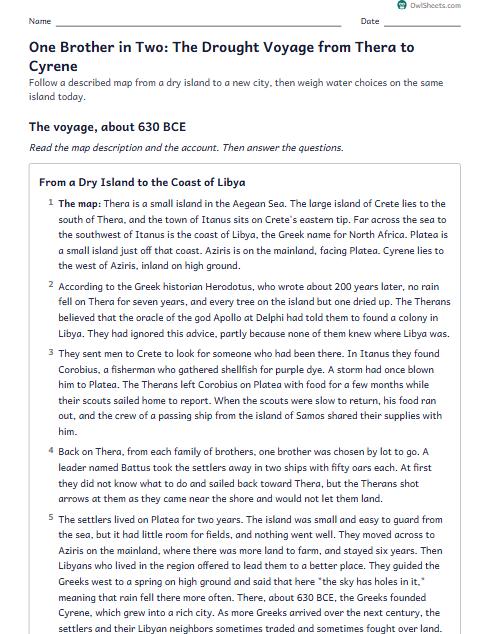
One Brother in Two: The Drought Voyage from Thera to Cyrene
Grade 6 · ECO.6.3
14 questionsPremium
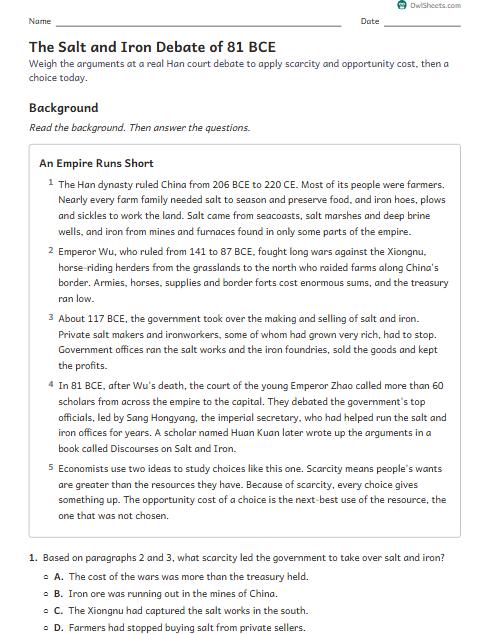
The Salt and Iron Debate of 81 BCE
Grade 6 · ECO.6.3
11 questionsPremium
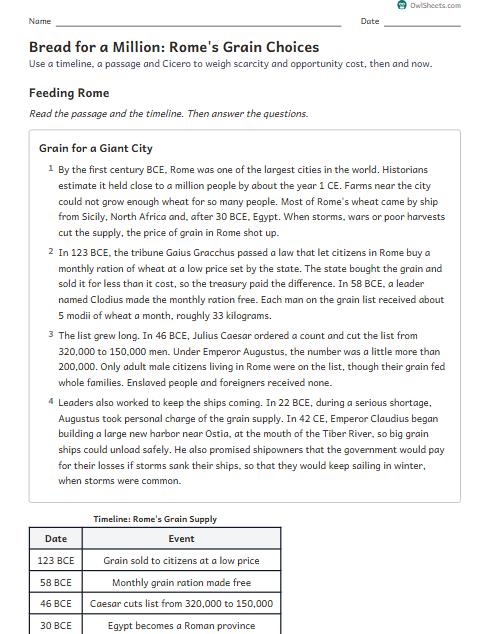
Bread for a Million: Rome's Grain Choices
Grade 6 · ECO.6.3
11 questionsPremium