Grade 6 · Social StudiesHIS.6.2Premium
Digging at Ur, 1927–1929: A Dig Diary from a Sumerian City-State
Grade 6 history: read a made-up diary from the real 1920s dig at Ur to describe a Sumerian city-state, cuneiform, the wheel and irrigation.
Preview
OwlSheets.com
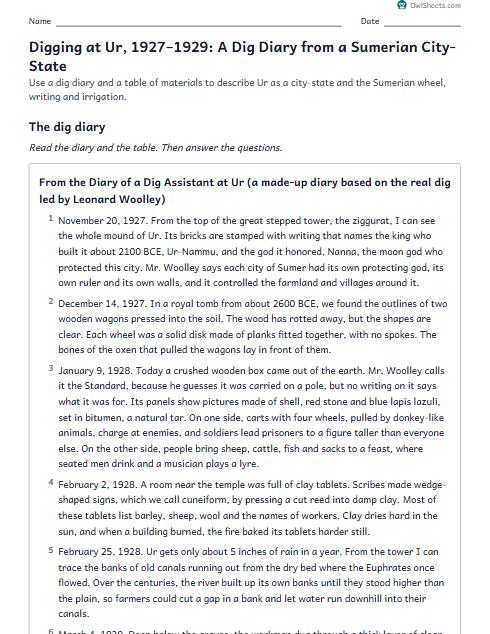
Digging at Ur, 1927–1929: A Dig Diary from a Sumerian City-State
Use a dig diary and a table of materials to describe Ur as a city-state and the Sumerian wheel, writing and irrigation.
The dig diary
Read the diary and the table. Then answer the questions.
From the Diary of a Dig Assistant at Ur (a made-up diary based on the real dig led by Leonard Woolley)
1November 20, 1927. From the top of the great stepped tower, the ziggurat, I can see the whole mound of Ur. Its bricks are stamped with writing that names the king who built it about 2100 BCE, Ur-Nammu, and the god it honored, Nanna, the moon god who protected this city. Mr. Woolley says each city of Sumer had its own protecting god, its own ruler and its own walls, and it controlled the farmland and villages around it.
2December 14, 1927. In a royal tomb from about 2600 BCE, we found the outlines of two wooden wagons pressed into the soil. The wood has rotted away, but the shapes are clear. Each wheel was a solid disk made of planks fitted together, with no spokes. The bones of the oxen that pulled the wagons lay in front of them.
3January 9, 1928. Today a crushed wooden box came out of the earth. Mr. Woolley calls it the Standard, because he guesses it was carried on a pole, but no writing on it says what it was for. Its panels show pictures made of shell, red stone and blue lapis lazuli, set in bitumen, a natural tar. On one side, carts with four wheels, pulled by donkey-like animals, charge at enemies, and soldiers lead prisoners to a figure taller than everyone else. On the other side, people bring sheep, cattle, fish and sacks to a feast, where seated men drink and a musician plays a lyre.
4February 2, 1928. A room near the temple was full of clay tablets. Scribes made wedge-shaped signs, which we call cuneiform, by pressing a cut reed into damp clay. Most of these tablets list barley, sheep, wool and the names of workers. Clay dries hard in the sun, and when a building burned, the fire baked its tablets harder still.
5February 25, 1928. Ur gets only about 5 inches of rain in a year. From the tower I can trace the banks of old canals running out from the dry bed where the Euphrates once flowed. Over the centuries, the river built up its own banks until they stood higher than the plain, so farmers could cut a gap in a bank and let water run downhill into their canals.
6March 4, 1929. Deep below the graves, the workmen dug through a thick layer of clean, water-laid silt with no pottery or tools in it. Beneath it lay the remains of an older village. Mr. Woolley believes this is the great flood told of in ancient stories. I am less sure that one pit can tell us so much.
| Material | Used for | Most likely source |
|---|---|---|
| Lapis lazuli (blue stone) | Blue inlay and beads | Mountains of Afghanistan |
| Gold | Headdresses and cups | Lands far to the north or east |
| Shell | White inlay figures | Shores of the Persian Gulf |
| Bitumen (natural tar) | Glue for inlay | Tar pools up the Euphrates |
| Clay | Tablets, bricks and pots | The river plain at Ur |
| Reeds | Writing tools and mats | Marshes near Ur |
The preview shows the first questions. Unlock the worksheet to see all of it.
Related worksheets
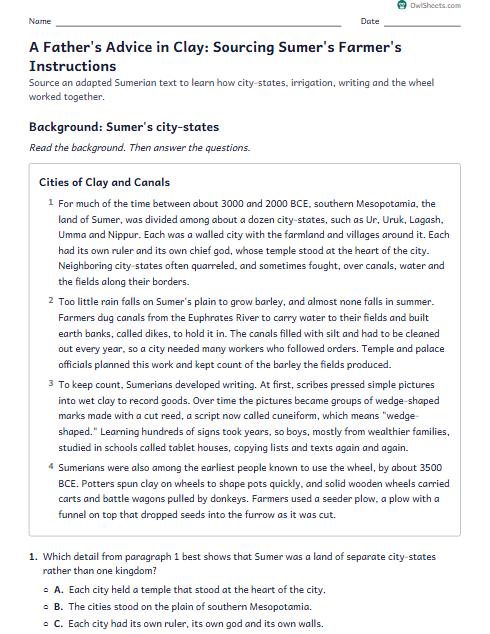
A Father's Advice in Clay: Sourcing Sumer's Farmer's Instructions
Grade 6 · HIS.6.2
14 questionsPremium
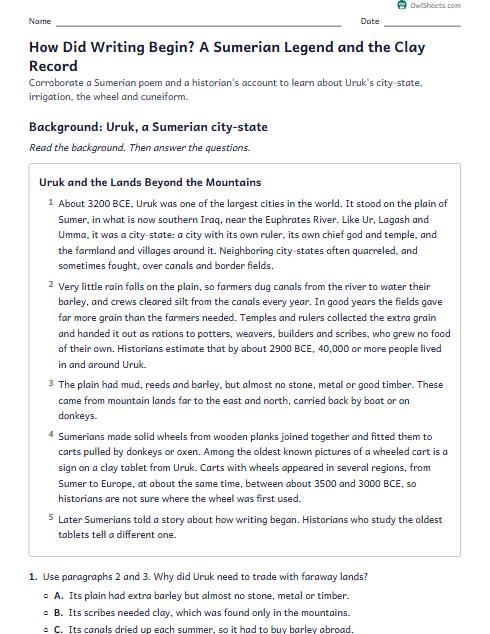
How Did Writing Begin? A Sumerian Legend and the Clay Record
Grade 6 · HIS.6.2
14 questionsPremium
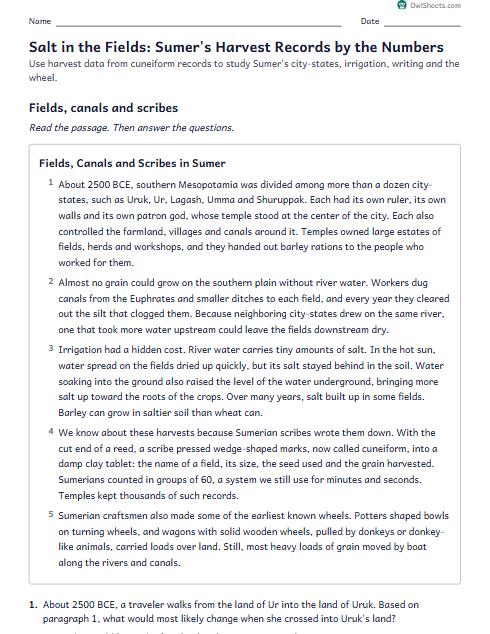
Salt in the Fields: Sumer's Harvest Records by the Numbers
Grade 6 · HIS.6.2
13 questionsPremium
Carrying a Tablet from Nippur to Girsu: A Map Journey Through Sumer
Grade 6 · HIS.6.2
13 questionsPremium
Clues in Clay and Stone: A Sumer Exhibit
Grade 6 · HIS.6.2
10 questionsPremium
Canal or Wall? A Council Meeting in a Sumerian City-State
Grade 6 · HIS.6.2
10 questionsPremium