Grade 6 · Social StudiesHIS.6.2Premium
Salt in the Fields: Sumer's Harvest Records by the Numbers
Grade 6 history: read harvest data from Sumerian clay records to explain city-states, irrigation and its salty side effect, cuneiform counting and the wheel.
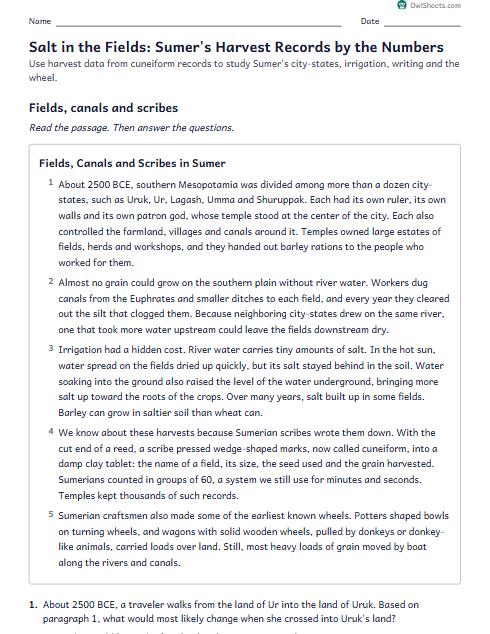
Preview
OwlSheets.com
Salt in the Fields: Sumer's Harvest Records by the Numbers
Use harvest data from cuneiform records to study Sumer's city-states, irrigation, writing and the wheel.
Fields, canals and scribes
Read the passage. Then answer the questions.
Fields, Canals and Scribes in Sumer
1About 2500 BCE, southern Mesopotamia was divided among more than a dozen city-states, such as Uruk, Ur, Lagash, Umma and Shuruppak. Each had its own ruler, its own walls and its own patron god, whose temple stood at the center of the city. Each also controlled the farmland, villages and canals around it. Temples owned large estates of fields, herds and workshops, and they handed out barley rations to the people who worked for them.
2Almost no grain could grow on the southern plain without river water. Workers dug canals from the Euphrates and smaller ditches to each field, and every year they cleared out the silt that clogged them. Because neighboring city-states drew on the same river, one that took more water upstream could leave the fields downstream dry.
3Irrigation had a hidden cost. River water carries tiny amounts of salt. In the hot sun, water spread on the fields dried up quickly, but its salt stayed behind in the soil. Water soaking into the ground also raised the level of the water underground, bringing more salt up toward the roots of the crops. Over many years, salt built up in some fields. Barley can grow in saltier soil than wheat can.
4We know about these harvests because Sumerian scribes wrote them down. With the cut end of a reed, a scribe pressed wedge-shaped marks, now called cuneiform, into a damp clay tablet: the name of a field, its size, the seed used and the grain harvested. Sumerians counted in groups of 60, a system we still use for minutes and seconds. Temples kept thousands of such records.
5Sumerian craftsmen also made some of the earliest known wheels. Potters shaped bowls on turning wheels, and wagons with solid wooden wheels, pulled by donkeys or donkey-like animals, carried loads over land. Still, most heavy loads of grain moved by boat along the rivers and canals.
- A. She would leave the farmland and enter an empty desert.
- B. She would be under a different ruler and a different patron god.
- C. She would have to switch from cuneiform to another script.
- D. Nothing, because one king ruled all the cities of Sumer.
- A. Each city-state had its own river, and the rivers often changed course.
- B. Temples sold river water, and their prices differed from city to city.
- C. Their fields depended on the same river, and upstream users could take more.
- D. Rain fell only on some city-states, so the others had to buy water.
The preview shows the first questions. Unlock the worksheet to see all of it.
Related worksheets
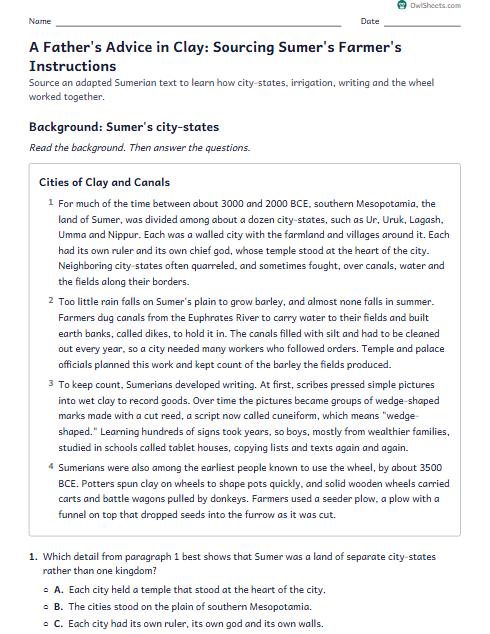
A Father's Advice in Clay: Sourcing Sumer's Farmer's Instructions
Grade 6 · HIS.6.2
14 questionsPremium
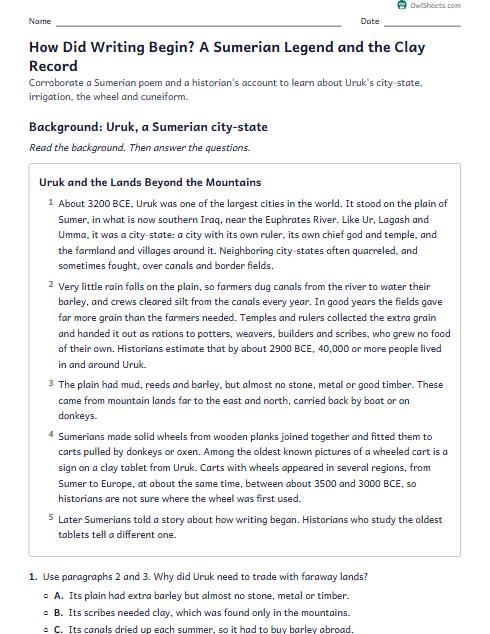
How Did Writing Begin? A Sumerian Legend and the Clay Record
Grade 6 · HIS.6.2
14 questionsPremium
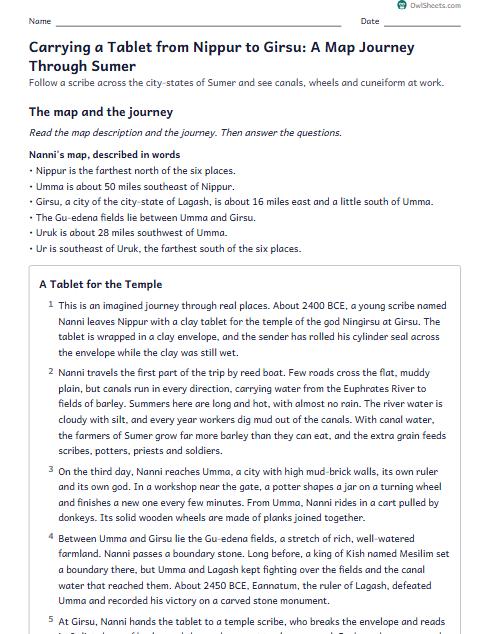
Carrying a Tablet from Nippur to Girsu: A Map Journey Through Sumer
Grade 6 · HIS.6.2
13 questionsPremium
Digging at Ur, 1927–1929: A Dig Diary from a Sumerian City-State
Grade 6 · HIS.6.2
13 questionsPremium
Clues in Clay and Stone: A Sumer Exhibit
Grade 6 · HIS.6.2
10 questionsPremium
Canal or Wall? A Council Meeting in a Sumerian City-State
Grade 6 · HIS.6.2
10 questionsPremium