Grade 6 · Social StudiesHIS.6.2Premium
A Father's Advice in Clay: Sourcing Sumer's Farmer's Instructions
Grade 6 history: source an adapted Sumerian farming text to explain Mesopotamia's city-states, irrigation, cuneiform writing and the wheel.
Preview
OwlSheets.com
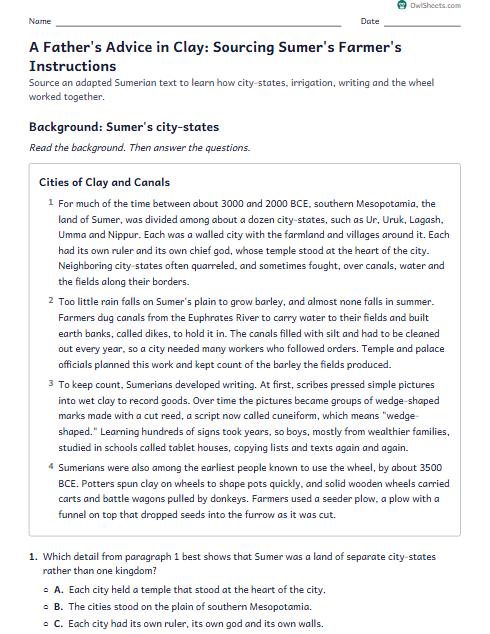
A Father's Advice in Clay: Sourcing Sumer's Farmer's Instructions
Source an adapted Sumerian text to learn how city-states, irrigation, writing and the wheel worked together.
Background: Sumer's city-states
Read the background. Then answer the questions.
Cities of Clay and Canals
1For much of the time between about 3000 and 2000 BCE, southern Mesopotamia, the land of Sumer, was divided among about a dozen city-states, such as Ur, Uruk, Lagash, Umma and Nippur. Each was a walled city with the farmland and villages around it. Each had its own ruler and its own chief god, whose temple stood at the heart of the city. Neighboring city-states often quarreled, and sometimes fought, over canals, water and the fields along their borders.
2Too little rain falls on Sumer's plain to grow barley, and almost none falls in summer. Farmers dug canals from the Euphrates River to carry water to their fields and built earth banks, called dikes, to hold it in. The canals filled with silt and had to be cleaned out every year, so a city needed many workers who followed orders. Temple and palace officials planned this work and kept count of the barley the fields produced.
3To keep count, Sumerians developed writing. At first, scribes pressed simple pictures into wet clay to record goods. Over time the pictures became groups of wedge-shaped marks made with a cut reed, a script now called cuneiform, which means "wedge-shaped." Learning hundreds of signs took years, so boys, mostly from wealthier families, studied in schools called tablet houses, copying lists and texts again and again.
4Sumerians were also among the earliest people known to use the wheel, by about 3500 BCE. Potters spun clay on wheels to shape pots quickly, and solid wooden wheels carried carts and battle wagons pulled by donkeys. Farmers used a seeder plow, a plow with a funnel on top that dropped seeds into the furrow as it was cut.
- A. Each city held a temple that stood at the heart of the city.
- B. The cities stood on the plain of southern Mesopotamia.
- C. Each city had its own ruler, its own god and its own walls.
- D. The cities were built near farmland and villages.
- A. More workers, barley and tasks had to be tracked than anyone could remember.
- B. The canals needed signs carved on them so boats could find the right city.
- C. Farmers needed written prayers to read aloud to the god before each harvest.
- D. Every farmer had learned to read and wanted the orders sent to him in writing.
The preview shows the first questions. Unlock the worksheet to see all of it.
Related worksheets
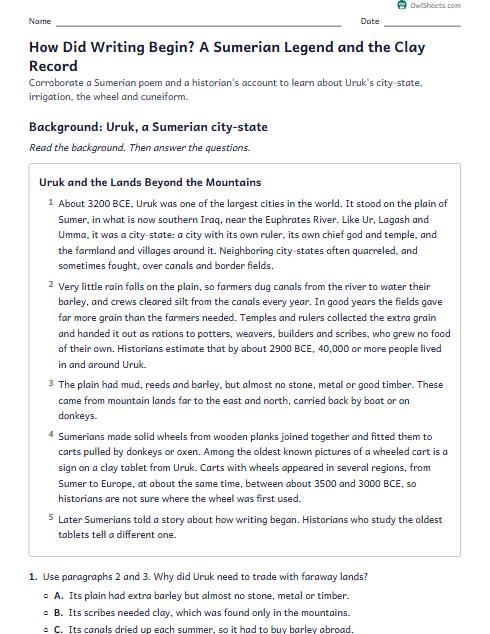
How Did Writing Begin? A Sumerian Legend and the Clay Record
Grade 6 · HIS.6.2
14 questionsPremium
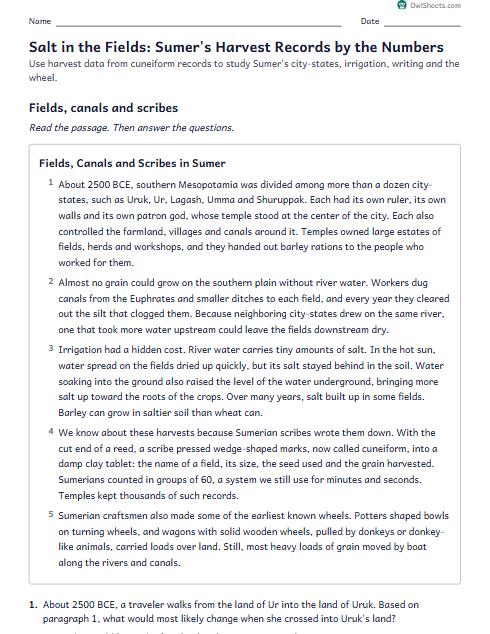
Salt in the Fields: Sumer's Harvest Records by the Numbers
Grade 6 · HIS.6.2
13 questionsPremium
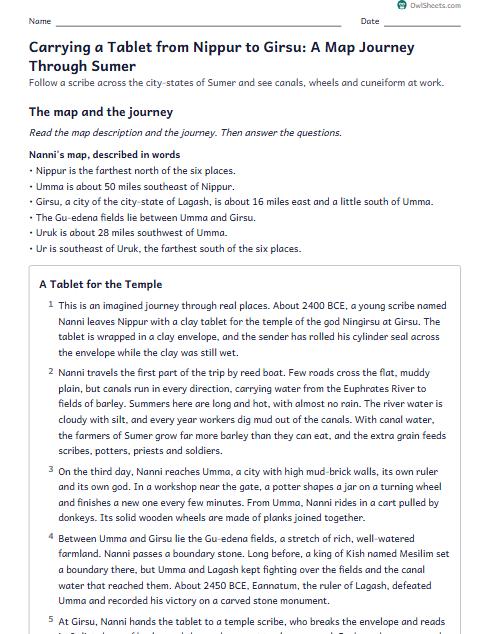
Carrying a Tablet from Nippur to Girsu: A Map Journey Through Sumer
Grade 6 · HIS.6.2
13 questionsPremium
Digging at Ur, 1927–1929: A Dig Diary from a Sumerian City-State
Grade 6 · HIS.6.2
13 questionsPremium
Clues in Clay and Stone: A Sumer Exhibit
Grade 6 · HIS.6.2
10 questionsPremium
Canal or Wall? A Council Meeting in a Sumerian City-State
Grade 6 · HIS.6.2
10 questionsPremium