Grade 6 · Social StudiesHIS.6.2Premium
How Did Writing Begin? A Sumerian Legend and the Clay Record
Grade 6 history: compare a Sumerian legend and a historian's account of how writing began in Uruk, with data on its oldest tablets.
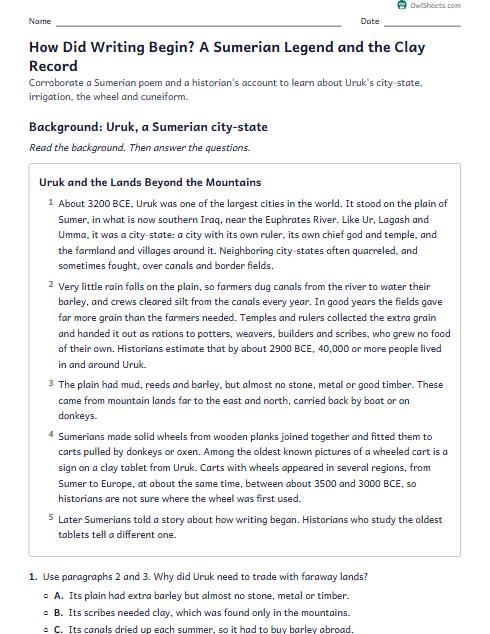
Preview
OwlSheets.com
How Did Writing Begin? A Sumerian Legend and the Clay Record
Corroborate a Sumerian poem and a historian's account to learn about Uruk's city-state, irrigation, the wheel and cuneiform.
Background: Uruk, a Sumerian city-state
Read the background. Then answer the questions.
Uruk and the Lands Beyond the Mountains
1About 3200 BCE, Uruk was one of the largest cities in the world. It stood on the plain of Sumer, in what is now southern Iraq, near the Euphrates River. Like Ur, Lagash and Umma, it was a city-state: a city with its own ruler, its own chief god and temple, and the farmland and villages around it. Neighboring city-states often quarreled, and sometimes fought, over canals and border fields.
2Very little rain falls on the plain, so farmers dug canals from the river to water their barley, and crews cleared silt from the canals every year. In good years the fields gave far more grain than the farmers needed. Temples and rulers collected the extra grain and handed it out as rations to potters, weavers, builders and scribes, who grew no food of their own. Historians estimate that by about 2900 BCE, 40,000 or more people lived in and around Uruk.
3The plain had mud, reeds and barley, but almost no stone, metal or good timber. These came from mountain lands far to the east and north, carried back by boat or on donkeys.
4Sumerians made solid wheels from wooden planks joined together and fitted them to carts pulled by donkeys or oxen. Among the oldest known pictures of a wheeled cart is a sign on a clay tablet from Uruk. Carts with wheels appeared in several regions, from Sumer to Europe, at about the same time, between about 3500 and 3000 BCE, so historians are not sure where the wheel was first used.
5Later Sumerians told a story about how writing began. Historians who study the oldest tablets tell a different one.
- A. Its plain had extra barley but almost no stone, metal or timber.
- B. Its scribes needed clay, which was found only in the mountains.
- C. Its canals dried up each summer, so it had to buy barley abroad.
- D. Its rival city-states would not let it farm the land near its walls.
- A. Wheeled carts appear in several regions at about the same time.
- B. The plain of Sumer was too muddy for people there to use carts.
- C. Sumerian tablets say the first carts were bought from abroad.
- D. The oldest Sumerian wheels were made of stone and have broken.
The preview shows the first questions. Unlock the worksheet to see all of it.
Related worksheets
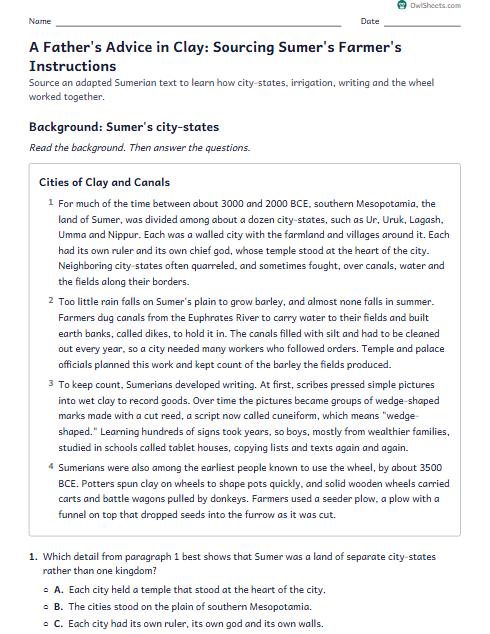
A Father's Advice in Clay: Sourcing Sumer's Farmer's Instructions
Grade 6 · HIS.6.2
14 questionsPremium
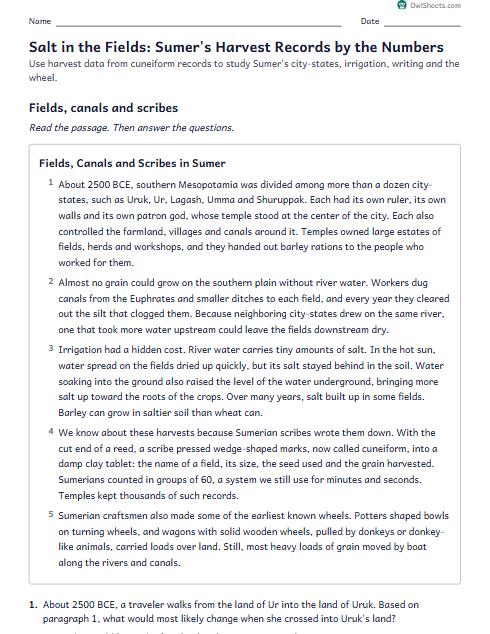
Salt in the Fields: Sumer's Harvest Records by the Numbers
Grade 6 · HIS.6.2
13 questionsPremium
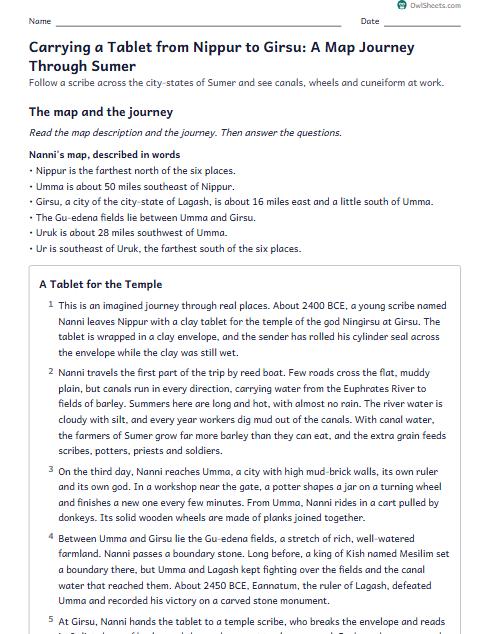
Carrying a Tablet from Nippur to Girsu: A Map Journey Through Sumer
Grade 6 · HIS.6.2
13 questionsPremium
Digging at Ur, 1927–1929: A Dig Diary from a Sumerian City-State
Grade 6 · HIS.6.2
13 questionsPremium
Clues in Clay and Stone: A Sumer Exhibit
Grade 6 · HIS.6.2
10 questionsPremium
Canal or Wall? A Council Meeting in a Sumerian City-State
Grade 6 · HIS.6.2
10 questionsPremium