Grade 6 · Social StudiesCIV.6.2Premium
Clay, Stone and Bronze: A Timeline of Written Laws
Grade 6 civics: a timeline and adapted laws from Ur-Nammu, the Hittites, Dreros, Gortyn and China show how written laws led to the rule of law.
Preview
OwlSheets.com
Clay, Stone and Bronze: A Timeline of Written Laws
Follow early written laws from Ur, the Hittites, Crete and China and trace the idea of the rule of law.
The timeline
Read the timeline and the passage. Then answer the questions.
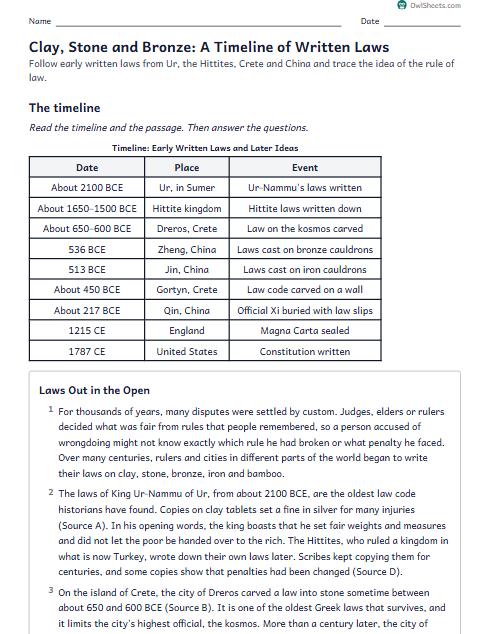
| Date | Place | Event |
|---|---|---|
| About 2100 BCE | Ur, in Sumer | Ur-Nammu's laws written |
| About 1650–1500 BCE | Hittite kingdom | Hittite laws written down |
| About 650–600 BCE | Dreros, Crete | Law on the kosmos carved |
| 536 BCE | Zheng, China | Laws cast on bronze cauldrons |
| 513 BCE | Jin, China | Laws cast on iron cauldrons |
| About 450 BCE | Gortyn, Crete | Law code carved on a wall |
| About 217 BCE | Qin, China | Official Xi buried with law slips |
| 1215 CE | England | Magna Carta sealed |
| 1787 CE | United States | Constitution written |
Laws Out in the Open
1For thousands of years, many disputes were settled by custom. Judges, elders or rulers decided what was fair from rules that people remembered, so a person accused of wrongdoing might not know exactly which rule he had broken or what penalty he faced. Over many centuries, rulers and cities in different parts of the world began to write their laws on clay, stone, bronze, iron and bamboo.
2The laws of King Ur-Nammu of Ur, from about 2100 BCE, are the oldest law code historians have found. Copies on clay tablets set a fine in silver for many injuries (Source A). In his opening words, the king boasts that he set fair weights and measures and did not let the poor be handed over to the rich. The Hittites, who ruled a kingdom in what is now Turkey, wrote down their own laws later. Scribes kept copying them for centuries, and some copies show that penalties had been changed (Source D).
3On the island of Crete, the city of Dreros carved a law into stone sometime between about 650 and 600 BCE (Source B). It is one of the oldest Greek laws that survives, and it limits the city's highest official, the kosmos. More than a century later, the city of Gortyn, also on Crete, carved a long code in large letters on a stone wall. Its fines for the same harm often depended on whether the victim was free or enslaved.
4In China, in 536 BCE, Zichan, the chief minister of the state of Zheng, had the state's punishments cast into bronze cauldrons. Shuxiang, a nobleman of another state, wrote him a letter of protest (Source C). In 513 BCE, the state of Jin cast its laws on iron cauldrons, and an ancient history reports that Confucius criticized it too. Later, the Qin state wrote detailed laws for its officials. In 1975, archaeologists opened the tomb of Xi, a Qin official who died about 217 BCE, and found bamboo slips copying many of these laws, including rules that fined officials whose counts of stored grain were wrong.
5Much later, in 1215 CE, English barons forced King John to seal Magna Carta, which said that no free man could be punished except by lawful judgment or "the law of the land." The U.S. Constitution of 1787 calls itself "the supreme law of the land." Both rest on an idea that grew slowly from early written laws: the rule of law. It means rules are public and known ahead of time, and rulers and officials must obey them too.
The Gortyn code was carved about years after Ur-Nammu's laws were written.
The preview shows the first questions. Unlock the worksheet to see all of it.
Related worksheets
Late in the Rain: Qin Law in Bamboo and in the Han Histories
Grade 6 · CIV.6.2
16 questionsPremium
Laws on the Wall: The Gortyn Crier Reports, About 450 BCE
Grade 6 · CIV.6.2
14 questionsPremium
Ink or Blood? A Club Debate on Draco's Laws
Grade 6 · CIV.6.2
15 questionsPremium
Copied from Athens? Two Accounts of the Twelve Tables
Grade 6 · CIV.6.2
14 questionsPremium
Counting Hammurabi's Laws: What a Code Covered
Grade 6 · CIV.6.2
11 questionsPremium
Down the Euphrates Under Hammurabi's Laws
Grade 6 · CIV.6.2
11 questionsPremium