Grade 6 · Social StudiesCIV.6.2Premium
Copied from Athens? Two Accounts of the Twelve Tables
Grade 6 civics: read adapted laws of Hammurabi and the Twelve Tables, corroborate two accounts of how Rome's laws were made, and link them to the rule of law.
Preview
OwlSheets.com
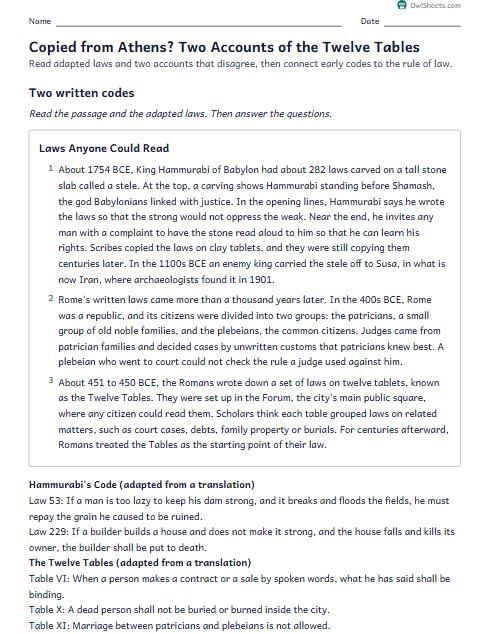
Copied from Athens? Two Accounts of the Twelve Tables
Read adapted laws and two accounts that disagree, then connect early codes to the rule of law.
Two written codes
Read the passage and the adapted laws. Then answer the questions.
Laws Anyone Could Read
1About 1754 BCE, King Hammurabi of Babylon had about 282 laws carved on a tall stone slab called a stele. At the top, a carving shows Hammurabi standing before Shamash, the god Babylonians linked with justice. In the opening lines, Hammurabi says he wrote the laws so that the strong would not oppress the weak. Near the end, he invites any man with a complaint to have the stone read aloud to him so that he can learn his rights. Scribes copied the laws on clay tablets, and they were still copying them centuries later. In the 1100s BCE an enemy king carried the stele off to Susa, in what is now Iran, where archaeologists found it in 1901.
2Rome's written laws came more than a thousand years later. In the 400s BCE, Rome was a republic, and its citizens were divided into two groups: the patricians, a small group of old noble families, and the plebeians, the common citizens. Judges came from patrician families and decided cases by unwritten customs that patricians knew best. A plebeian who went to court could not check the rule a judge used against him.
3About 451 to 450 BCE, the Romans wrote down a set of laws on twelve tablets, known as the Twelve Tables. They were set up in the Forum, the city's main public square, where any citizen could read them. Scholars think each table grouped laws on related matters, such as court cases, debts, family property or burials. For centuries afterward, Romans treated the Tables as the starting point of their law.
Law 53: If a man is too lazy to keep his dam strong, and it breaks and floods the fields, he must repay the grain he caused to be ruined.
Law 229: If a builder builds a house and does not make it strong, and the house falls and kills its owner, the builder shall be put to death.
The Twelve Tables (adapted from a translation)
Table VI: When a person makes a contract or a sale by spoken words, what he has said shall be binding.
Table X: A dead person shall not be buried or burned inside the city.
Table XI: Marriage between patricians and plebeians is not allowed.
Note: Table XI was repealed in 445 BCE, when a new law allowed patricians and plebeians to marry.
- A. The king's word is above the written law.
- B. Judges should decide each case by custom.
- C. People should be able to know the laws that govern them.
- D. A jury of citizens should decide cases in court.
The preview shows the first questions. Unlock the worksheet to see all of it.
Related worksheets
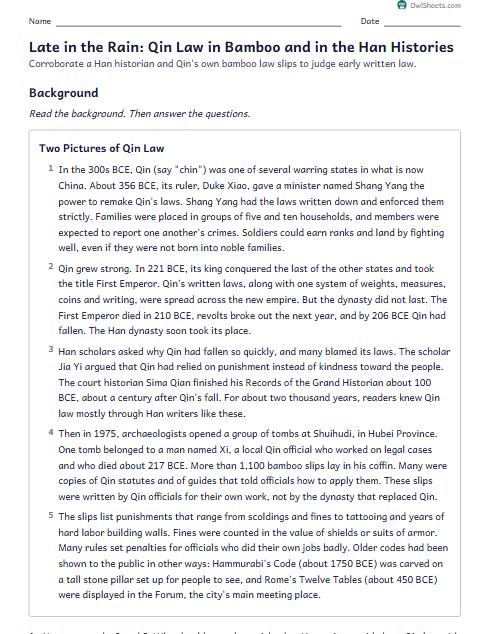
Late in the Rain: Qin Law in Bamboo and in the Han Histories
Grade 6 · CIV.6.2
16 questionsPremium
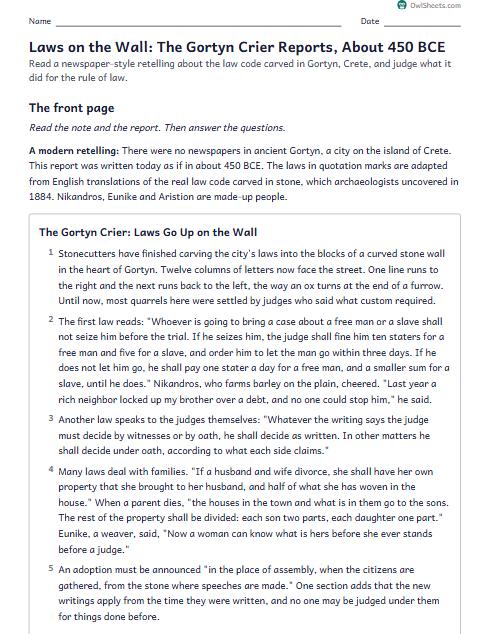
Laws on the Wall: The Gortyn Crier Reports, About 450 BCE
Grade 6 · CIV.6.2
14 questionsPremium
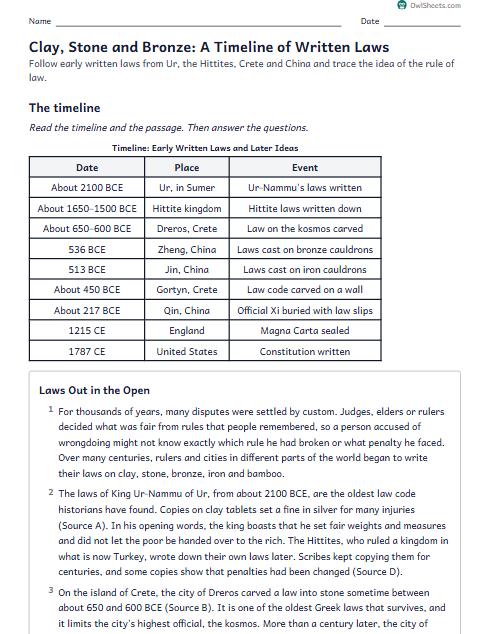
Clay, Stone and Bronze: A Timeline of Written Laws
Grade 6 · CIV.6.2
14 questionsPremium
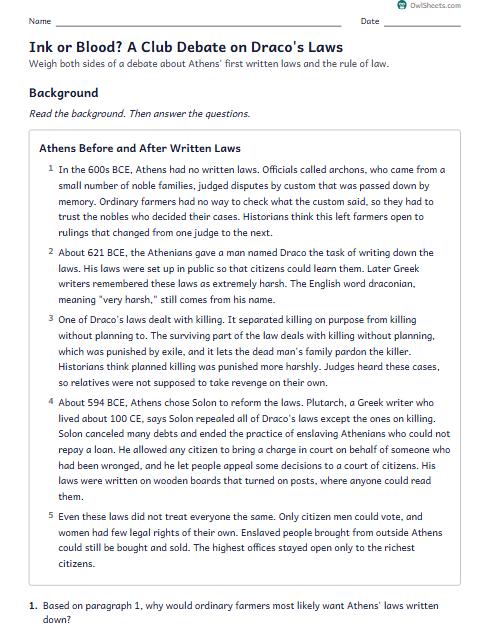
Ink or Blood? A Club Debate on Draco's Laws
Grade 6 · CIV.6.2
15 questionsPremium
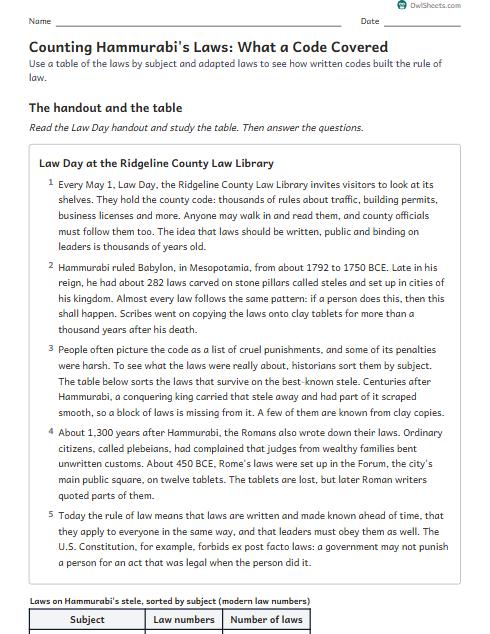
Counting Hammurabi's Laws: What a Code Covered
Grade 6 · CIV.6.2
11 questionsPremium
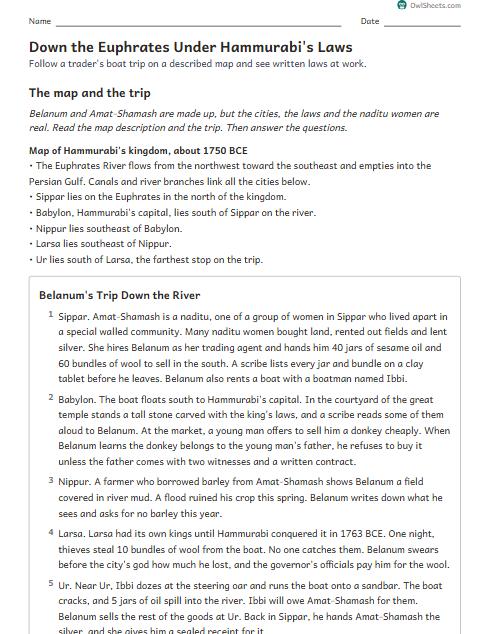
Down the Euphrates Under Hammurabi's Laws
Grade 6 · CIV.6.2
11 questionsPremium