Grade 6 · Social StudiesCIV.6.2Premium
Late in the Rain: Qin Law in Bamboo and in the Han Histories
Grade 6 civics: compare Sima Qian's story of a deadline missed in the rain with Qin law slips from Shuihudi to see how written laws set rules and punishments.
Preview
OwlSheets.com
Late in the Rain: Qin Law in Bamboo and in the Han Histories
Corroborate a Han historian and Qin's own bamboo law slips to judge early written law.
Background
Read the background. Then answer the questions.
Two Pictures of Qin Law
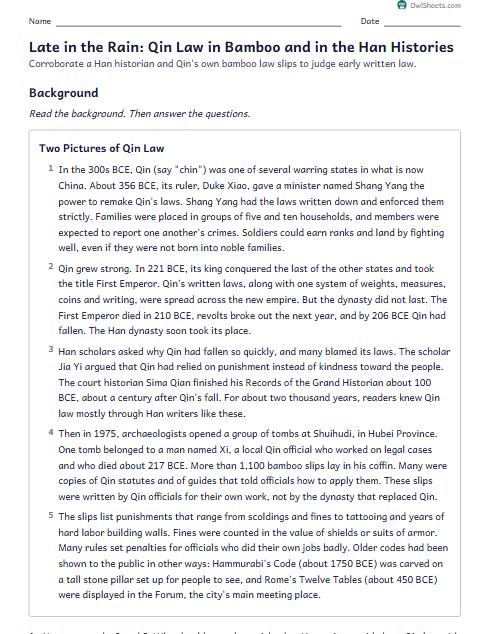
1In the 300s BCE, Qin (say "chin") was one of several warring states in what is now China. About 356 BCE, its ruler, Duke Xiao, gave a minister named Shang Yang the power to remake Qin's laws. Shang Yang had the laws written down and enforced them strictly. Families were placed in groups of five and ten households, and members were expected to report one another's crimes. Soldiers could earn ranks and land by fighting well, even if they were not born into noble families.
2Qin grew strong. In 221 BCE, its king conquered the last of the other states and took the title First Emperor. Qin's written laws, along with one system of weights, measures, coins and writing, were spread across the new empire. But the dynasty did not last. The First Emperor died in 210 BCE, revolts broke out the next year, and by 206 BCE Qin had fallen. The Han dynasty soon took its place.
3Han scholars asked why Qin had fallen so quickly, and many blamed its laws. The scholar Jia Yi argued that Qin had relied on punishment instead of kindness toward the people. The court historian Sima Qian finished his Records of the Grand Historian about 100 BCE, about a century after Qin's fall. For about two thousand years, readers knew Qin law mostly through Han writers like these.
4Then in 1975, archaeologists opened a group of tombs at Shuihudi, in Hubei Province. One tomb belonged to a man named Xi, a local Qin official who worked on legal cases and who died about 217 BCE. More than 1,100 bamboo slips lay in his coffin. Many were copies of Qin statutes and of guides that told officials how to apply them. These slips were written by Qin officials for their own work, not by the dynasty that replaced Qin.
5The slips list punishments that range from scoldings and fines to tattooing and years of hard labor building walls. Fines were counted in the value of shields or suits of armor. Many rules set penalties for officials who did their own jobs badly. Older codes had been shown to the public in other ways: Hammurabi's Code (about 1750 BCE) was carved on a tall stone pillar set up for people to see, and Rome's Twelve Tables (about 450 BCE) were displayed in the Forum, the city's main meeting place.
- A. The Han replaced Qin and had reasons to show its faults.
- B. Han writers lived before Qin's laws were written down.
- C. Han writers based their books on the Shuihudi slips.
- D. Han writers were Qin officials defending their own work.
- A. They gave officials advice but set no punishments at all.
- B. They were an official's working copies, not a public display.
- C. They were carved on stone pillars in Qin's capital city.
- D. They were written for nobles and members of the court.
The preview shows the first questions. Unlock the worksheet to see all of it.
Related worksheets
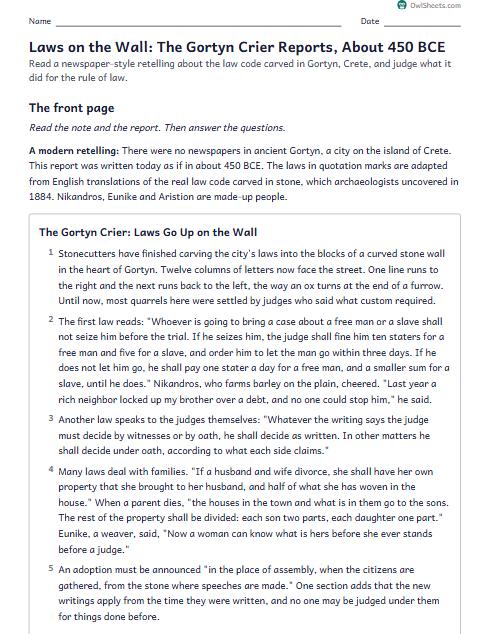
Laws on the Wall: The Gortyn Crier Reports, About 450 BCE
Grade 6 · CIV.6.2
14 questionsPremium
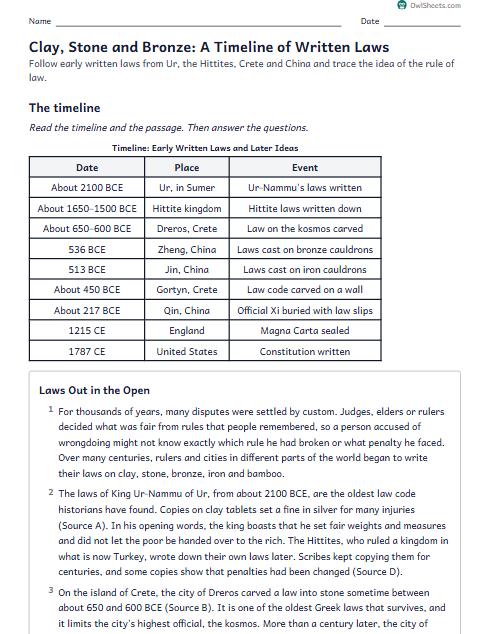
Clay, Stone and Bronze: A Timeline of Written Laws
Grade 6 · CIV.6.2
14 questionsPremium
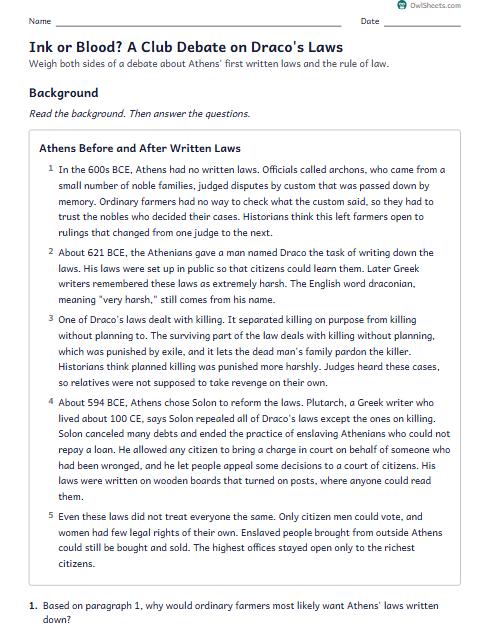
Ink or Blood? A Club Debate on Draco's Laws
Grade 6 · CIV.6.2
15 questionsPremium
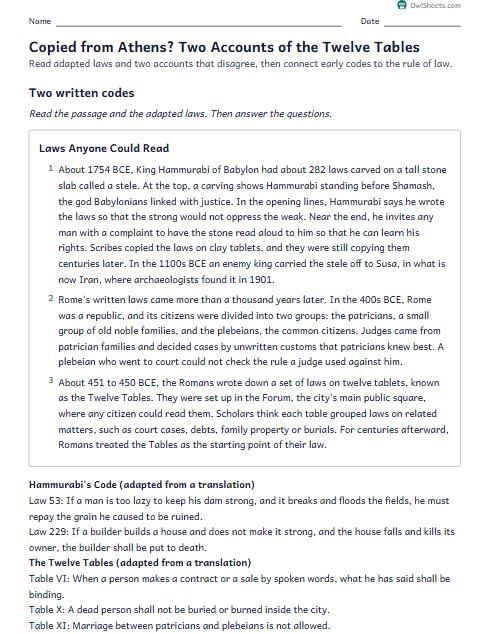
Copied from Athens? Two Accounts of the Twelve Tables
Grade 6 · CIV.6.2
14 questionsPremium
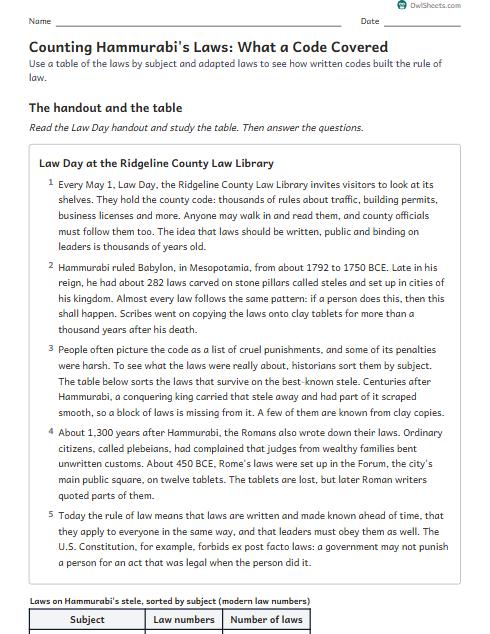
Counting Hammurabi's Laws: What a Code Covered
Grade 6 · CIV.6.2
11 questionsPremium
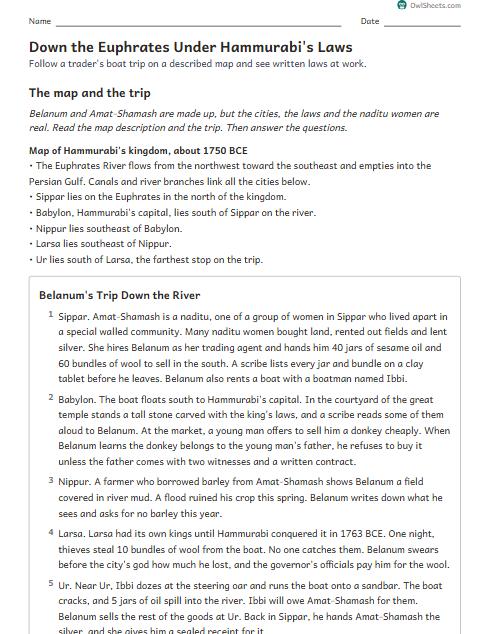
Down the Euphrates Under Hammurabi's Laws
Grade 6 · CIV.6.2
11 questionsPremium