Grade 6 · Social StudiesCIV.6.2Premium
Ink or Blood? A Club Debate on Draco's Laws
Grade 6 civics: a history club debates Draco's and Solon's laws in early Athens, using an adapted stone copy of a law and Plutarch, to explain the rule of law.
Preview
OwlSheets.com
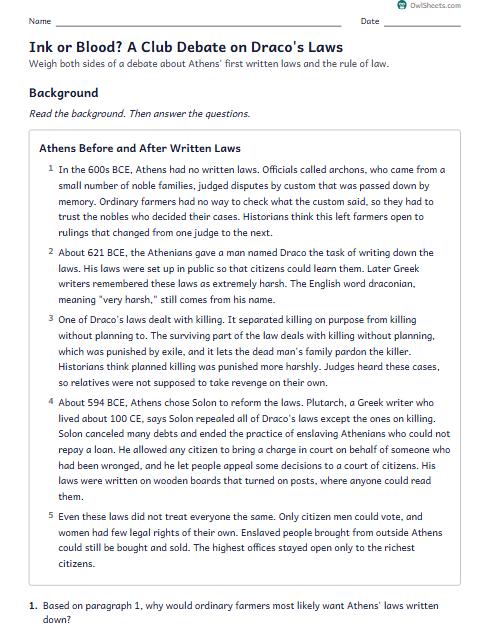
Ink or Blood? A Club Debate on Draco's Laws
Weigh both sides of a debate about Athens' first written laws and the rule of law.
Background
Read the background. Then answer the questions.
Athens Before and After Written Laws
1In the 600s BCE, Athens had no written laws. Officials called archons, who came from a small number of noble families, judged disputes by custom that was passed down by memory. Ordinary farmers had no way to check what the custom said, so they had to trust the nobles who decided their cases. Historians think this left farmers open to rulings that changed from one judge to the next.
2About 621 BCE, the Athenians gave a man named Draco the task of writing down the laws. His laws were set up in public so that citizens could learn them. Later Greek writers remembered these laws as extremely harsh. The English word draconian, meaning "very harsh," still comes from his name.
3One of Draco's laws dealt with killing. It separated killing on purpose from killing without planning to. The surviving part of the law deals with killing without planning, which was punished by exile, and it lets the dead man's family pardon the killer. Historians think planned killing was punished more harshly. Judges heard these cases, so relatives were not supposed to take revenge on their own.
4About 594 BCE, Athens chose Solon to reform the laws. Plutarch, a Greek writer who lived about 100 CE, says Solon repealed all of Draco's laws except the ones on killing. Solon canceled many debts and ended the practice of enslaving Athenians who could not repay a loan. He allowed any citizen to bring a charge in court on behalf of someone who had been wronged, and he let people appeal some decisions to a court of citizens. His laws were written on wooden boards that turned on posts, where anyone could read them.
5Even these laws did not treat everyone the same. Only citizen men could vote, and women had few legal rights of their own. Enslaved people brought from outside Athens could still be bought and sold. The highest offices stayed open only to the richest citizens.
- A. So the noble families would have to pay to run the city's courts.
- B. So the punishment for each crime would be lighter than under custom.
- C. So they could check the rules for themselves instead of trusting nobles.
- D. So they could choose the archons each year from among the farmers.
- A. He faced the same unknown penalty, because the nobles kept Draco's laws hidden.
- B. He faced a harsh penalty, but he could know it ahead of time from the posted law.
- C. He faced no trial at all, because the new laws let the victim's family punish him.
- D. He faced a lighter penalty, because written laws let farmers pick their own judges.
The preview shows the first questions. Unlock the worksheet to see all of it.
Related worksheets
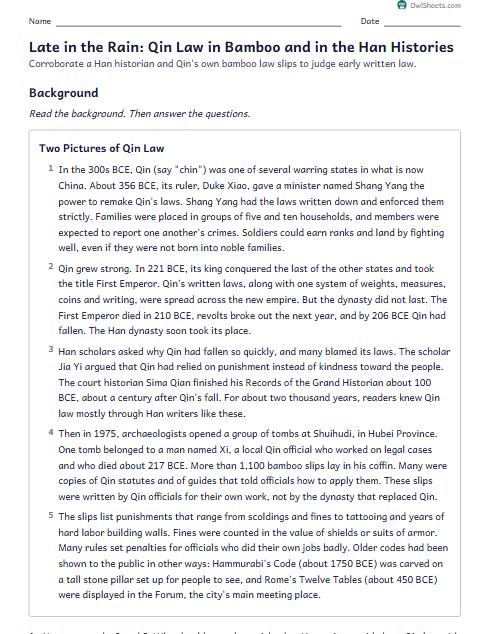
Late in the Rain: Qin Law in Bamboo and in the Han Histories
Grade 6 · CIV.6.2
16 questionsPremium
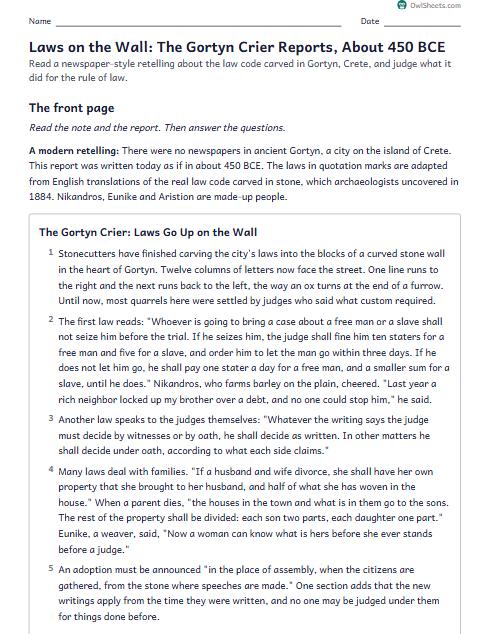
Laws on the Wall: The Gortyn Crier Reports, About 450 BCE
Grade 6 · CIV.6.2
14 questionsPremium
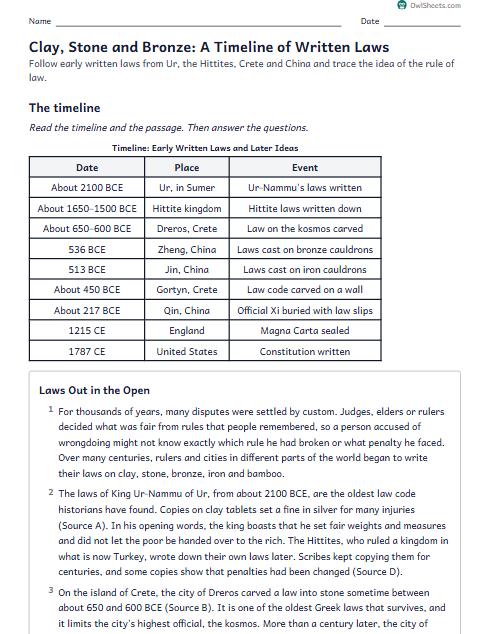
Clay, Stone and Bronze: A Timeline of Written Laws
Grade 6 · CIV.6.2
14 questionsPremium
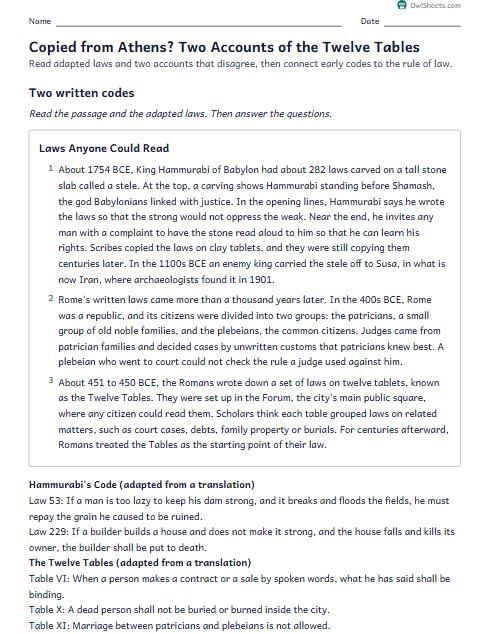
Copied from Athens? Two Accounts of the Twelve Tables
Grade 6 · CIV.6.2
14 questionsPremium
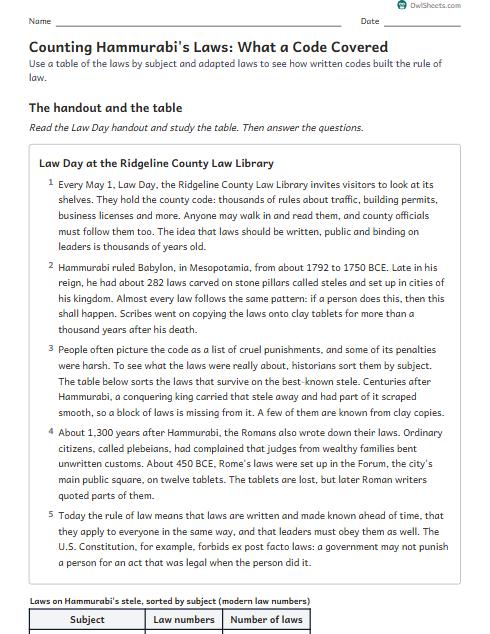
Counting Hammurabi's Laws: What a Code Covered
Grade 6 · CIV.6.2
11 questionsPremium
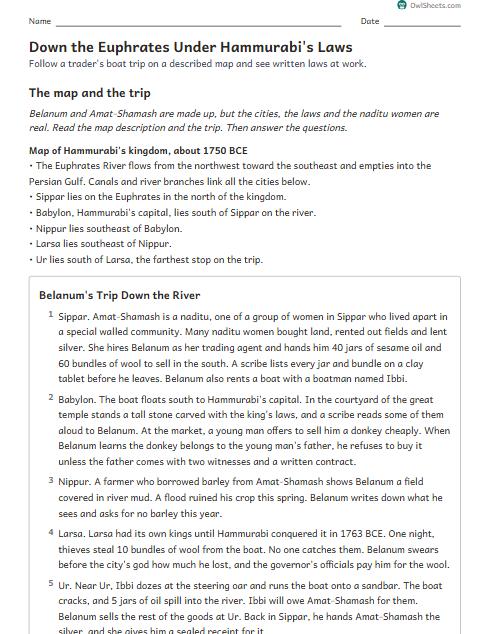
Down the Euphrates Under Hammurabi's Laws
Grade 6 · CIV.6.2
11 questionsPremium