Grade 6 · Social StudiesCIV.6.2Premium
Laws on the Wall: The Gortyn Crier Reports, About 450 BCE
Grade 6 civics: a newspaper-style retelling of Gortyn's law code on Crete shows how written laws set rules, fines and limits on judges.
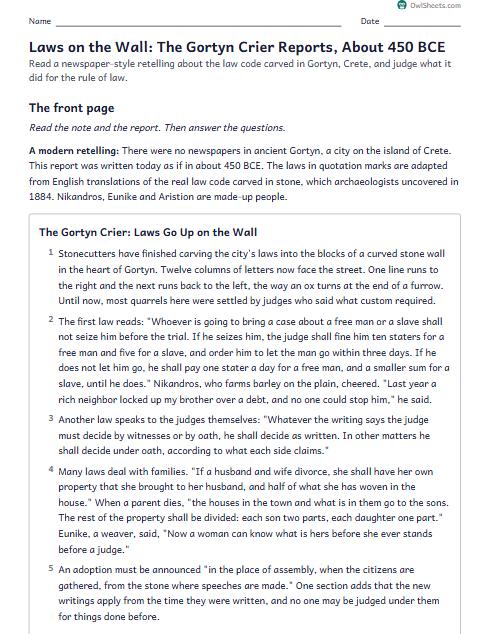
Preview
OwlSheets.com
Laws on the Wall: The Gortyn Crier Reports, About 450 BCE
Read a newspaper-style retelling about the law code carved in Gortyn, Crete, and judge what it did for the rule of law.
The front page
Read the note and the report. Then answer the questions.
The Gortyn Crier: Laws Go Up on the Wall
1Stonecutters have finished carving the city's laws into the blocks of a curved stone wall in the heart of Gortyn. Twelve columns of letters now face the street. One line runs to the right and the next runs back to the left, the way an ox turns at the end of a furrow. Until now, most quarrels here were settled by judges who said what custom required.
2The first law reads: "Whoever is going to bring a case about a free man or a slave shall not seize him before the trial. If he seizes him, the judge shall fine him ten staters for a free man and five for a slave, and order him to let the man go within three days. If he does not let him go, he shall pay one stater a day for a free man, and a smaller sum for a slave, until he does." Nikandros, who farms barley on the plain, cheered. "Last year a rich neighbor locked up my brother over a debt, and no one could stop him," he said.
3Another law speaks to the judges themselves: "Whatever the writing says the judge must decide by witnesses or by oath, he shall decide as written. In other matters he shall decide under oath, according to what each side claims."
4Many laws deal with families. "If a husband and wife divorce, she shall have her own property that she brought to her husband, and half of what she has woven in the house." When a parent dies, "the houses in the town and what is in them go to the sons. The rest of the property shall be divided: each son two parts, each daughter one part." Eunike, a weaver, said, "Now a woman can know what is hers before she ever stands before a judge."
5An adoption must be announced "in the place of assembly, when the citizens are gathered, from the stone where speeches are made." One section adds that the new writings apply from the time they were written, and no one may be judged under them for things done before.
- A. How rich the man who did the seizing was
- B. Whether the person seized was free or a slave
- C. How large the debt between the two men was
- D. Whether a judge had seen the person seized
The preview shows the first questions. Unlock the worksheet to see all of it.
Related worksheets
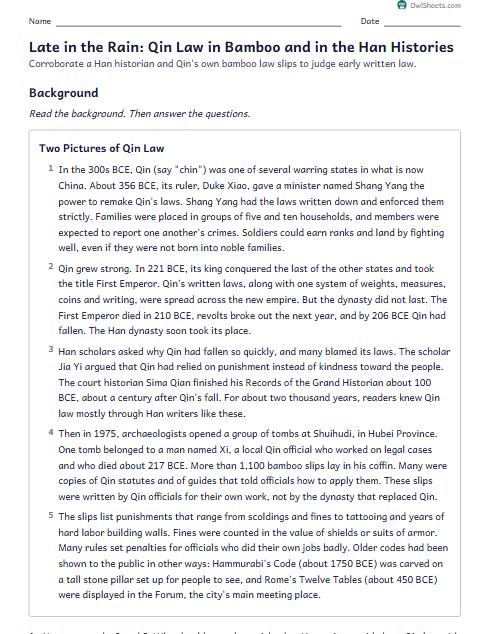
Late in the Rain: Qin Law in Bamboo and in the Han Histories
Grade 6 · CIV.6.2
16 questionsPremium
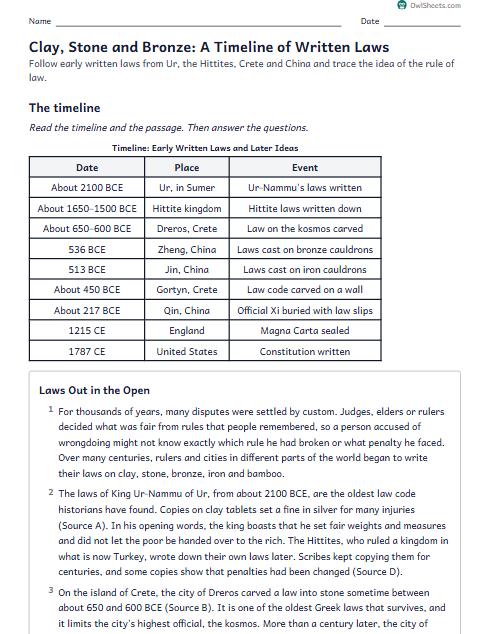
Clay, Stone and Bronze: A Timeline of Written Laws
Grade 6 · CIV.6.2
14 questionsPremium
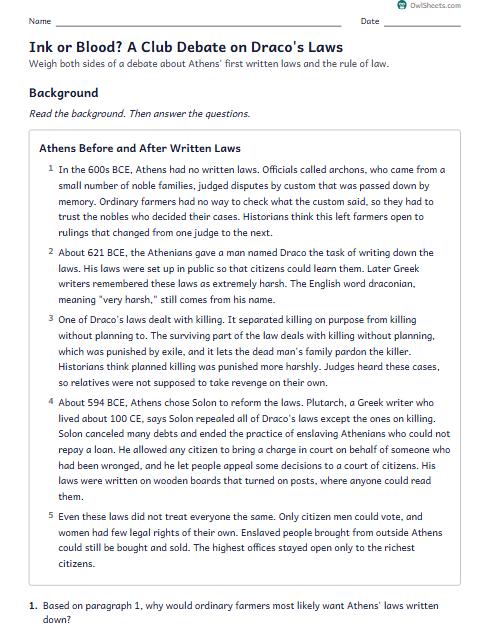
Ink or Blood? A Club Debate on Draco's Laws
Grade 6 · CIV.6.2
15 questionsPremium
Copied from Athens? Two Accounts of the Twelve Tables
Grade 6 · CIV.6.2
14 questionsPremium
Counting Hammurabi's Laws: What a Code Covered
Grade 6 · CIV.6.2
11 questionsPremium
Down the Euphrates Under Hammurabi's Laws
Grade 6 · CIV.6.2
11 questionsPremium