Grade 6 · Social StudiesCIV.6.3Premium
Toga, Charm and Ballot: A Citizenship Gallery
Grade 6 civics: tour a gallery of a Roman bulla, a toga statue, a voting coin, an Athenian decree, a helmet and a jury summons to compare citizenship.
Preview
OwlSheets.com
Toga, Charm and Ballot: A Citizenship Gallery
Read the labels on six objects to compare citizens in Athens, Rome and the United States today.
The gallery guide
Read the gallery guide. Each numbered paragraph is the label for one case. Then answer the questions.
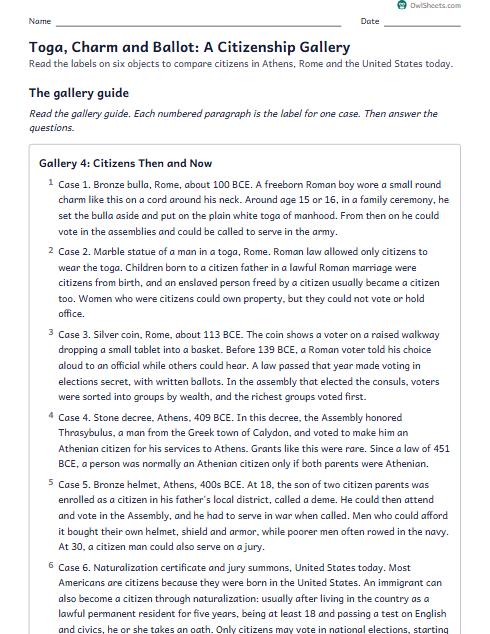
Gallery 4: Citizens Then and Now
1Case 1. Bronze bulla, Rome, about 100 BCE. A freeborn Roman boy wore a small round charm like this on a cord around his neck. Around age 15 or 16, in a family ceremony, he set the bulla aside and put on the plain white toga of manhood. From then on he could vote in the assemblies and could be called to serve in the army.
2Case 2. Marble statue of a man in a toga, Rome. Roman law allowed only citizens to wear the toga. Children born to a citizen father in a lawful Roman marriage were citizens from birth, and an enslaved person freed by a citizen usually became a citizen too. Women who were citizens could own property, but they could not vote or hold office.
3Case 3. Silver coin, Rome, about 113 BCE. The coin shows a voter on a raised walkway dropping a small tablet into a basket. Before 139 BCE, a Roman voter told his choice aloud to an official while others could hear. A law passed that year made voting in elections secret, with written ballots. In the assembly that elected the consuls, voters were sorted into groups by wealth, and the richest groups voted first.
4Case 4. Stone decree, Athens, 409 BCE. In this decree, the Assembly honored Thrasybulus, a man from the Greek town of Calydon, and voted to make him an Athenian citizen for his services to Athens. Grants like this were rare. Since a law of 451 BCE, a person was normally an Athenian citizen only if both parents were Athenian.
5Case 5. Bronze helmet, Athens, 400s BCE. At 18, the son of two citizen parents was enrolled as a citizen in his father's local district, called a deme. He could then attend and vote in the Assembly, and he had to serve in war when called. Men who could afford it bought their own helmet, shield and armor, while poorer men often rowed in the navy. At 30, a citizen man could also serve on a jury.
6Case 6. Naturalization certificate and jury summons, United States today. Most Americans are citizens because they were born in the United States. An immigrant can also become a citizen through naturalization: usually after living in the country as a lawful permanent resident for five years, being at least 18 and passing a test on English and civics, he or she takes an oath. Only citizens may vote in national elections, starting at age 18, and only citizens 18 and older may serve on federal juries. A jury summons orders a citizen to report for jury duty.
- A. In both cities, he first passed a test on the laws in front of the Assembly at 18.
- B. In Rome, a family ceremony with the toga; in Athens, enrollment in his deme at 18.
- C. In Rome, enrollment in a deme at 30; in Athens, setting aside his bulla at 15 or 16.
- D. In both cities, he became an adult citizen once he could buy his own armor.
- A. It showed which men had already served as consuls of Rome.
- B. It let people in a crowd see who held a citizen's rights and duties.
- C. It marked men freed from slavery so that officials could watch them.
- D. It showed which men were rich enough to vote in the first group.
The preview shows the first questions. Unlock the worksheet to see all of it.
Related worksheets
Freed at the Oars: The Athenian Herald on Arginusae, 406 BCE
Grade 6 · CIV.6.3
14 questionsPremium
Gauls in the Senate? Claudius and the Debate of 48 CE
Grade 6 · CIV.6.3
14 questionsPremium
Three Walks to Take Part: Citizens on the Map
Grade 6 · CIV.6.3
13 questionsPremium
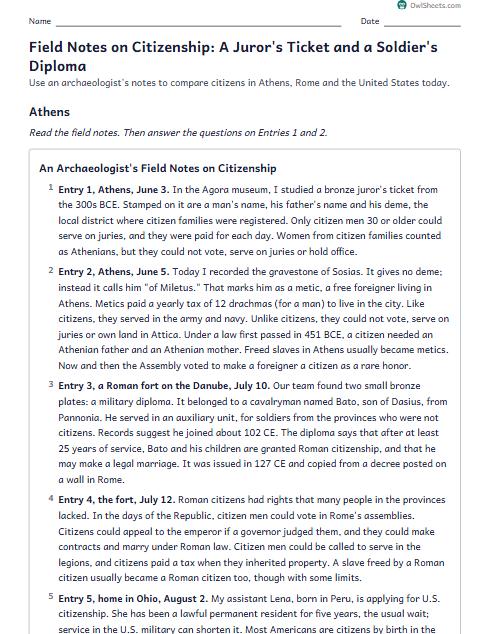
Field Notes on Citizenship: A Juror's Ticket and a Soldier's Diploma
Grade 6 · CIV.6.3
13 questionsPremium
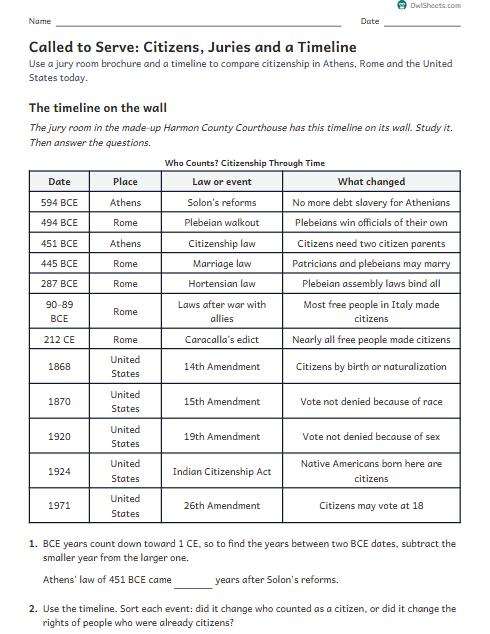
Called to Serve: Citizens, Juries and a Timeline
Grade 6 · CIV.6.3
11 questionsPremium
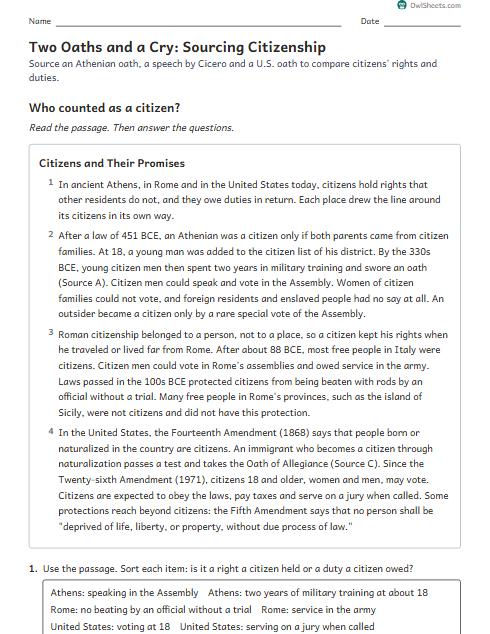
Two Oaths and a Cry: Sourcing Citizenship
Grade 6 · CIV.6.3
11 questionsFree