Grade 6 · Social StudiesCIV.6.3Premium
Field Notes on Citizenship: A Juror's Ticket and a Soldier's Diploma
Grade 6 civics: an archaeologist's notes on a juror's ticket, a metic's gravestone and a Roman military diploma compare citizenship then and in the U.S. today.
Preview
OwlSheets.com
Field Notes on Citizenship: A Juror's Ticket and a Soldier's Diploma
Use an archaeologist's notes to compare citizens in Athens, Rome and the United States today.
Athens
Read the field notes. Then answer the questions on Entries 1 and 2.
An Archaeologist's Field Notes on Citizenship
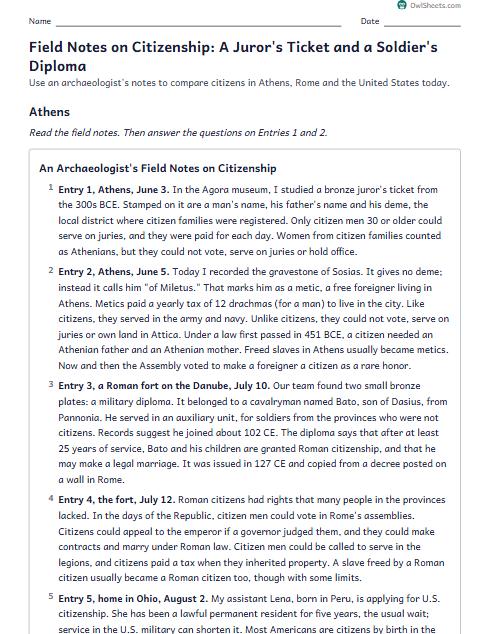
1Entry 1, Athens, June 3. In the Agora museum, I studied a bronze juror's ticket from the 300s BCE. Stamped on it are a man's name, his father's name and his deme, the local district where citizen families were registered. Only citizen men 30 or older could serve on juries, and they were paid for each day. Women from citizen families counted as Athenians, but they could not vote, serve on juries or hold office.
2Entry 2, Athens, June 5. Today I recorded the gravestone of Sosias. It gives no deme; instead it calls him "of Miletus." That marks him as a metic, a free foreigner living in Athens. Metics paid a yearly tax of 12 drachmas (for a man) to live in the city. Like citizens, they served in the army and navy. Unlike citizens, they could not vote, serve on juries or own land in Attica. Under a law first passed in 451 BCE, a citizen needed an Athenian father and an Athenian mother. Freed slaves in Athens usually became metics. Now and then the Assembly voted to make a foreigner a citizen as a rare honor.
3Entry 3, a Roman fort on the Danube, July 10. Our team found two small bronze plates: a military diploma. It belonged to a cavalryman named Bato, son of Dasius, from Pannonia. He served in an auxiliary unit, for soldiers from the provinces who were not citizens. Records suggest he joined about 102 CE. The diploma says that after at least 25 years of service, Bato and his children are granted Roman citizenship, and that he may make a legal marriage. It was issued in 127 CE and copied from a decree posted on a wall in Rome.
4Entry 4, the fort, July 12. Roman citizens had rights that many people in the provinces lacked. In the days of the Republic, citizen men could vote in Rome's assemblies. Citizens could appeal to the emperor if a governor judged them, and they could make contracts and marry under Roman law. Citizen men could be called to serve in the legions, and citizens paid a tax when they inherited property. A slave freed by a Roman citizen usually became a Roman citizen too, though with some limits.
5Entry 5, home in Ohio, August 2. My assistant Lena, born in Peru, is applying for U.S. citizenship. She has been a lawful permanent resident for five years, the usual wait; service in the U.S. military can shorten it. Most Americans are citizens by birth in the United States or to citizen parents. Others are naturalized: they must be at least 18, pass English and civics tests, and take an oath of allegiance. As a citizen, Lena will be able to vote, since U.S. citizens, women and men, may vote at 18.
- A. To show he came from a registered citizen family
- B. To show how much land he owned in Attica
- C. To show which army unit he served in
- D. To show how many trials he had judged
The preview shows the first questions. Unlock the worksheet to see all of it.
Related worksheets
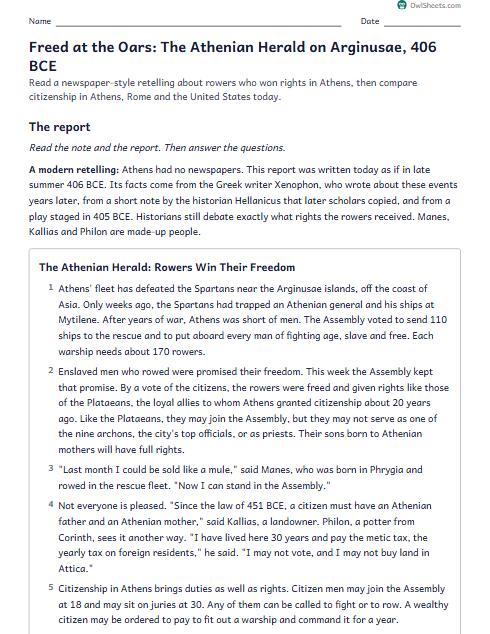
Freed at the Oars: The Athenian Herald on Arginusae, 406 BCE
Grade 6 · CIV.6.3
14 questionsPremium
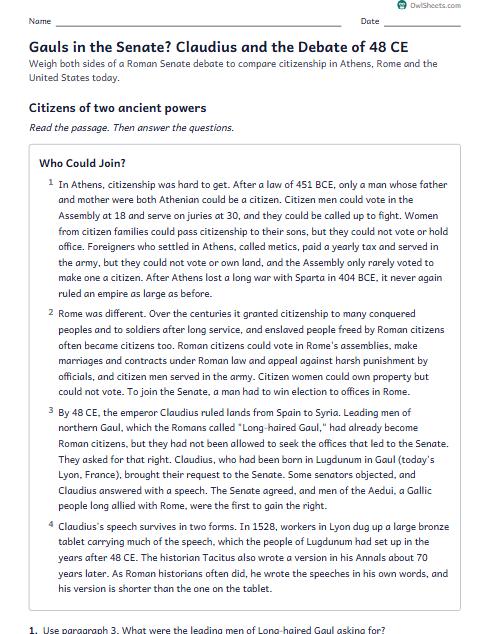
Gauls in the Senate? Claudius and the Debate of 48 CE
Grade 6 · CIV.6.3
14 questionsPremium
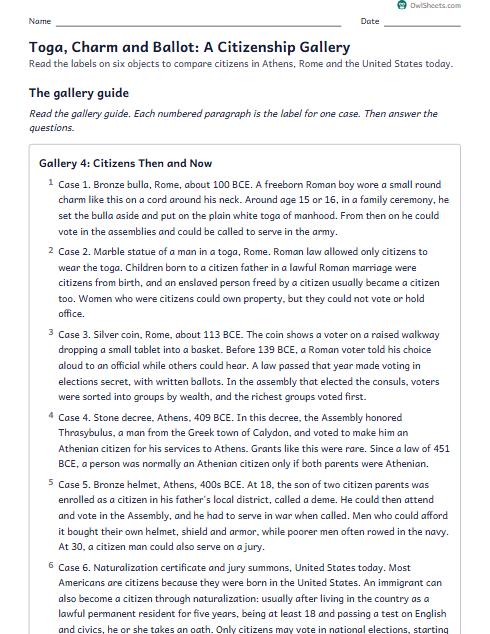
Toga, Charm and Ballot: A Citizenship Gallery
Grade 6 · CIV.6.3
14 questionsPremium
Three Walks to Take Part: Citizens on the Map
Grade 6 · CIV.6.3
13 questionsPremium
Called to Serve: Citizens, Juries and a Timeline
Grade 6 · CIV.6.3
11 questionsPremium
Two Oaths and a Cry: Sourcing Citizenship
Grade 6 · CIV.6.3
11 questionsFree