Grade 6 · Social StudiesECO.6.1Premium
Surplus and Neighborhoods: Data from Teotihuacan
Grade 6 economics: read about Teotihuacan, then use a table of compound finds and a harvest graph to explain how surplus led to jobs, classes and trade.
Preview
OwlSheets.com
Surplus and Neighborhoods: Data from Teotihuacan
Use a passage, a table of finds and a harvest graph to link surplus food to jobs, classes and trade.
A city in the Valley of Mexico
Read the passage. Then answer the questions.
Teotihuacan: A City Fed by Its Valley
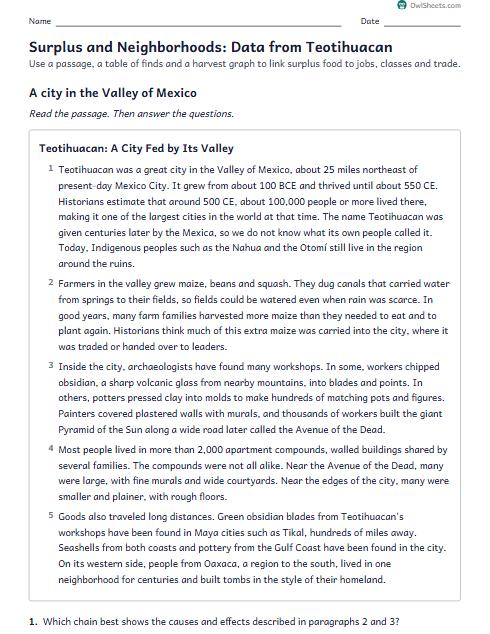
1Teotihuacan was a great city in the Valley of Mexico, about 25 miles northeast of present-day Mexico City. It grew from about 100 BCE and thrived until about 550 CE. Historians estimate that around 500 CE, about 100,000 people or more lived there, making it one of the largest cities in the world at that time. The name Teotihuacan was given centuries later by the Mexica, so we do not know what its own people called it. Today, Indigenous peoples such as the Nahua and the Otomí still live in the region around the ruins.
2Farmers in the valley grew maize, beans and squash. They dug canals that carried water from springs to their fields, so fields could be watered even when rain was scarce. In good years, many farm families harvested more maize than they needed to eat and to plant again. Historians think much of this extra maize was carried into the city, where it was traded or handed over to leaders.
3Inside the city, archaeologists have found many workshops. In some, workers chipped obsidian, a sharp volcanic glass from nearby mountains, into blades and points. In others, potters pressed clay into molds to make hundreds of matching pots and figures. Painters covered plastered walls with murals, and thousands of workers built the giant Pyramid of the Sun along a wide road later called the Avenue of the Dead.
4Most people lived in more than 2,000 apartment compounds, walled buildings shared by several families. The compounds were not all alike. Near the Avenue of the Dead, many were large, with fine murals and wide courtyards. Near the edges of the city, many were smaller and plainer, with rough floors.
5Goods also traveled long distances. Green obsidian blades from Teotihuacan's workshops have been found in Maya cities such as Tikal, hundreds of miles away. Seashells from both coasts and pottery from the Gulf Coast have been found in the city. On its western side, people from Oaxaca, a region to the south, lived in one neighborhood for centuries and built tombs in the style of their homeland.
- A. Canals → workshops → extra maize → maize goes to farms
- B. Workshops → canals → extra maize → large compounds
- C. Canals → extra maize → maize goes to the city → workshops
- D. Extra maize → canals → workshops → spring water
Farmers in the valley grew maize, beans and squash.In others, potters pressed clay into molds to make hundreds of matching pots and figures.Most people lived in more than 2,000 apartment compounds, walled buildings shared by several families.Seashells from both coasts and pottery from the Gulf Coast have been found in the city.
The preview shows the first questions. Unlock the worksheet to see all of it.
Related worksheets
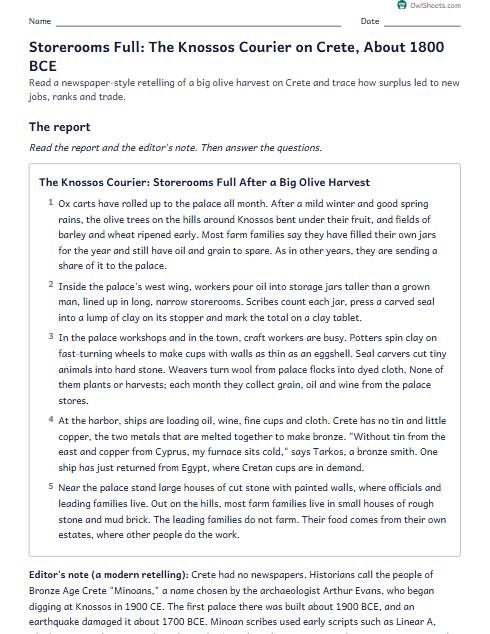
Storerooms Full: The Knossos Courier on Crete, About 1800 BCE
Grade 6 · ECO.6.1
14 questionsPremium
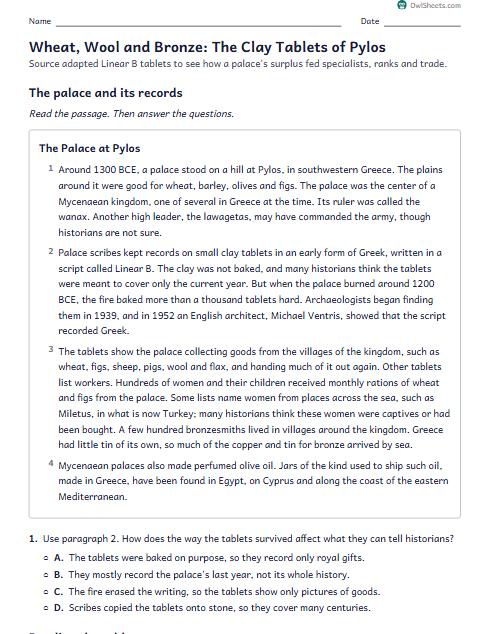
Wheat, Wool and Bronze: The Clay Tablets of Pylos
Grade 6 · ECO.6.1
14 questionsPremium
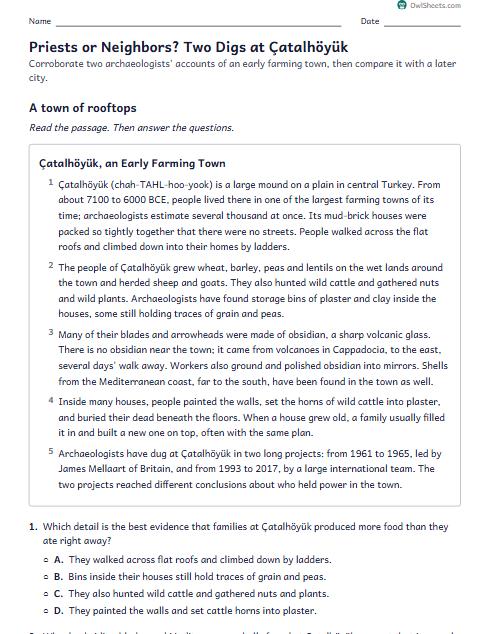
Priests or Neighbors? Two Digs at Çatalhöyük
Grade 6 · ECO.6.1
14 questionsPremium
Maize, Basalt and Obsidian: Field Notes from Olmec San Lorenzo
Grade 6 · ECO.6.1
13 questionsPremium
Fish for Cotton: A Journey Up the Supe Valley
Grade 6 · ECO.6.1
11 questionsFree
Millet, Bronze and Kings: A Shang China Exhibit
Grade 6 · ECO.6.1
10 questionsPremium