Grade 6 · Social StudiesECO.6.1Premium
Priests or Neighbors? Two Digs at Çatalhöyük
Grade 6 economics: weigh two accounts of Çatalhöyük in Turkey and compare it with Sumer to explain how food surplus led to specialized jobs, classes and trade.
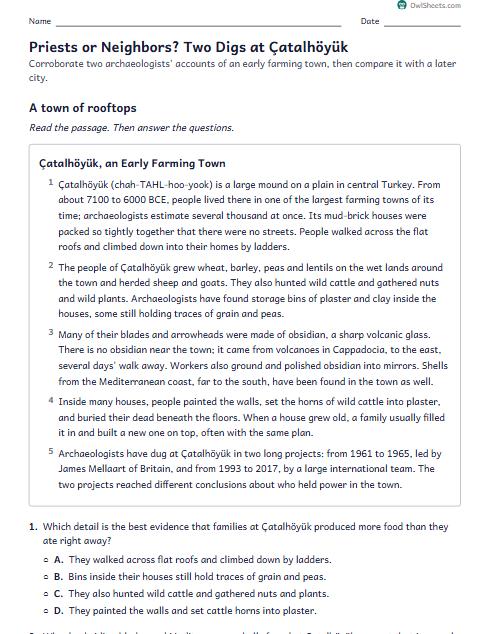
Preview
OwlSheets.com
Priests or Neighbors? Two Digs at Çatalhöyük
Corroborate two archaeologists' accounts of an early farming town, then compare it with a later city.
A town of rooftops
Read the passage. Then answer the questions.
Çatalhöyük, an Early Farming Town
1Çatalhöyük (chah-TAHL-hoo-yook) is a large mound on a plain in central Turkey. From about 7100 to 6000 BCE, people lived there in one of the largest farming towns of its time; archaeologists estimate several thousand at once. Its mud-brick houses were packed so tightly together that there were no streets. People walked across the flat roofs and climbed down into their homes by ladders.
2The people of Çatalhöyük grew wheat, barley, peas and lentils on the wet lands around the town and herded sheep and goats. They also hunted wild cattle and gathered nuts and wild plants. Archaeologists have found storage bins of plaster and clay inside the houses, some still holding traces of grain and peas.
3Many of their blades and arrowheads were made of obsidian, a sharp volcanic glass. There is no obsidian near the town; it came from volcanoes in Cappadocia, to the east, several days' walk away. Workers also ground and polished obsidian into mirrors. Shells from the Mediterranean coast, far to the south, have been found in the town as well.
4Inside many houses, people painted the walls, set the horns of wild cattle into plaster, and buried their dead beneath the floors. When a house grew old, a family usually filled it in and built a new one on top, often with the same plan.
5Archaeologists have dug at Çatalhöyük in two long projects: from 1961 to 1965, led by James Mellaart of Britain, and from 1993 to 2017, by a large international team. The two projects reached different conclusions about who held power in the town.
- A. They walked across flat roofs and climbed down by ladders.
- B. Bins inside their houses still hold traces of grain and peas.
- C. They also hunted wild cattle and gathered nuts and plants.
- D. They painted the walls and set cattle horns into plaster.
- A. Both were made in town workshops and then sold to the volcano peoples.
- B. Neither one could be used for tools, so they had value only as money.
- C. Both were buried under the floors, where traders left their payments.
- D. Neither one is found near the town, so they came from distant places.
The preview shows the first questions. Unlock the worksheet to see all of it.
Related worksheets
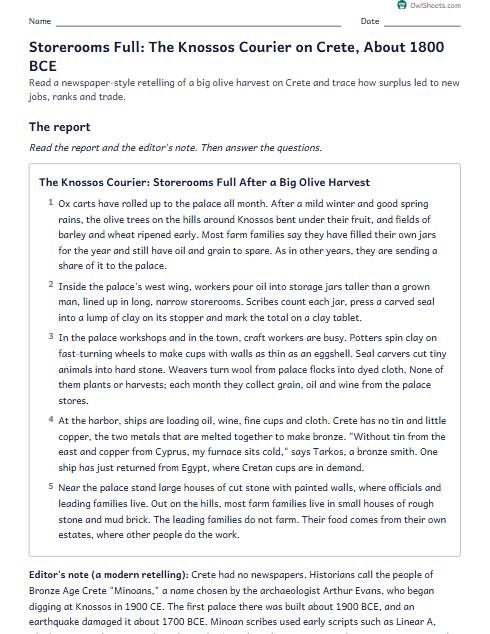
Storerooms Full: The Knossos Courier on Crete, About 1800 BCE
Grade 6 · ECO.6.1
14 questionsPremium
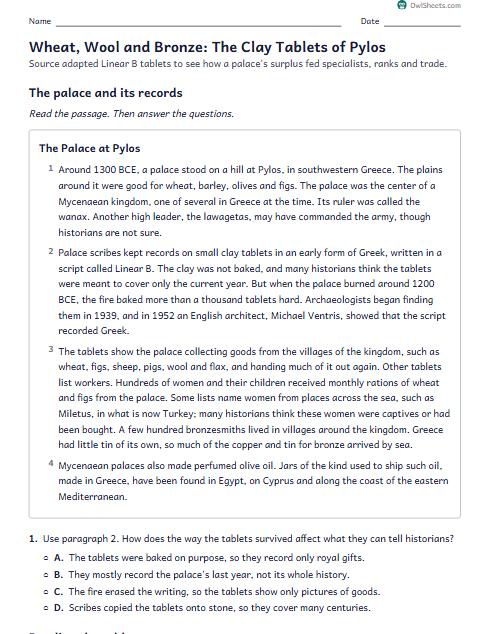
Wheat, Wool and Bronze: The Clay Tablets of Pylos
Grade 6 · ECO.6.1
14 questionsPremium
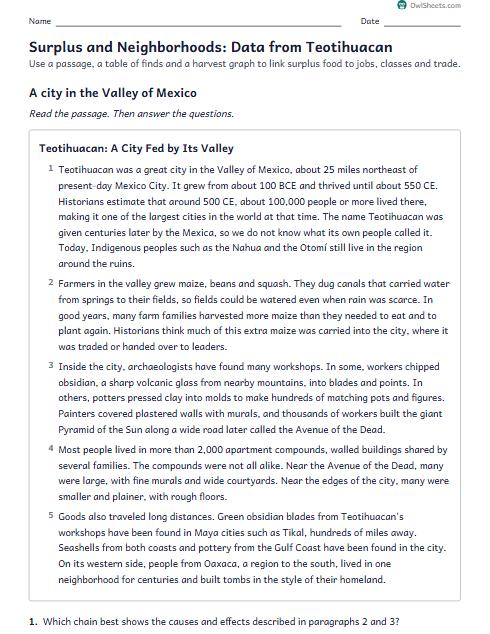
Surplus and Neighborhoods: Data from Teotihuacan
Grade 6 · ECO.6.1
13 questionsPremium
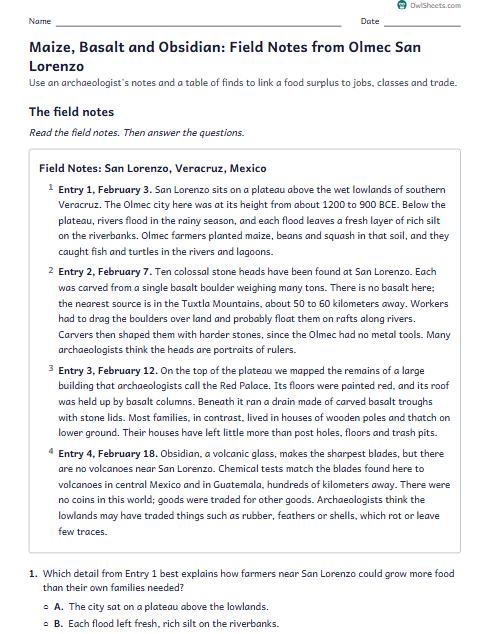
Maize, Basalt and Obsidian: Field Notes from Olmec San Lorenzo
Grade 6 · ECO.6.1
13 questionsPremium
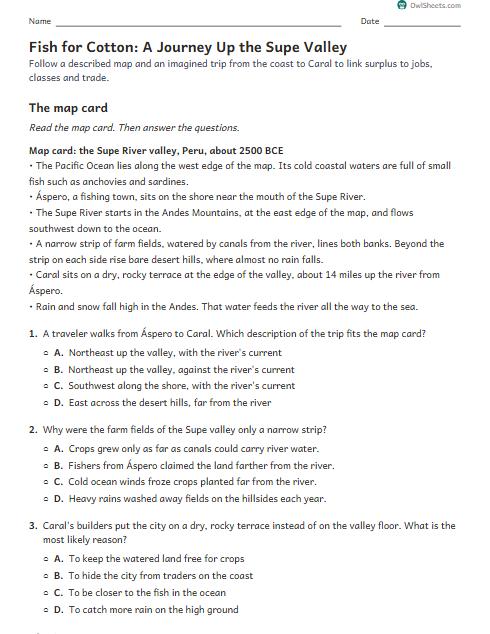
Fish for Cotton: A Journey Up the Supe Valley
Grade 6 · ECO.6.1
11 questionsFree
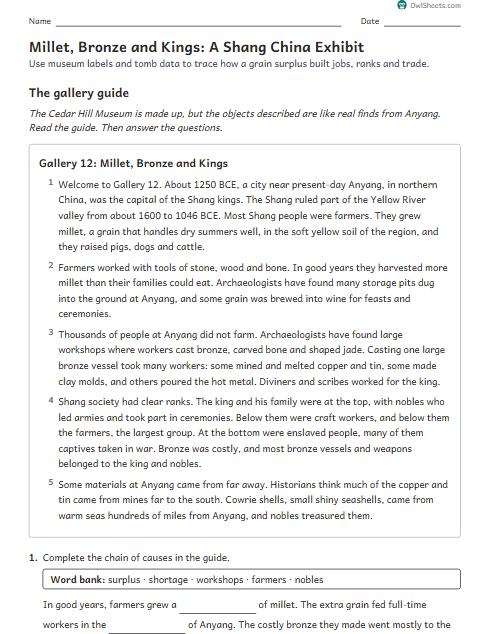
Millet, Bronze and Kings: A Shang China Exhibit
Grade 6 · ECO.6.1
10 questionsPremium